There is a romantic idea that the fastest way to learn German is to be thrown into a room where nobody speaks English. Total immersion. Sink or swim.
It works beautifully — for a phrasebook holiday. For der, die, das it is a slow, expensive way to feel stupid. German is a language with a machine inside it: cases, genders, separable prefixes, verb-final clauses. You cannot absorb a machine by osmosis. Someone has to explain the gears.
The Myth of "Only Ever Speak German"
Let us be fair to immersion. It is unbeatable for listening, pronunciation and fluency pressure. It is terrible for grammar explanation, because grammar needs precision and precision needs your first language.
Try to explain the difference between Ich sehe den Mann and Ich sehe dem Mann in German only, to someone who has never studied another case system. You will end up miming. Explain it in English, or Polish, or Turkish, and it takes ninety seconds.
The honest answer is not either. It is both — in the right order.
What you will get from this guide
- Why German grammar resists pure immersion
- Which parts genuinely need translation, and which do not
- A level-by-level plan for how much native-language support to use
- How to pick a course that explains German in a language you think in
German Is a Rule-Heavy Language
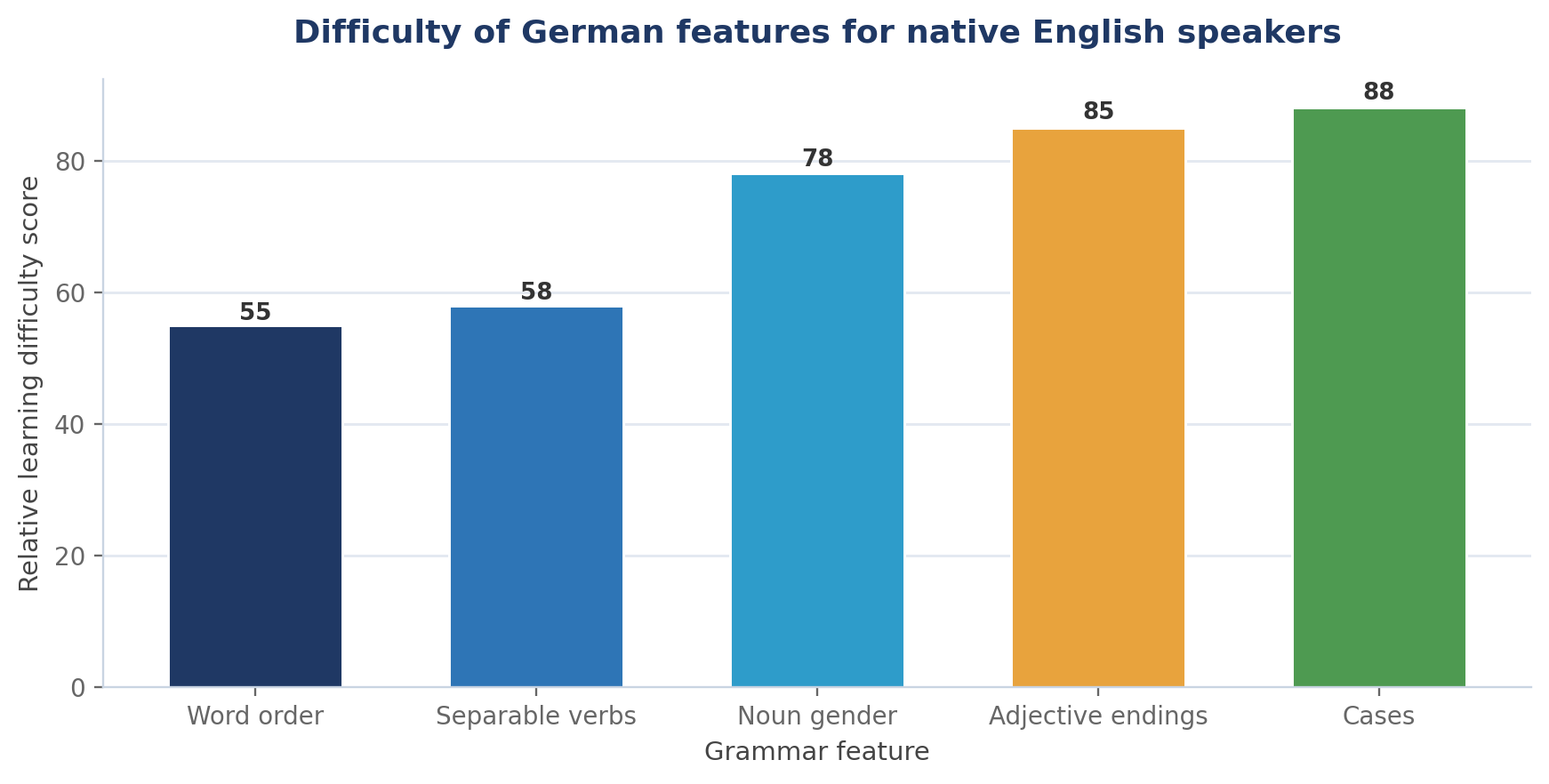
Compare the language to your own learning load. German asks you to track things English simply does not.
Every one of those rows is a rule, and rules are best taught, not inhaled. This is exactly where your own language earns its keep.
Look at the top three bars. Gender, cases, adjective endings. Those are the exact spots where a learner who never got a clear explanation in their own language quietly gives up.
Get German explained in a language you actually think in.
Our AI voice tutor teaches with full native-language support when you need it, and pure German when you are ready for it. You get clarity on the hard rules and real speaking practice in the same course.
See the German course →Create a free accountWhere Your First Language Genuinely Helps
Native-language support is not a crutch. It is a tool with specific jobs.
The false friend warning is worth a whole lesson. bekommen means to receive. werden means to become. also means so or therefore, not also. Every learner who was never warned makes that mistake for years.
Where Native Language Support Should Stop
Support is a tool, not a lifestyle. These areas should stay in German almost from day one.
The pattern is clean: input and speech in German, explanation in yours.
How Much Support at Each Level
The dose should shrink as you climb. Here is a practical plan.
At A1 you would drown without explanations. At B2 you would be insulted by them. A good course moves the dial level by level rather than picking a side.
The Evidence You Already Have
Think about the last German rule that confused you. Did you resolve it by hearing the same sentence ten more times, or by someone saying ah, it is because "mit" always takes the dative?
Now think about the last time you spoke German fluently for two minutes. That came from practice, not explanation.
Both are true. That is the entire argument.
Adult learners in particular have an asset children do not: they already understand grammar as a concept. Refusing to use that is throwing away free speed.
One course. Two modes. Zero confusion.
Start with rules explained clearly in your language, then shift into German-first teaching as your level rises. That is how our Course Pass works — with an AI voice tutor that adapts to you.
Start learning German properly →Create a free accountFrequently Asked Questions
Doesn't using English slow down my German? Only if it replaces practice. Used for explanations, it accelerates you, because understanding a rule in ninety seconds beats guessing at it for three weeks.
Which German exams should I work towards? The Goethe-Institut exams (A1 to B2), telc, ÖSD and TestDaF are the main recognised certificates. Goethe-Institut exams are the most widely available internationally.
Can I reach B2 while using my own language for grammar? Yes. B2 is the level where instruction in German becomes comfortable, but many successful learners still ask for occasional grammar clarifications in their first language.
How do I know the course supports my language? Check the course details. A good course will tell you which languages are supported for explanations, and whether hybrid explanation is part of the programme.
References & Further Reading
- Goethe-Institut — official German courses and the A1 to B2 Goethe certificate exams.
- telc gGmbH — German language certificates including telc Deutsch B1–C1 and business German.
- TestDaF-Institut — university-admission German test, with real sample papers available.
- Duden — the standard reference for German spelling, grammar and usage.
- Deutsche Welle (DW Deutsch lernen) — free graded German courses from A1 to B2, including native-language support options.
Learn the rules where they are clearest. Practise them where it counts. That is the whole strategy.