Start with one number, because it ends most arguments before they begin.
The Foreign Service Institute, the language school of the United States Department of State, files German in its second-hardest band for English speakers: roughly 750 classroom hours to reach professional working proficiency. Thirty weeks. Full time. No weekends off.
That is the number nobody puts in a YouTube thumbnail. It is also the reason you are here, quietly wondering whether your forty minutes a night is doing anything at all. It is. You just need to see the map before you judge the road.
What you will get from this guide
- Honest hour bands for A1 through B2, with what each one actually feels like
- A weekly-hours table that turns "hours" into real calendar weeks
- The five things that shrink your timeline, and the four that quietly stretch it
- Weekly checkpoints so you can tell progress from the illusion of progress
What "Learning German" Even Means
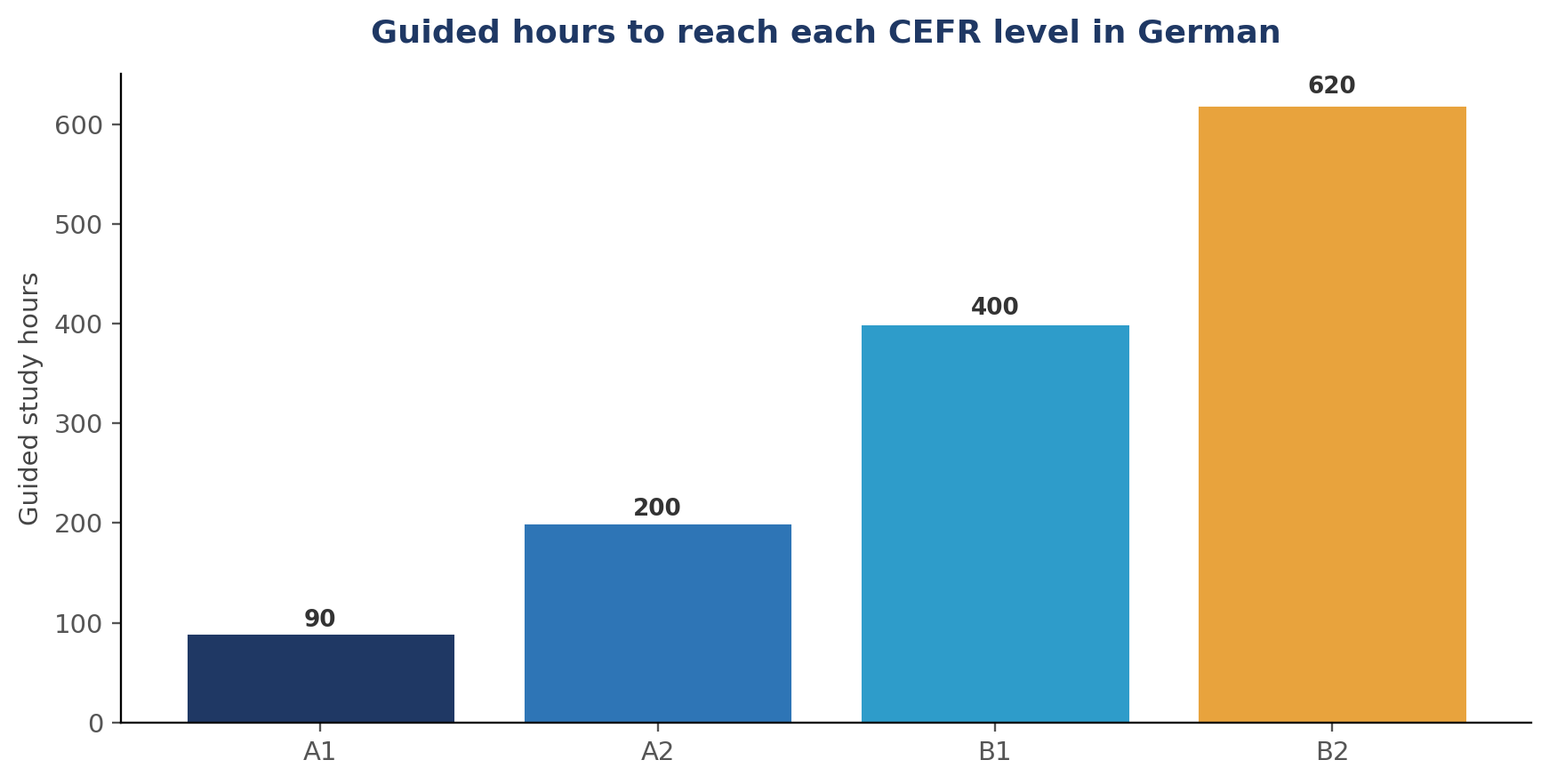
Here is the busted myth: there is one finish line. There is not. They are numbered A1, A2, B1 and B2 under the Common European Framework of Reference.
Your timeline is not a property of German. It is a property of your target. "How long does it take" is an incomplete sentence until you finish it with "to do what."
Read that middle column as a range, not a promise. The figures are planning estimates aligned to CEFR hour bands, and they describe classroom hours with a teacher, not hours of scrolling a vocabulary app on the bus.
The Real Variable Is Not Talent. It Is Weekly Hours.
Two learners with identical brains get different results. The difference is almost always the drumbeat: how many hours land each week, and whether they keep landing after week six.
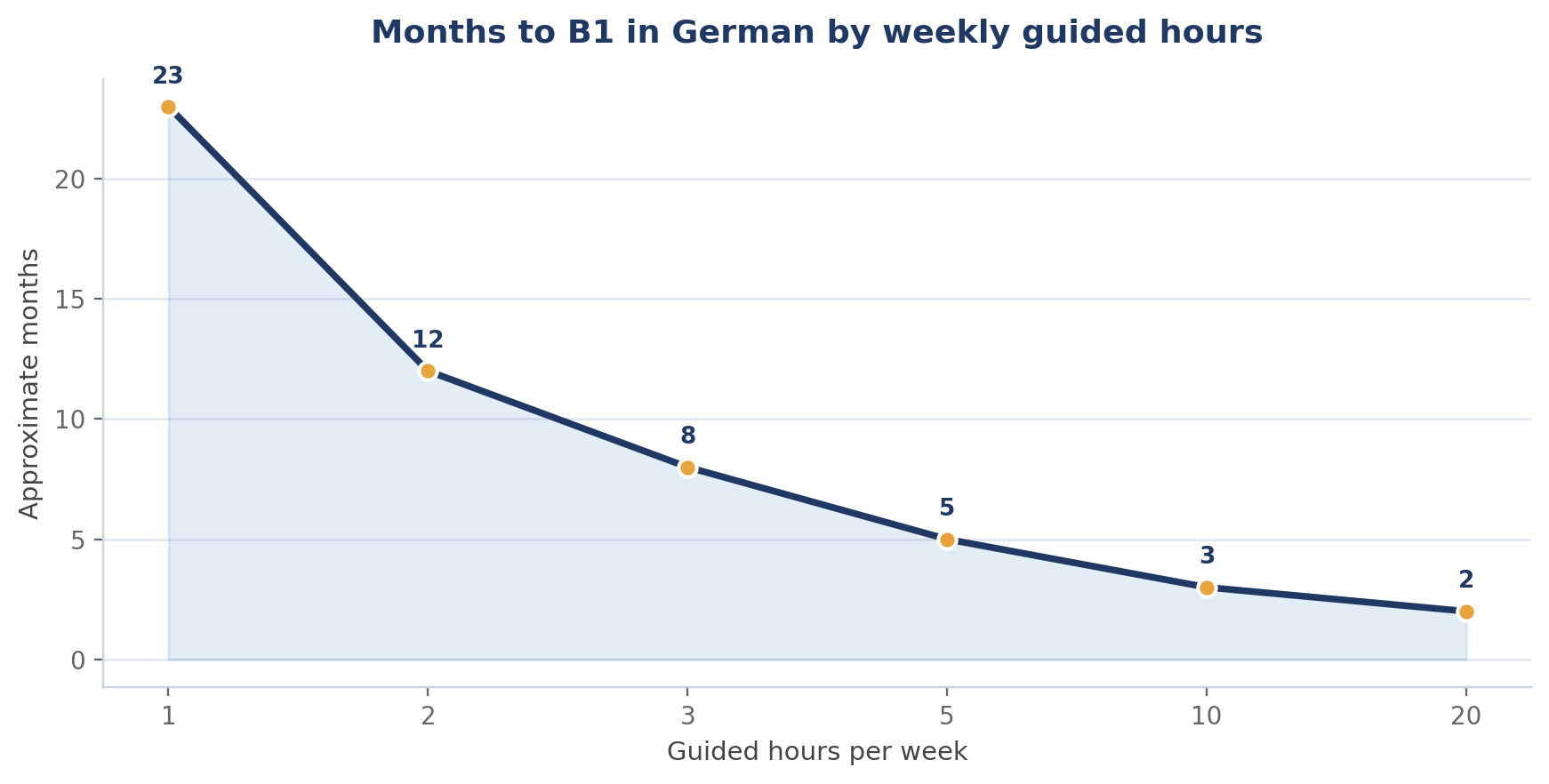
The table below is the one you should photograph and stick above your desk. Guided hours divided by your real weekly rhythm gives you calendar weeks, and then months.
Do the arithmetic on your own life. Two lessons a week gets a motivated adult from nothing to B1 in roughly a year. That is not a slow result. That is a human result.
Stop guessing your own timeline
The fastest route is not more apps. It is a personal AI voice tutor that corrects you in real time, every single session, at your own pace. Build the drumbeat with a LanguageSkills German course and watch the weeks compress.
See German course options →Create a free accountWhat Each Stage Actually Feels Like
Numbers tell you when. They do not tell you what. So here is the felt experience, stage by stage, so you can locate yourself on the map instead of panicking in the fog.
Notice the pattern. Month one is easy and month nine is hard, which is the exact opposite of what most people expect. Beginners quit at month two because it feels fast, then quit at month nine because it feels slow.
The Five Accelerators
These five reduce your hours per level. Each one is boring. Each one works.
The single heaviest lever is real-time correction. Without it you can spend 400 hours building a habit of wrong. With it, your AI voice tutor catches the wrong article the first time and you never pay for that lesson twice.
The Four Silent Thieves of Time
Now the uncomfortable half. These are why two people with the same plan finish eighteen months apart.
Add one more, quieter thief: inconsistency. A learner who studies thirty minutes every day outruns a learner who studies four hours every second Sunday. Rhythm beats intensity over a year, every time.
When the Grammar Wall Hits
Around B1, German stops being a joke. The cases settle in, adjective endings multiply, and the word order makes you feel like you are doing accountancy mid-sentence.
This is where your hours begin to buy less than they used to. Do not read that as failure. Recognition and production are different currencies: you will understand plenty long before you can produce it, and that lag is normal, not a sign you are bad at languages.
If your timeline is slipping with no obvious culprit, run that table against your last thirty hours. Nine times out of ten, reading has quietly eaten speaking's lunch.
Break the B1 plateau with real speaking practice, not a worksheet
Plenty of learners can read German and go silent the moment it matters. Guided speaking practice with AI feedback forces the part that is actually behind. Start a German course and move the lagging skill first.
Book a German placement session →Create a free accountWeekly Checkpoints: Progress vs the Illusion of Progress
Track leading indicators, not the feeling that today was "good." Feelings lie. These six markers do not.
Test yourself monthly against this kind of grid. If two rows move, you are on track and the plateau is an illusion. If four rows are frozen for eight weeks, change the plan, not your personality.
So, Honestly: How Long to Learn German?
Add it up. A motivated adult with two guided hours a week plus fifteen minutes of daily input reaches A2 in five to six months, B1 in about a year, and B2 in around a year and a half. Double the hours and you can nearly halve the calendar. Halve the hours and you roughly double the wait.
That is the whole answer. There is no secret. There is a drumbeat, an AI voice tutor that corrects you, and enough input that German stops sounding like a wall of noise. German is not unusually hard for English speakers in vocabulary. It is unusually relentless in grammar, and relentless things reward consistency more than they reward intensity.
Two final rules worth more than any app you can install. First, keep a speaking habit from week one, because speaking is the skill you cannot cram. Second, protect the weekly rhythm like an appointment you would never cancel, because the twenty weeks you skip are the twenty weeks you pay for later. Pick a level, tie it to a date, and let the calendar do the rest.
Frequently Asked Questions
Can I learn German in 3 months? To a conversational A1 or low A2, yes, if you study intensively, roughly two to four hours a day with guided instruction. To B1 in three months you would need something close to full-time immersion plus a strong aptitude. Anyone promising fluency in ninety casual minutes a week is selling the feeling, not the skill.
Is German harder than Spanish or French? For English speakers, German is generally a bigger grammar burden: cases, three genders and a separable-verb system. It is not a harder alphabet, and a large share of core vocabulary will feel familiar. The FSI puts German in Category II and Spanish and French in Category I, meaning Spanish and French typically need noticeably fewer hours.
How many hours a day should I study German? For steady progress, sixty to ninety minutes a day beats a five-hour Sunday sprint. If your schedule is tight, thirty focused minutes daily plus two guided sessions a week is a genuinely workable plan that reaches B1 in about a year.
Do I need to live in Germany to learn German? No, though immersion compresses the listening and speaking portions. Guided speaking practice, a conversation partner and daily German audio can recreate most of the essential immersion benefits, just more slowly.
How many words do I need for B1? Expect roughly 2,400 to 3,000 words of active, usable vocabulary at B1, with more recognized passively than produced. Chasing raw word counts matters less than being able to retrieve the common ones instantly under pressure.
What is the fastest legitimate way to learn German? Guided lessons with real-time AI feedback, daily comprehensible input, and speaking from the first week. Every shortcut that actually works is a version of "more contact hours, corrected sooner," and nothing has replaced that yet.
References & Further Reading
- Foreign Service Institute, US Department of State — language difficulty categories and classroom-hour estimates for English speakers: https://www.state.gov/foreign-service-institute
- Goethe-Institut — official course levels, exam structure and German proficiency descriptions across A1 to B2: https://www.goethe-institut.de/en/learn-german
- Common European Framework of Reference for Languages, Council of Europe — the source framework for level descriptors: https://www.coe.int/en/web/common-european-framework-reference-languages
- Deutsche Welle — free German learning materials at A1 to B2 levels, developed with the Goethe-Institut: https://learngerman.dw.com
- Duden — the standard reference for German spelling, grammar and usage: https://www.duden.de
- telc — German language examinations mapped to CEFR levels, including the B1 and B2 certificates used for citizenship and work: https://www.telc.net