Your phone says 412 days. Your German still says Ich sprechen ein bisschen. That gap is not a character flaw — it is a design flaw, and naming it is the first step toward fixing it. The best way to learn German is whichever method makes you open your mouth and be corrected, repeatedly, by a tutor who knows where you are going.
What you will get from this guide
- A honest comparison of the four main online German formats
- Realistic hour bands for each CEFR level
- Costs, timelines and the exact signs a course is wasting your time
Why Apps Stop Working Around Week Six
Gamified apps are brilliant at one thing: getting you to come back. They are much worse at getting you to speak. Recognition — tapping the right tile — is not production. Your brain happily learns to recognise der Bahnhof while never once having to build a German sentence under mild social pressure.
The moment you need to answer a real question, live, with a stranger waiting, the whole house of cards wobbles. That is the wall. Week six is just when most people hit it.
The Four Real Options on the Table
No single format guarantees fluency. Speaking is a motor skill; motor skills need reps with feedback.
Think of it like swimming lessons. You can watch every technique video ever filmed and still sink the first time you are in deep water. A coach shouting "elbows higher" from the poolside is worth a thousand playlists.
What Actually Matters When You Choose
Five factors separate a course that works from one that drains your wallet.
Speaking practice time. Count the minutes you personally talk in a lesson. Under ten minutes an hour, walk away.
Correction quality. Good tutors do not just say "falsch". They isolate the pattern, model it, and make you redo it.
Level fit. A class pitched one band too high is theatre. You nod, you understand nothing, you quit.
Structure against a real framework. CEFR levels give you a ladder instead of a fog. Ask which level the course targets and how it maps to Goethe or telc exams.
Accountability. Weekly deadlines and a tutor who notices your absence beat any streak counter.
How Long German Actually Takes
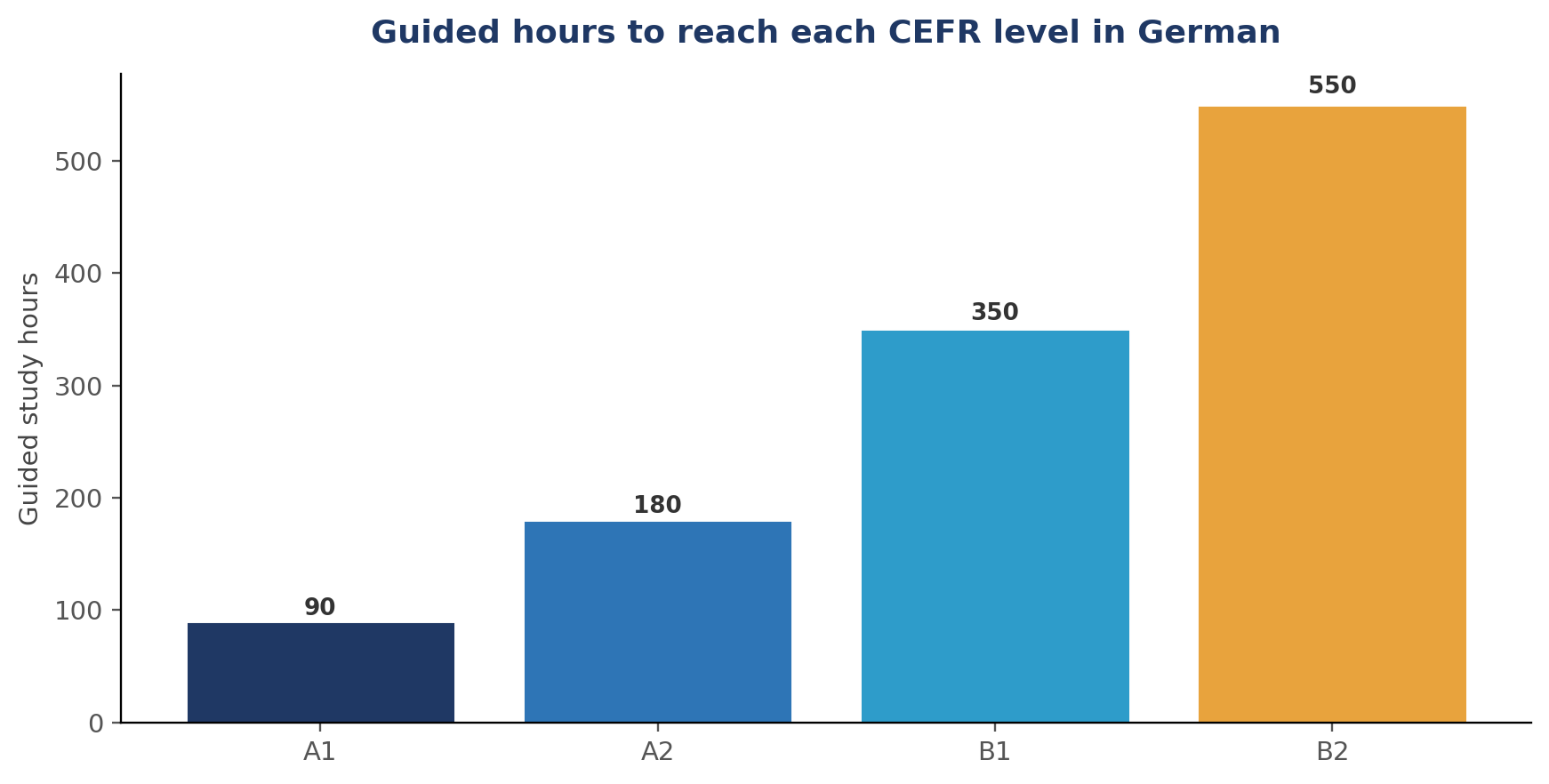
German sits in the "Category II" difficulty band for English speakers at the Foreign Service Institute — roughly 750 class hours to professional working proficiency. CEFR bands are friendlier for everyday goals, and the numbers below are planning estimates, not guarantees.
Notice the shape. A1 is a weekend sprint. B1 is a season. B2 is a project you plan around. Anyone promising B2 in eight weeks is selling you a T-shirt, not a skill.
What a Good Week Looks Like
Progress is boring on a Tuesday and obvious on a December.
That is roughly four and a half hours. Do that for a year and you will pass a B1 exam. Do the Sunday off properly, too: rest is part of the plan, not a betrayal of it.
Stop guessing which method works
Self-paced German lessons with an AI voice tutor, structured against CEFR levels, from your first Guten Tag to B2.
Find your German course →Create a free accountThe Five Traps That Eat a Year
- Course-hopping. Three weeks here, four there, nothing finished. Finish one level.
- Perfect pronunciation paralysis. You will sound foreign for a long time. Sound foreign out loud anyway.
- Silent reading. Reading builds vocabulary but not speech. Read aloud.
- Learning grammar in isolation. Rules without sentences evaporate by Thursday.
- No output deadline. Book the exam. Deadlines create fluency.
Free Resources Worth Your Time
Deutsche Welle's Langsam gesprochene Nachrichten is the single best free listening tool for A2–B1. The Goethe-Institut publishes free practice materials tied to its exams. Duden is the authority when a dictionary disagrees with your gut. Use all three as support beams — not as the whole building.
For a full walkthrough of how self-paced AI-tutor instruction fits each level, see our guide to learning German online.
Your first lesson is the hardest one
After that, it is just Tuesdays. Pick a level, meet your AI voice tutor, and start the count that actually matters.
Start learning German →Create a free accountFrequently Asked Questions
Can I learn German online without ever speaking to anyone? You can learn to read German that way. You will not learn to speak it. Speaking is produced by speaking, under mild pressure, with correction.
Is a free app enough to pass the Goethe B1 exam? For most learners, no. The exam has a live speaking component and a timed writing component. Both need feedback from a tutor who can diagnose your errors.
How many hours a week do I need for A2? Most learners reach A2 in about 180 guided hours. Three to four hours a week puts that roughly a year out; six hours a week gets you there in seven or eight months.
Should I learn German or Dutch first? If you need German, learn German. If you are choosing freely, Dutch is marginally easier for English speakers, but the gap is smaller than the motivation gap between a language you want and one you do not.
References & Further Reading
- Foreign Service Institute, Language Difficulties and Learning Expectations — U.S. Department of State
- Council of Europe, Common European Framework of Reference for Languages: Companion Volume (2020)
- Goethe-Institut, official exam and level descriptions — goethe.de
- Deutsche Welle, Langsam gesprochene Nachrichten — dw.com/deutschlernen
- Duden, Die Grammatik (9th edition), Dudenverlag