Picture the moment. You walk into a café in Berlin, order a Milchkaffee without pointing at the menu, and the barista answers you in fast, real German — and you actually understand. That moment feels like magic. It isn't. It is the predictable result of a plan, and this guide gives you that plan from absolute zero.
German has a reputation for being hard. Ignore the noise. English and German are linguistic cousins: thousands of words are near-identical (Haus/house, Wasser/water, Freund/friend), and German spelling is famously logical — once you know the sounds, you can pronounce almost any word you read. Around 130 million people speak German, and it is the most widely spoken native language in Europe. You are not climbing a wall. You are walking through a door that is already ajar.
What you will get from this guide
- The real number of hours it takes to reach A1, A2, B1 and B2 in German
- A step-by-step roadmap that takes you from "Guten Tag" to real conversations
- A printable-style 30-day starter plan you can begin today
- The five mistakes that quietly keep beginners stuck for years
Why German Is a Smarter Bet Than You Think
Most people choose a language on vibes. Choose one on returns instead. German is the language of Europe's largest economy, and it shows up on payslips, university offers and visa forms.
Here is the part nobody tells you: German is the gateway language of Europe. Learn it, and Dutch, Danish and Swedish stop looking like code and start looking like dialects.
How Long Does It Really Take to Learn German?
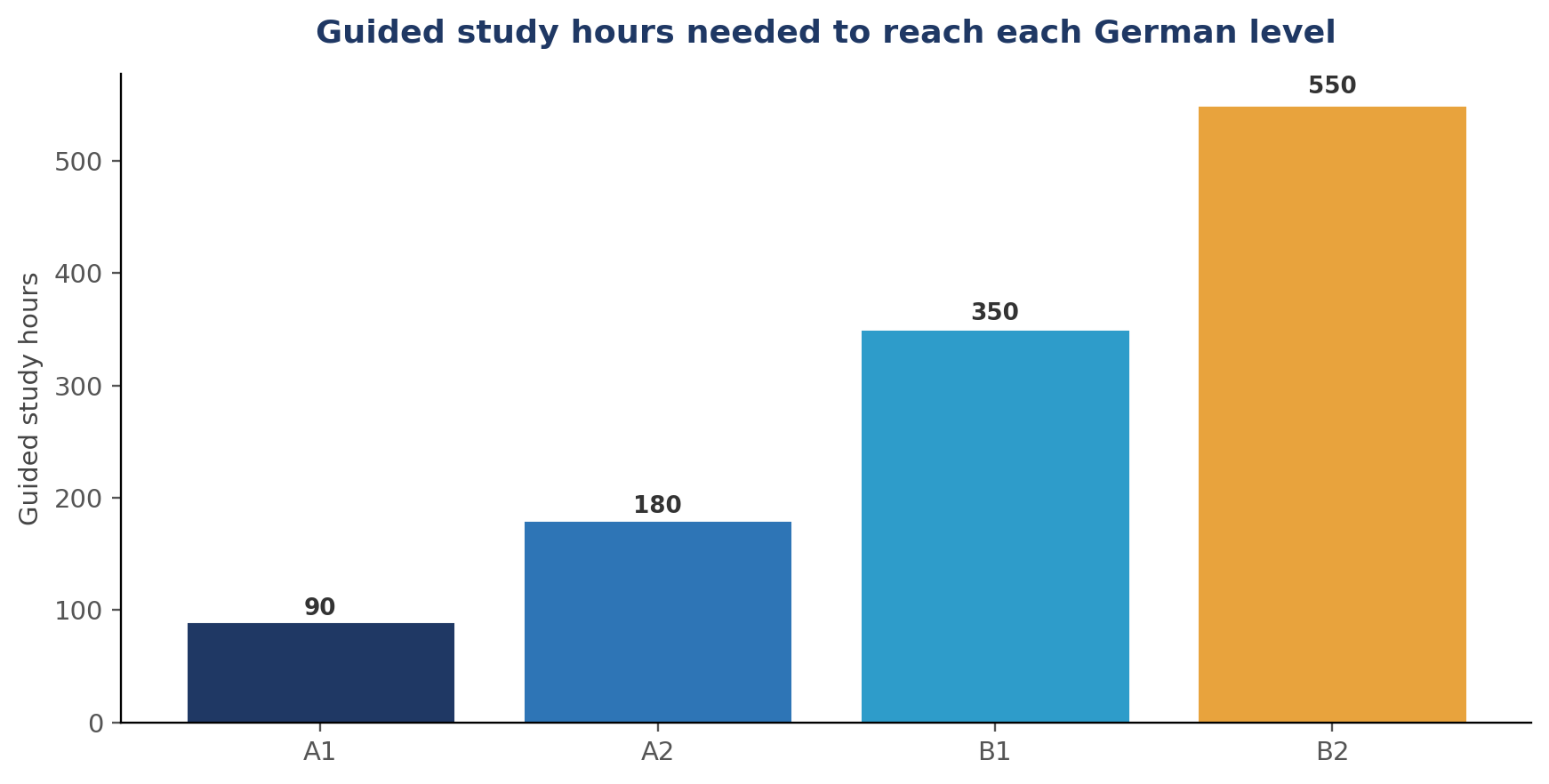
Every credible language school, from the Goethe-Institut to university language centres, uses the same yardstick: guided study hours. These are classroom or structured-course hours, not passive app-tapping.
Read that table twice, because it contains the single most useful truth in language learning: A1 is cheap, B2 is expensive, and the middle is where people quit. Reaching B1 is a realistic 12–18 month project for a busy adult. Reaching B2 is a two-year commitment. Anyone promising fluency in six weeks is selling a feeling, not a skill.
The Six-Step Roadmap from Zero to Conversational
Step 1 — Lock the sounds (Week 1). Before vocabulary, before grammar, learn how German sounds. The umlauts (ä, ö, ü), the "ch" (soft after e/i, throaty after a/o/u), the "-er" ending that becomes a soft "ah", and the sch / st / sp clusters. Twenty minutes a day for one week buys you a lifetime of not practising your mistakes.
Step 2 — Collect your first 500 words (Weeks 2–5). Not 5,000. Five hundred. Aimed at your life: greetings, numbers, food, transport, work, family, weather. Use spaced-repetition cards with audio attached to every single word.
Step 3 — Meet the four cases early, not late (Weeks 3–8). Nominative, accusative, dative, genitive. Beginners avoid them, then hit a wall at A2. Learn them as roles in a sentence — who does what to whom — not as abstract tables.
Step 4 — Build the verb engine (Weeks 6–14). German verbs are the real architecture of the language: the present tense, the past (Perfekt), modal verbs (können, müssen, wollen), and above all word order — the famous "sentence bracket" that pushes the second verb to the end.
Step 5 — Speak out loud from day one. Not month three. Day one. Bad German spoken daily beats perfect German never spoken. Record yourself, cringe, improve.
Step 6 — Put yourself in comprehensible input. Once you can survive A2, flood your ears: Deutsche Welle's Langsam gesprochene Nachrichten (slowly spoken news), Easy German street interviews, and German-language podcasts built for learners. Then watch Netflix in German with German subtitles — not English ones.
Your First 30 Days: A Concrete Plan
Thirty days will not make you fluent. It will make you dangerous — the kind of beginner who walks into week five with momentum instead of doubt.
Your first 30 days go faster with a guide
Self-study is a solo hike. A guided German course is a trail map with a ranger walking beside you — corrected pronunciation, feedback on your writing, and a class that keeps pace with your ambition. Start with a free LanguageSkills.net account, take a 5-minute placement check, and see exactly where you stand before you spend a single rupee or euro.
Create your free account →Create a free accountSelf-Study vs a Guided German Course
Free resources are genuinely good now. So is the honest answer: they are excellent at starting you and terrible at finishing you.
The pattern is brutally consistent: free tools win the first 30 days, structured courses win months 3 to 18. If your goal is a certificate, a job in Germany or a real conversation, the course pays for itself in time saved.
The Five Mistakes That Trap German Beginners
- Learning words without audio. German spelling lies to you. Vase sounds like "VAH-zuh". Always learn the sound with the spelling.
- Skipping the cases to "come back later". You never come back. Cases are the rails; learn them at 20% depth and deepen them for the rest of your life.
- Studying 4 hours on Sunday, nothing all week. Spaced repetition beats cramming by a wide margin. Nine minutes daily outperforms two hours weekly.
- Only reading, never speaking. Reading German trains recognition. Speaking trains production. They are different muscles, and you need both.
- Waiting to be "ready" to talk. There is no ready. Your first conversation will be clumsy and you will survive it, and the second will be better.
Don't teach yourself the mistakes you'll pay to unlearn
Most beginners don't fail from lack of effort — they fail because nobody told them their "ch" was wrong for eight months. LanguageSkills.net's AI voice tutor gives you feedback from lesson one, so the feedback loop is measured in minutes, not months. Study at your own pace, any time.
Browse German courses →Create a free accountFrequently Asked Questions
Is German difficult for English speakers? It sits in the middle. Getting to A1–A2 is easier than French for many learners because the vocabulary overlaps so densely; getting from B1 to B2 is harder, mostly because of cases and word order. Overall it is neither a sprint nor a wall — it is a steady climb.
Can I learn German for free? Yes, to roughly A2. Deutsche Welle lessons, free podcasts and Anki decks will carry you. Beyond that, most learners plateau hard because nobody corrects their production.
How many words do I need to speak German? Around 700 words covers basic A1 survival. Roughly 2,500 words plus 80% of core grammar gets you through most daily A2–B1 conversations. 5,000+ words is comfortable B2 territory.
Should I learn standard German or a dialect? Standard German (Hochdeutsch). Always. Dialects arrive later, and they arrive naturally.
Is an online German course as good as an offline one? For structured curricula, yes — often better, because you get recordings, homework feedback and flexible slots. For raw social immersion, in-person still has the edge.
The Bottom Line
You do not need talent, and you do not need to be young. You need a sequence, a habit and somebody who will tell you when you are wrong. Start with pronunciation and 500 words. Add the cases at week three. Speak out loud from day one. Fifteen months from now, you will be holding a conversation in German that would have seemed impossible today.
And if you want the shortcut that isn't a gimmick — structured lessons, an AI tutor, CEFR-aligned levels — LanguageSkills.net is where that road starts.
Ready to actually speak German?
Free accounts get you the placement test, sample lessons and your level roadmap. The Course Pass gets you an AI voice tutor, speaking practice with AI feedback, and structured lessons from A1 to B2. One decision separates "I've been meaning to learn German" from "Ich spreche Deutsch."
Get your German Course Pass →Create a free accountReferences & Further Reading
- Council of Europe, Common European Framework of Reference for Languages (CEFR) — level descriptors
- Goethe-Institut, course level guidance and examination formats (A1 to B2)
- telc gGmbH, Deutsch examination frameworks
- Deutsche Welle, Deutsch lernen and Langsam gesprochene Nachrichten
- Ethnologue / Statista, global German speaker estimates
- Federal Statistical Office of Germany (Destatis), migration and labour market language requirements