Say ich. Now say Bach. Same two letters at the end, two completely different mouths. That is the first thing German does to beginners: it hands you a spelling system you think you know, then moves the goalposts.
Deutsch für Anfänger is not hard. It is front-loaded — the strange part arrives early, and then the language becomes astonishingly regular. So let's stop reading about it. Here is your first lesson, minutes and all. Do it today, out loud, and you will speak German before dinner.
What you will get from this guide
- A complete 45-minute first lesson you can do right now
- The four German sounds worth drilling first
- The four cases explained without jargon
- Your first ten sentences, correct on the first try
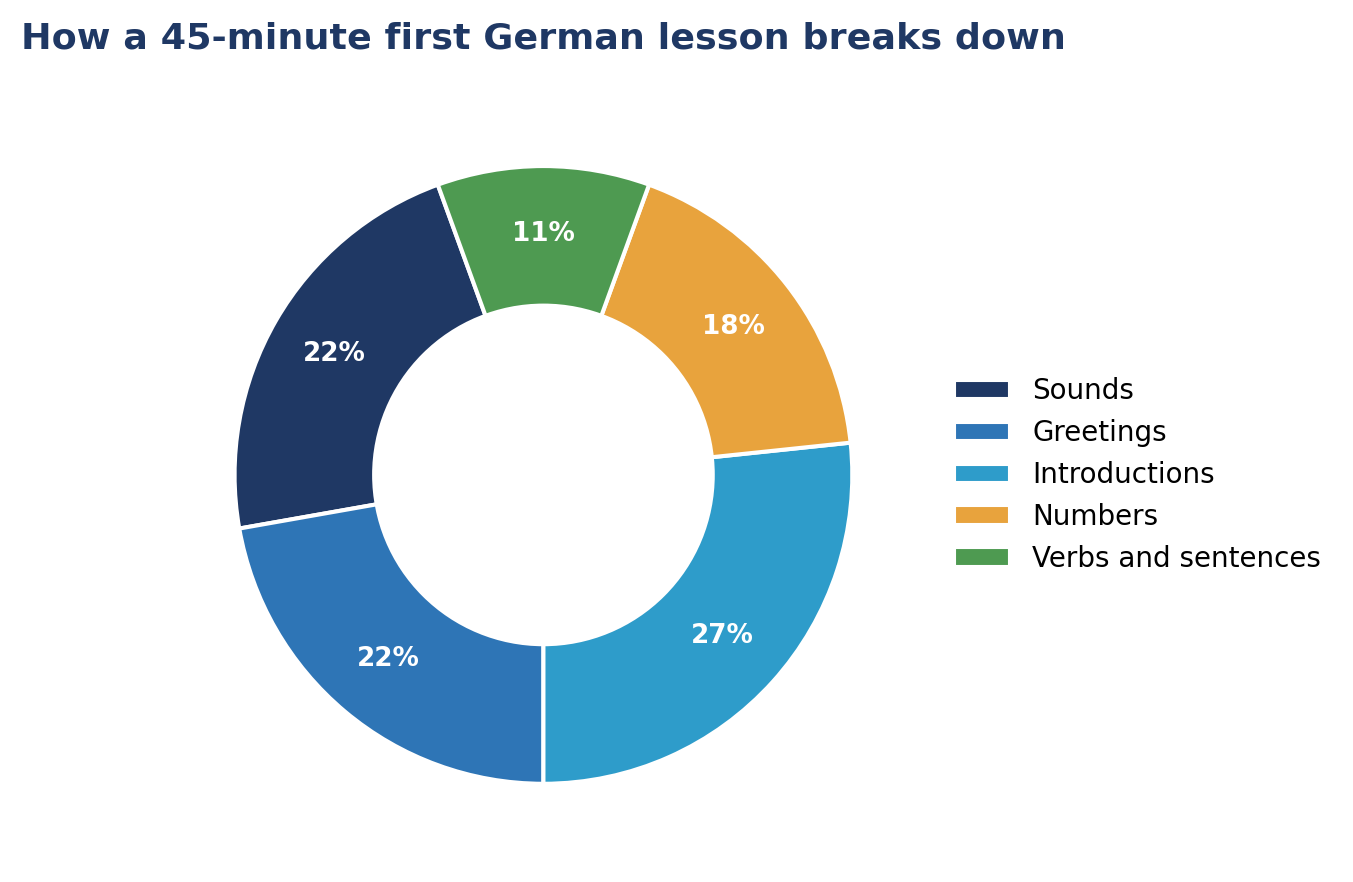
Minute by minute: your first 45 minutes
That is it. Forty-five minutes, and you own the skeleton of every A1 conversation you will ever have.
The four sounds people fear (and how to tame them)
Two rules cover most of German pronunciation. Letters are spoken, not swallowed: Knie is k-n-ee. And vowels followed by a double consonant go short — Stadt, kommen.
The four cases in plain words
Every beginner's nightmare, described honestly. A case is just a job label for a noun.
Only masculine words visibly change in A1. That is the secret nobody tells you: learn der, die, das with every noun, and the cases mostly take care of themselves.
Learn the cases with a voice, not a table
Cases click the moment you say den Mann out loud and hear it back. A personal AI voice tutor turns grammar into speaking practice from lesson one, at your own pace.
See German courses →Create a free accountYour first ten sentences
Copy these, then change one word in each. Repetition with variation is how grammar moves from the page into your mouth.
Ten sentences. Change the endings, change the person, and you have fifty.
The word order rule that fixes everything
German puts the verb in second place in a statement. Always. Break the rule and you sound wrong even when every word is right.
If you remember one thing from your first lesson, remember this: the verb is a passenger who always takes seat number two.
Nouns, gender, and how to guess
Learn the article as part of the word. Not Tisch — der Tisch. Say it out loud with the article every single time and your brain files the pair together.
Frequently Asked Questions
How long does it take to reach A1 in German? Around 80 to 100 guided hours for most learners, spread over three to six months at a comfortable pace. Self-study without speaking tends to take considerably longer.
Do I need to learn all four cases to speak German? You need the nominative, accusative and dative from the start; the genitive can wait. Learn each noun with its article and the cases become patterns rather than rules to memorise.
Is German harder than Spanish or French? It has more upfront grammar, especially cases and word order. Its spelling, however, is more consistent than English, and its rules break far less often.
Should I learn vocabulary or grammar first? Both, in the same lesson. Every new word goes into a sentence, and every new rule gets used with a word you already know.
Your first lesson takes 45 minutes. Your first conversation takes a week.
Say your first German sentence out loud today
Create a free account, take the placement check, and start an A1 lesson where you speak from minute one with your AI voice tutor. The Goethe-Institut-aligned path starts here.
Start free →Create a free accountReferences & Further Reading
- Goethe-Institut — German courses and Goethe-Zertifikat A1 exam information: https://www.goethe.de/en/spr.html
- Deutsche Welle — Nicos Weg and free German courses from A1 to B1: https://learngerman.dw.com/en/overview
- Duden — German dictionary, grammar and spelling reference: https://www.duden.de
- Council of Europe — CEFR descriptors and the A1 can-do statements: https://www.coe.int/en/web/common-european-framework-reference-languages
- Deutsche Welle — Deutschtrainer vocabulary series with audio: https://learngerman.dw.com/en/deutschtrainer