Every German learner meets the same villain. It is not the vocabulary. It is the moment a textbook writes der Mann in one sentence and den Mann in the next, and nobody explains why the word just changed clothes.
That is the case system, and it is the wall between A1 and B2. This guide is the roadmap over it — level by level, hour by hour.
What you will get from this guide
- What fluency actually means at A1, A2, B1 and B2
- Realistic guided-hour estimates for each level
- The exact grammar walls that stall learners, and when to climb them
What "Fluent" Really Means in German
Fluent is a feeling, not a certificate. The useful definition is this: you can handle unexpected conversations without rehearsing them first. That arrives around B1 and gets comfortable at B2.
Do not skip B1. It is the true finish line for most learners and the most rewarding jump of all.
The Hour Reality Check
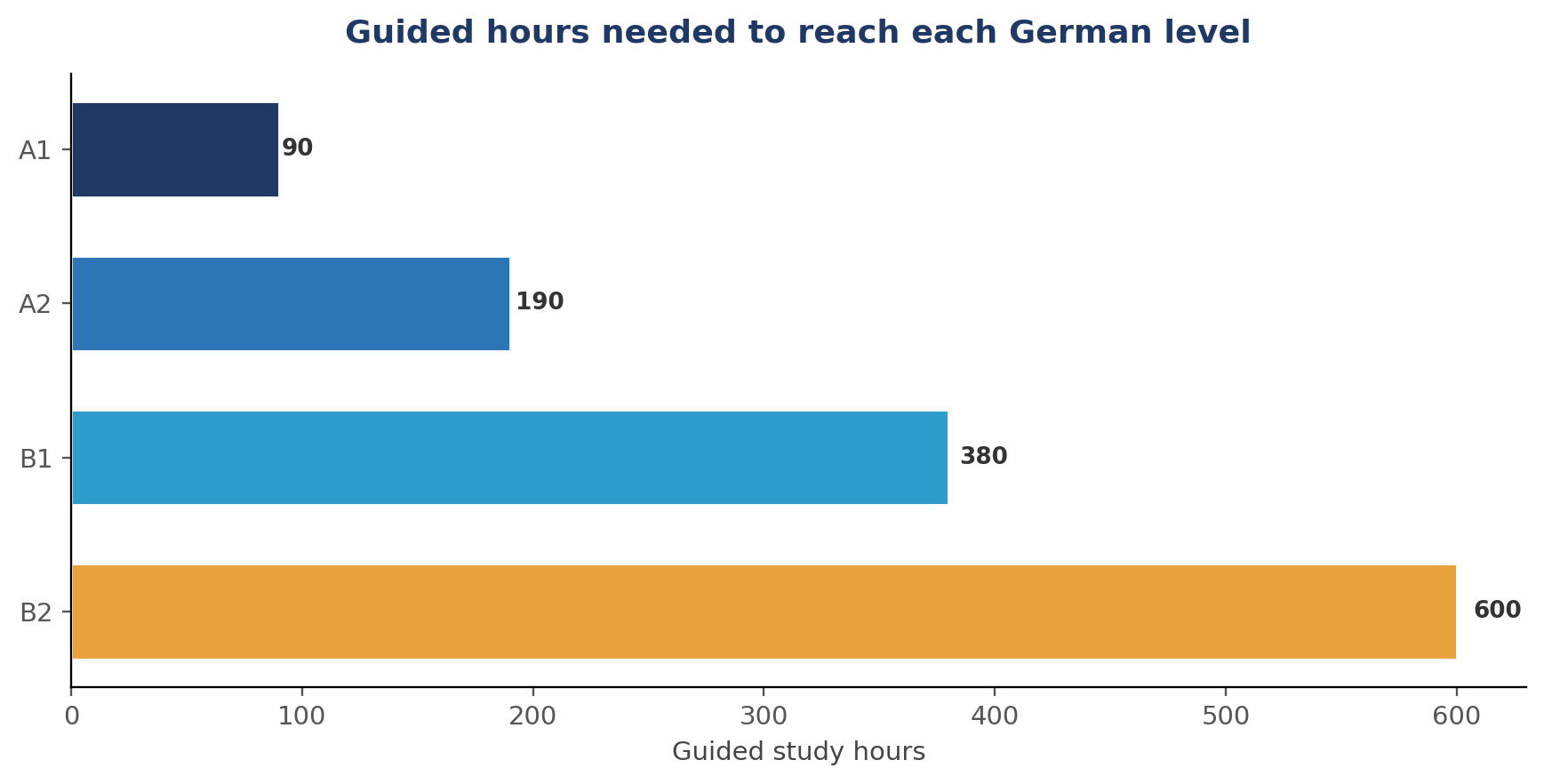
Nobody becomes fluent in three months. Here are honest guided-hour bands, aligned with CEFR planning estimates used by German language schools.
Read the last column. Ten focused hours a week — a self-paced lesson, daily practice and real conversation — puts B2 inside eighteen months. That is the whole strategy.
The A1–A2 Stage: Build the Frame
A1 and A2 are about automation, not insight. You are installing a small, reliable engine.
Two habits print money here. Learn nouns as der Tisch, die Lampe, das Fenster — never as bare words. And speak from day one, out loud, even to your kettle.
The A2–B1 Wall: The Case System
This is where learners quit. German has four cases, and articles change shape depending on the job the noun is doing in the sentence. Nominative for the subject, accusative for the direct object, dative for the indirect object, genitive for possession.
Do not memorise that table cold. Instead, learn it through prepositions and verbs. Certain prepositions always take the accusative (durch, für, gegen, ohne, um), and certain verbs always take the dative (helfen, danken, gefallen). Chunk by chunk, the table fills itself in.
Then add word order. In a subordinate clause the verb moves to the end: Ich bleibe zu Hause, weil ich krank bin. That single rule unlocks readable German.
Stop guessing which article to use
Cases are not memorisable — they are trainable. A personal AI voice tutor corrects your article mistakes in real time, so the pattern grows roots instead of staying a table on paper.
Join a German course →Create a free accountThe B1–B2 Stage: From Correct to Confident
B1 is where grammar stops being the bottleneck. At B1 you know enough structure to be understood; what you lack is speed, range and nerve.
The jump to B2 is built almost entirely from input volume and output pressure. Consume German news, podcasts and series daily. Then force production: summaries, debates, voice notes, and live conversations where you cannot plan the answer.
A Week That Moves You
Here is a schedule that produces B2 in about eighteen months without heroics.
Four focused hours plus one self-paced lesson. Consistent, boring, effective.
Tests Worth Taking
Certificates do not make you fluent, but they measure you honestly and open doors in Germany, Austria and Switzerland. Three families dominate.
The Goethe-Institut publishes free practice materials and sample papers for every level, and DW's Deutsch lernen portal offers structured free courses that pair well with a self-paced lesson.
Four Traps That Delay B2
The fourth trap is the expensive one. Uncorrected errors harden into habits, and unlearning them costs more than learning them right the first time.
A1 to B2 with someone checking your work
You do not need more resources. You need a plan, a level check and an AI voice tutor that hears your mistakes before they harden. Start with a placement test today.
Start your German course →Create a free accountFrequently Asked Questions
How long does it take to become fluent in German? Reaching B1, where you can handle most everyday conversation, typically takes 350–400 guided hours. B2 usually needs around 550–650. At ten hours a week, that is roughly eighteen months to two years.
Can I become fluent in German in six months? Only with intensive full-time study of twenty to thirty hours weekly, and even then you would more realistically land at B1. Be sceptical of six-month fluency claims.
Is German harder than French or Spanish? For English speakers, German takes longer because of four cases, three genders and different word order. The US Foreign Service Institute classifies it as a Category II language.
Do I need to pass an exam to be fluent? No. Exams measure fluency, they do not create it. That said, Goethe, telc or TestDaF certificates are genuinely useful for visas, jobs and university admission.
References & Further Reading
- Goethe-Institut — exam levels, practice materials and CEFR descriptors
- telc gGmbH — German language certificates and test specifications
- Deutsche Welle — free structured German courses at every level
- Council of Europe — Common European Framework of Reference for Languages
- LanguageSkills.net — self-paced German courses with AI voice tutor and level-based placement