Fifteen minutes is not a compromise. It is a full working set.
The learner who does fifteen honest minutes every morning for two years speaks better German than the one who blocks out a heroic Sunday and cancels it by Tuesday.
What you will get from this guide
- A repeatable 15-minute session you can run before breakfast
- Honest timelines from A1 to B1 at that pace
- What to cut when your calendar collapses
- How to convert daily minutes into real progress
Why 15 minutes works at all
Three reasons, and none of them are motivational poster material.
First, daily contact keeps German warm. Vocabulary decays when you leave it; a short touch every day resets the clock. Second, fifteen minutes is small enough to survive a bad week — you will not negotiate with it the way you negotiate with ninety. Third, short sessions force you to choose. When time is scarce you drop the busywork and practise what matters.
The catch: casual fifteen minutes builds slow recognition. Deliberate fifteen minutes builds speech. Same duration, different life.
The 15-minute session, minute by minute
Here is a structure you can run six days a week without deciding anything.
Record the last three minutes sometimes. Listening back to yourself is uncomfortable, and that discomfort is where the improvement lives.
A week in fifteen-minute slots
Rotate focus so no single skill starves. You are training a language, not a vocabulary list.
Notice Friday is the only day that also feeds new material. Everything else recycles.
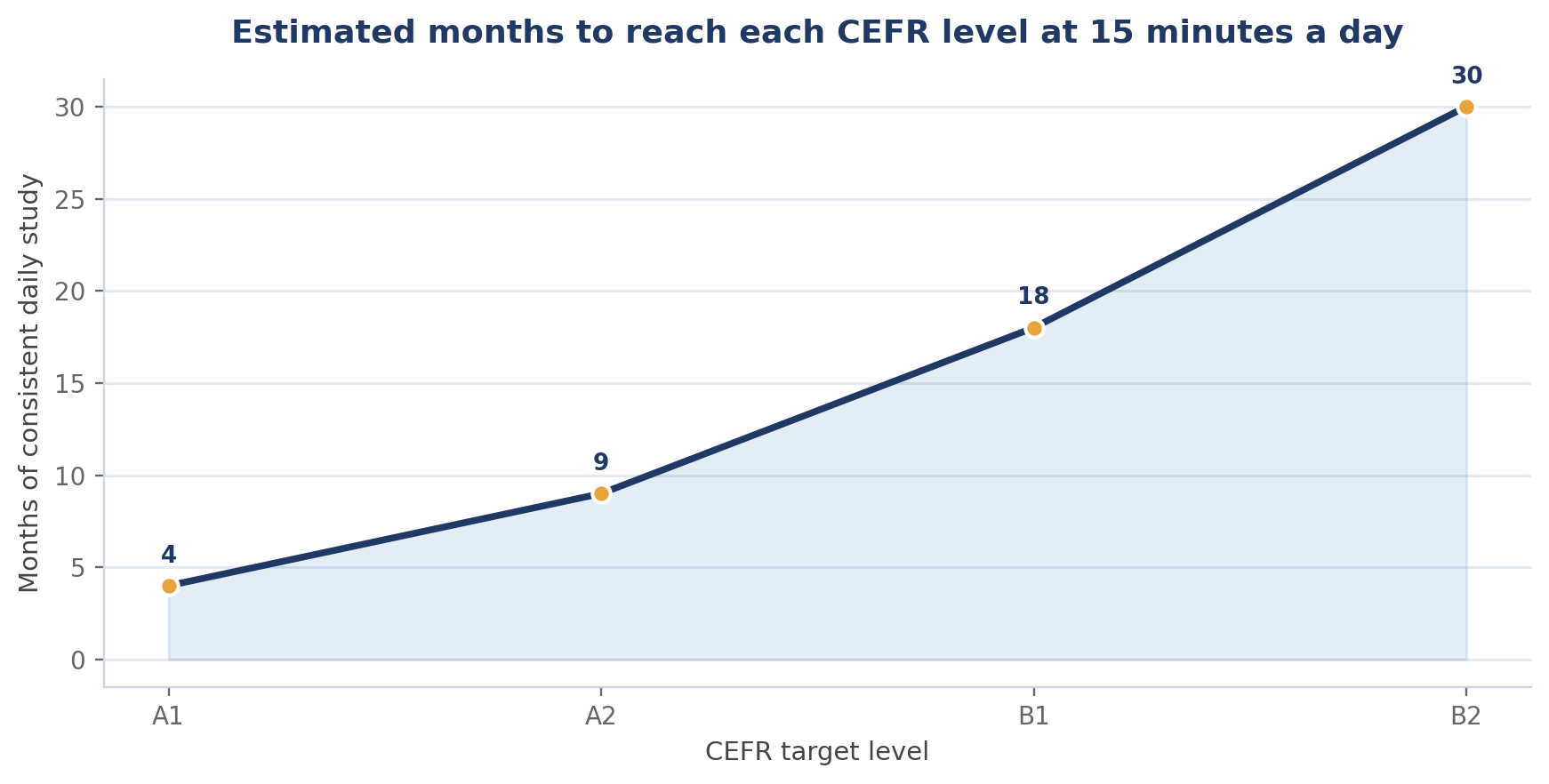
Realistic timelines, honestly stated
CEFR hour bands assume substantial guided study. Fifteen minutes a day is about 90 hours a year, so the arithmetic is unforgiving — but steady beats spectacular.
These are planning estimates, not promises. Speed depends on your starting language, your hours and whether anyone corrects you.
Where the minutes should not go
Busy learners waste the same fifteen minutes in the same ways.
Perfectionism costs more hours than laziness does. Laziness pauses; perfectionism stalls before starting.
Fifteen minutes a day, plus someone who corrects you
Ready to turn reading into real German? Start your self-paced course today.
Start the German course →Create a free accountSelf-study alone plateaus quietly. The course pass adds an AI voice tutor and structured speaking practice, so your daily minutes compound into a higher level. Button: See German courses →
Protectors: the habits that keep it running
Attach the session to an existing anchor — coffee, commute, brushing teeth — and it stops requiring willpower. Prepare the material the night before, because choosing costs minutes you do not have. Keep a one-page log of what you did; the unbroken chain becomes its own motivation. And set a real date: book a Goethe-Institut exam about ten months out and let the deadline carry you.
The Goethe-Institut runs A1 to B2 examinations worldwide, and a booked test shifts everything from "someday" to "Thursday".
When you miss a day
You will. Missing one day costs almost nothing. Missing four in a row costs the habit, not the vocabulary. So the rule is simple: never miss two in a row, and on a genuinely impossible day, do three minutes.
Three minutes is not the training. Three minutes is the handshake that keeps the relationship alive.
Adding a weekly class changes the maths
Fifteen solo minutes plus one sixty-minute structured lesson per week is roughly 150 guided hours a year — enough to reach a solid A2 within a year, and B1 in about two years with focused study. The solo minutes build vocabulary; the structured lesson builds speech, correction and confidence.
That combination is what separates learners who plateau at tourist German from those who hold a conversation and order lunch without pointing.
Turn daily minutes into a real German level
Ready to turn reading into real German? Start your self-paced course today.
Start the German course →Create a free accountFifteen minutes a day gets you moving. A structured course gets you to A2 and B1. Start with a free account and a placement check. Button: Start German →
Frequently Asked Questions
Can you really learn German in 15 minutes a day? Yes, to a real level, but slowly. Expect around nine months to A2 and closer to eighteen months to B1 with consistent daily practice and periodic structured instruction.
What is the best time of day for a 15-minute German session? The slot you never have to negotiate. Early morning and commute time work best for most people because the day has not yet claimed those minutes.
Should I study German grammar every day? No. One grammar rule twice a week, applied immediately in your own sentences, beats daily rule-crunching without production.
Is 15 minutes a day enough to pass the Goethe A2 exam? It can be, with a year of consistency and targeted exam practice. Add a few structured speaking sessions before the exam to rehearse the speaking component under real pressure.
References & Further Reading
- Goethe-Institut — official German courses and A1 to B2 examination framework worldwide.
- Council of Europe, Common European Framework of Reference for Languages — level descriptors and guided hour guidance.
- Deutsche Welle — free structured German courses and Deutsch lernen audio and video resources.
- Duden — authoritative German dictionary and usage reference.
- telc — alternative German certification aligned to CEFR levels for study, work and residence.