Most people quit German inside six weeks. Not because German is hard — because they start in the wrong order. They collect 400 flashcards, dodge the spoken word, and wonder why nothing sticks.
Here is the honest fix. Start with sound and sentences, add grammar second, and let real speaking carry the load.
What you will get from this guide
- The three moves that make German click faster
- A four-week ignition plan you can start anytime
- Honest CEFR hour bands so you know what "fluent" costs
- The study habits that quietly kill beginners
Why Most Beginners Stall
German punishes passive learners. You can read a page of Der Spiegel with a dictionary and still freeze when a baker says "Sonst noch etwas?"
The pattern is always the same. Input without output. Grammar without a mouth.
The Smartest Way to Start Learning German
Start with the mouth, not the book. German spelling is brutally honest — Haus, Straße, Freund sound close to what you see. That is a gift. Use it on day one.
Speak from the first session, badly. Guten Tag, ich heiße Anna. Ich komme aus Indien. Three sentences, out loud, ten times. That is worth more than an hour of silent reading.
Then layer grammar in a strict order. Cases are the famous villain, but you only need the nominative and accusative to survive month one. Dative and genitive can wait — they will still be there in March.
Finally, get an AI voice tutor in the loop. Apps teach you to tap. An AI tutor teaches you to answer under mild social pressure, which is exactly what a Berlin bakery delivers.
How Long Does It Take to Reach A1, A2, B1?
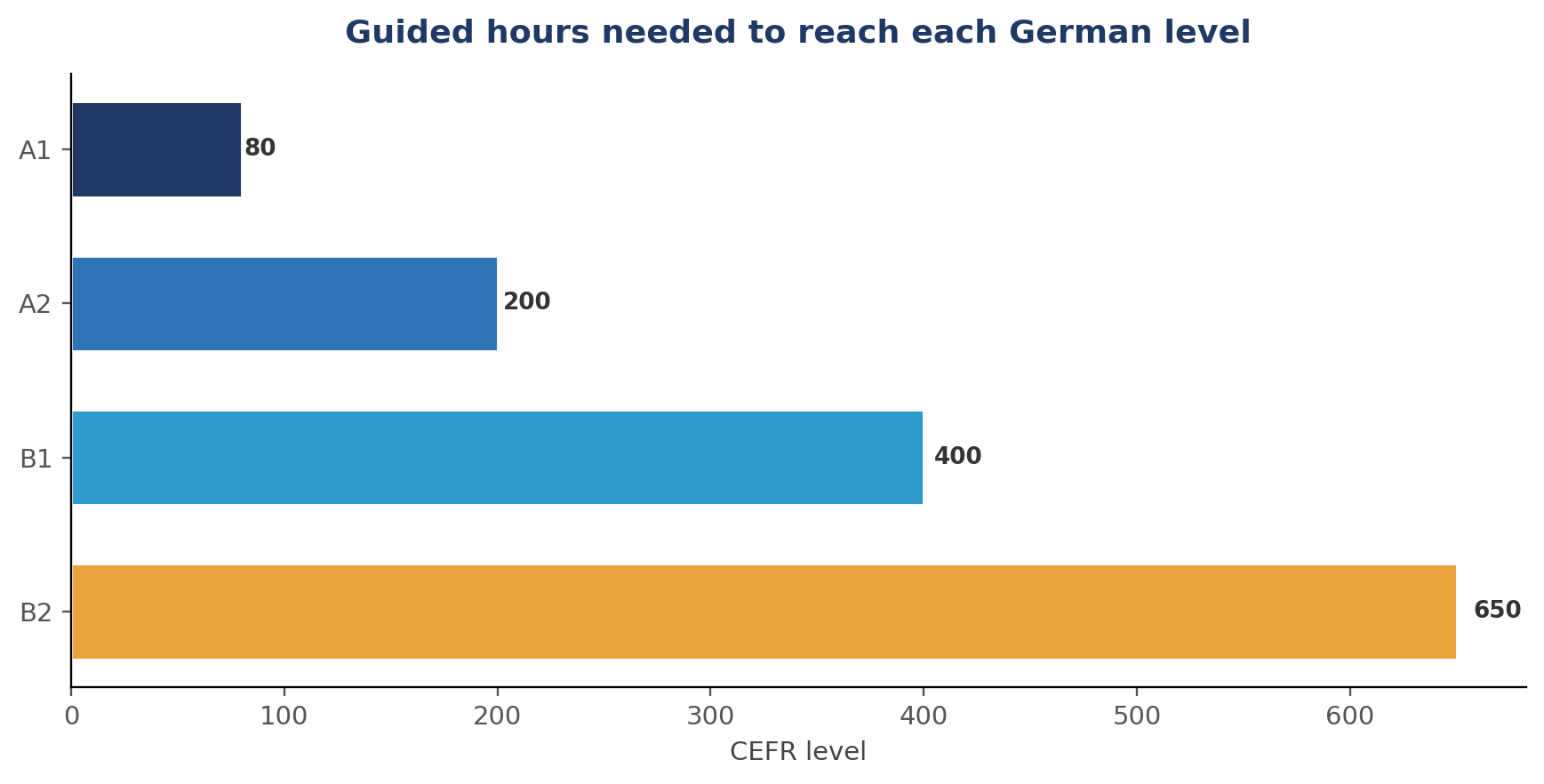
Everyone wants the number. Here is the honest shape of it. Bands are planning estimates, not promises — speed depends on your starting language, your hours, and whether you actually speak.
Notice the jump between A2 and B1. That gap is where most learners vanish. It is not a talent problem; it is a volume problem.
Stop guessing. Start speaking in week one.
Free account, AI voice tutor, real conversation — not another flashcard deck. Build the A1 base properly and the rest of German stops feeling like a wall.
Start your German course →Create a free accountWhat to Learn First — and What to Ignore
Beginners drown because they treat every rule as equally urgent. It is not.
Separable verbs are non-negotiable early. Ich stehe um sieben auf is everyday German, and it trips people who learned the verb list flat.
Vocabulary strategy matters too. Learn words in chunks, never alone. Not der Termin, but Ich habe einen Termin um drei. German rewards phrase-lifting; grab the whole block and reuse it.
The Traps That Quietly Kill Motivation
Three things sink beginners more than grammar ever does.
That last one is brutal. Restarting feels clean and safe. It is also the reason people "study German for three years" and still order coffee in English.
The rule that beats every hack
Speak before you feel ready. Readiness is the reward for starting, never the price of admission.
Your first German sentence is ninety seconds away.
AI voice tutor, A1 to B2, and a plan that respects your calendar. Book the free account, meet your AI tutor, and say Guten Tag like you mean it.
Claim your free account →Create a free accountFrequently Asked Questions
Is German too hard for a complete beginner? No. English speakers get thousands of shared words like Kindergarten, Hand, Wasser. The hard parts — cases and word order — are learned by speaking, not by staring.
Can I reach A1 in three months? Usually yes, with 20 focused minutes a day plus one AI tutor session weekly. The 80-hour estimate on the chart assumes guided instruction, so be honest with your own calendar.
Should I learn German with an app or a tutor? Use both, but rank them. Apps are for streaks and vocabulary. An AI voice tutor is for speaking, correction and accountability. Only one of those makes you fluent.
Do I need to learn High German or a dialect? Start with Standard German (Hochdeutsch). It works in Berlin, Vienna and Zurich. Dialects come later, and they come easily once the base is solid.
References & Further Reading
- Goethe-Institut — official German exams and level descriptions: https://www.goethe.de/en/spr/kup/prf.html
- Council of Europe — Common European Framework of Reference for Languages: https://www.coe.int/en/web/common-european-framework-reference-languages
- Deutsche Welle — free German courses and placement tools: https://learngerman.dw.com/
- Duden — German dictionary and grammar reference: https://www.duden.de/
- LanguageSkills.net — self-paced German courses with AI voice tutor, A1 to B2: https://languageskills.net/german