Most learners do not quit German because it is hard. They quit because nobody told them what comes next. One week it is der, die, das, the next it is a forest of subordinate clauses, and there is no map anywhere.
Here is the map. Not a mood board, not a motivational poster — an actual sequence, with hours, milestones and exams attached.
What you will get from this guide
- The six stages from zero to fluent German
- Realistic hour counts for each stage
- Which exam marks the end of each stage
- The single order mistake that wastes months
The Six Stages of German, in Plain Language
German learning follows a known ladder. The Common European Framework describes six rungs, and every serious course, textbook and exam is built on them.
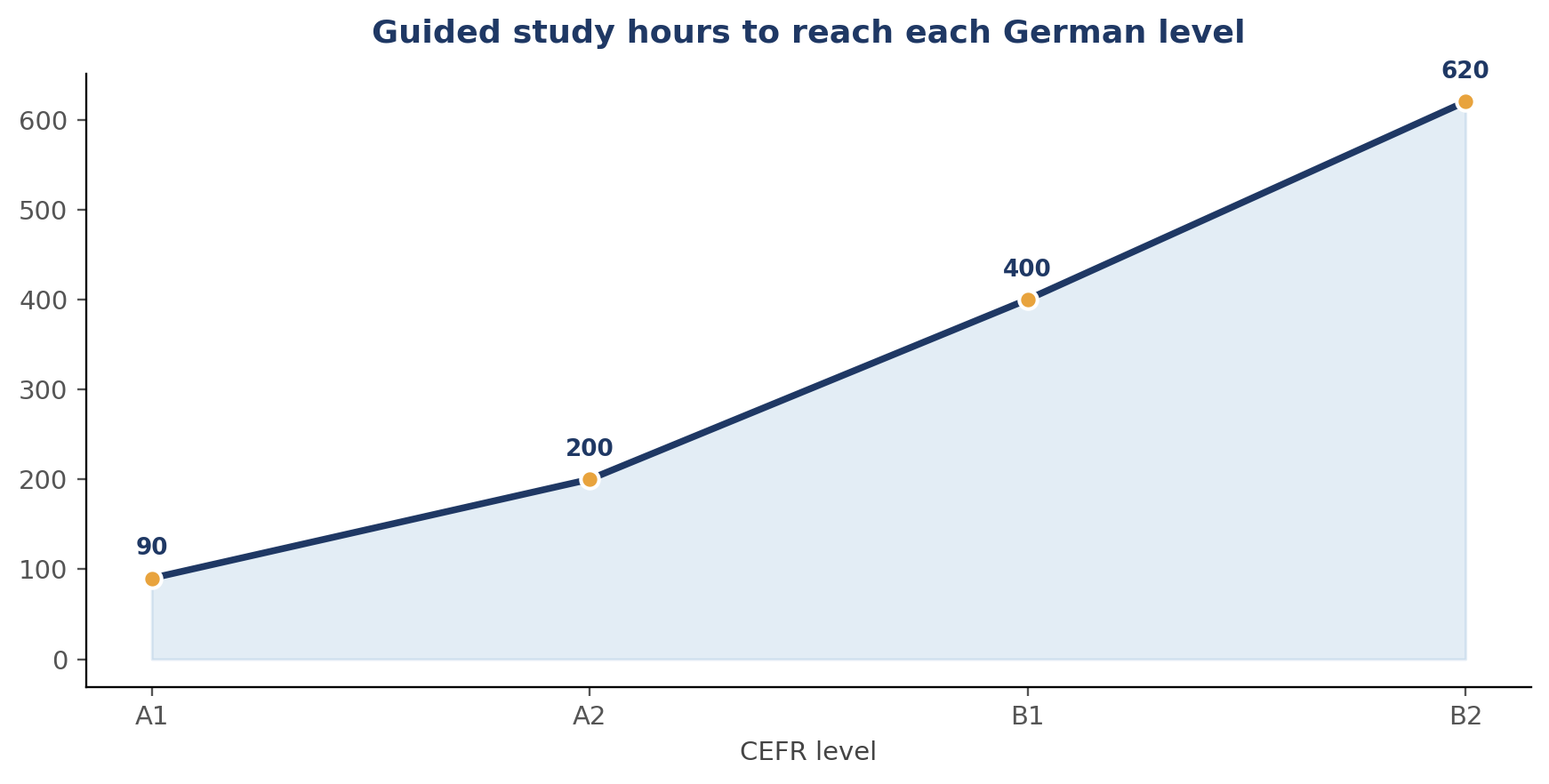
Those hour bands are CEFR-aligned planning estimates. They assume guided instruction plus homework. Self-study without feedback usually takes longer, because errors get comfortable.
Stage 1 and 2: A1 to A2 — Build the Skeleton
At A1 you learn the machinery: the alphabet, the sounds, present tense, sein and haben, and the case system in its simplest form. Two things decide whether this stage goes well.
Learn nouns with their article, always. Never write Tisch. Write der Tisch. The gender is part of the word, not an accessory.
Say everything out loud. German spelling is honest, but ch, r and the umlauts need reps. Silent reading builds silent German.
By A2 you should be able to survive a weekend alone in Berlin: book a room, order, ask directions, write a short message to a landlord.
Stage 3: B1 — The Wall Everyone Hits
B1 is where German stops being a game. Subordinate clauses arrive, the past tenses multiply, and suddenly a sentence puts the verb at the very end and walks away.
The fix is not more vocabulary. It is more output. At B1 you must produce longer, connected speech — even badly at first.
That is roughly four and a half focused hours per week. It is enough. Twenty minutes daily beats a heroic Sunday.
Stop rebuilding your own syllabus every Sunday night
A personal AI voice tutor knows exactly which structure you need next, gives feedback on the mistakes you cannot hear, and keeps the whole plan moving. One course, A1 to B2, no guesswork.
See the German course →Create a free accountStage 4: B2 — From Correct to Comfortable
B2 is the door to work and university in Germany. You learn to structure an argument, quote a source, and follow a debate program without subtitles.
Goethe-Institut exams are the standard measure. TestDaF is the alternative for university admission, and telc and ÖSD offer their own routes. Pick one exam and let it shape your last three months.
Timelines assume steady study, not bursts. Life happens — a skipped month costs more than it looks.
The Order Mistake That Wastes Months
Learners love to perfect one skill before touching the next. They read for a year, then discover they cannot speak. Reading builds vocabulary fast and speaking confidence not at all.
Run all four skills every week from week one: listen, speak, read, write. Same week, different days. That is the whole roadmap in one sentence.
When to Book an Exam
Book it two months before you feel ready. The deadline sharpens everything, and the certificate — Goethe, telc or TestDaF — is what employers and universities actually read.
Map, then move
You have the roadmap. What you need now is a personal AI voice tutor who walks it with you — correcting, pushing and keeping the pace. Start this week.
Start your German course →Create a free accountFrequently Asked Questions
How long does it really take to learn German? To reach conversational B1, plan for roughly 400 guided hours and six to twelve months of steady study. To B2, expect roughly 600–700 guided hours. The bands are estimates, not promises.
Can I skip A2? Sometimes, if your A1 is genuinely solid. Before jumping, test yourself: can you handle a full day of daily-life German without switching to English? If not, finish A2.
Do I need an exam at all? Not for love of the language. Yes for a visa, a job, a university place or a residence permit. Goethe-Zertifikat, telc, TestDaF and ÖSD certificates are the ones that count.
Is self-study enough? Self-study builds vocabulary and reading very well. Speaking needs feedback that can hear you and correct you. Most learners pair both.
References & Further Reading
- Goethe-Institut — German courses and exams — the reference institution for German certification.
- Common European Framework of Reference (CEFR) — the official level descriptions.
- Deutsche Welle — Learn German — free graded audio and video courses.
- TestDaF-Institut — university admission German exam.
- telc — Language tests — European exam provider including German certificates.