Three months. Ninety days. Someone on the internet says they did it, and now you are wondering whether you are the problem.
You are not. What they did was real, but narrower than the video title suggests. Here is precisely what 90 days of German buys you — and what it does not.
What you will get from this guide
- Which German level is actually reachable in 90 days
- An hour-by-hour plan with weekly milestones
- The grammar traps that eat months if you let them
- What Goethe-Institut levels really require
The Honest Answer in One Sentence
In 90 days you can reach a working A2 and touch B1 if you study intensively — you can order, travel, introduce yourself, handle appointments, and hold simple conversations. You will not be debating philosophy in German.
Anyone promising fluent C1 in three months is selling a feeling, not a fact.
What Each Level Actually Costs
The Goethe-Institut and the CEFR framework both work with cumulative guided hours. These are planning estimates, and they assume real instruction, not app taps.
Look at that B1 line. Three months to B1 is mathematically possible — around 20 hours a week. It is also a full-time job with no holidays.
The 90-Day Maths
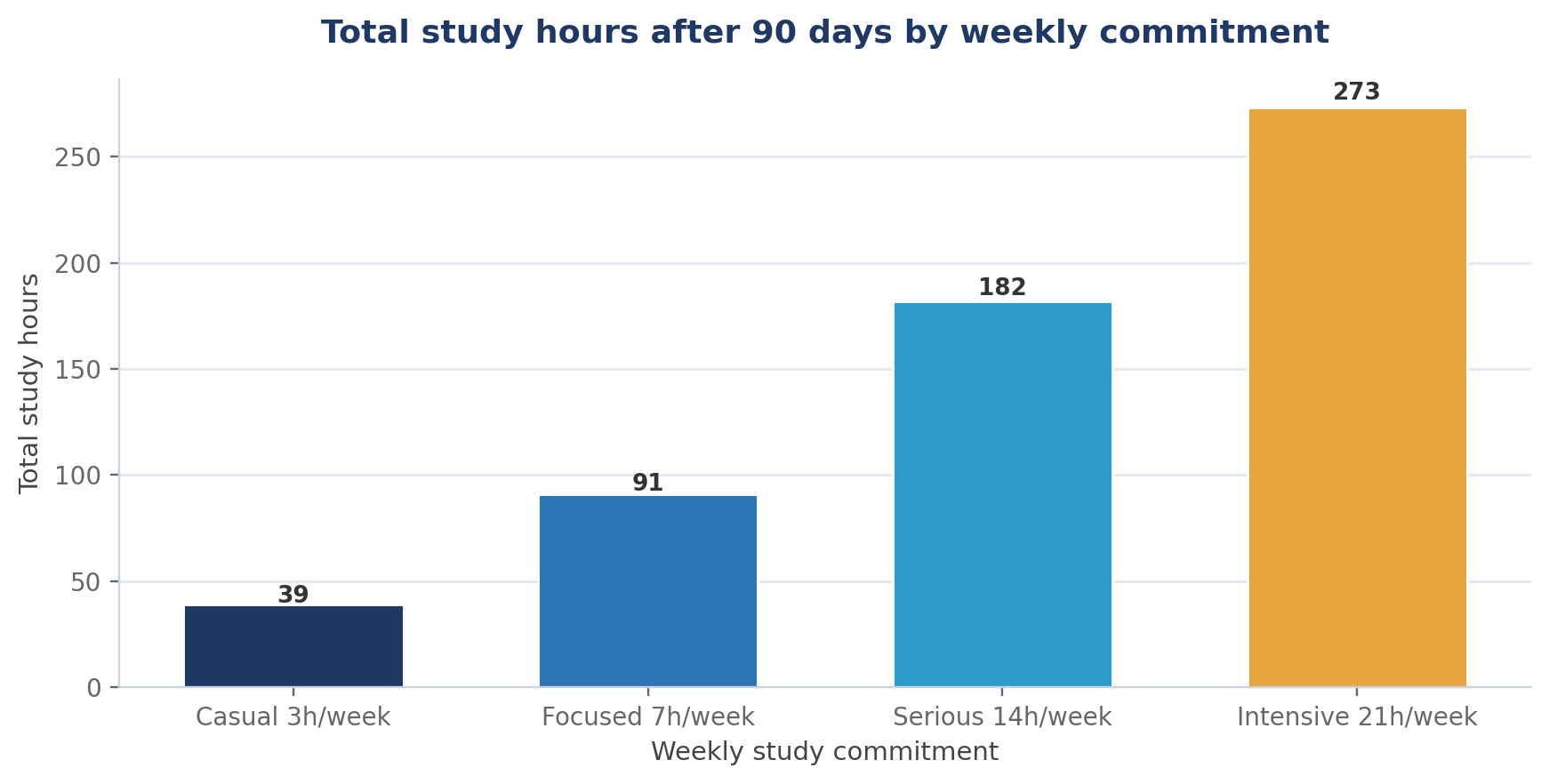
Here is what different weekly commitments produce across 13 weeks.
The chart explains everything. Casual learners land inside A1. Focused learners finish A2. Intensive learners brush B1 and pass an A2 exam with room to spare.
The Trap: Grammar That Eats Months
German punishes the unprepared in three places. Get ahead of them and your three months stretch much further.
That first row is the real culprit. Der Tisch, not Tisch. Ever.
A Week-by-Week Plan for 90 Days
Three phases. No wandering.
Marry this rhythm to 45-minute daily blocks plus two AI tutor sessions a week and you will be surprised.
Ninety days goes fast. An AI tutor makes it count.
Ready to turn reading into real German? Start your self-paced course today.
Start the German course →Create a free accountOur self-paced German courses start with a level check and end with a real target — A2 or B1. Personal AI voice tutor, speaking practice with feedback, weekly correction.
Button: Start your 90-day German plan →
What Three Months Cannot Buy
Some things resist speed. Be honest with yourself about them.
The last one stings the most. Germans speak fast, and comprehension lags speaking by a long margin. Expect it. Do not panic.
The Daily Routine That Works
Consistency beats intensity. This is a morning-and-evening split that fits a working life.
Total: around 8 hours a week — the "focused" column in the chart. That is the sweet spot for most people.
How to Know You Are On Track
Check yourself at day 30, 60 and 90. If the boxes are unticked, change the plan, not the goal.
Failing a checkpoint is data. Failing three times means your hours are too low, not that you lack talent.
Ready to stop guessing and start speaking?
Ready to turn reading into real German? Start your self-paced course today.
Start the German course →Create a free accountTake a free level check, start a self-paced course, and let an AI tutor tell you honestly how far three months will take you. No hype, just a plan.
Button: Get your free level check →
Frequently Asked Questions
Can you really learn German in 3 months?
Yes, to a useful A2 level with 7–10 hours a week, or a basic B1 with 20+ hours a week. Fluent, effortless German takes far longer — usually 600–800 guided hours for B2.
How many hours a day do I need to learn German in 3 months?
About one focused hour a day gets you to A2 in 90 days. Reaching B1 in that window needs three to four hours a day, including speaking practice with AI feedback.
Is A2 German enough to live in Germany?
It is enough to survive and handle daily life, but not for most jobs or formal study. Many employers and universities expect B1 or B2, so treat A2 as a stepping stone.
What should I learn first in German?
Sounds and greetings, present tense, then noun gender and cases. Learn every new noun together with its article — der Tisch, die Lampe — because the case system depends on it later.
References & Further Reading
- Goethe-Institut — official level descriptions and examination information for A1 to B2.
- Council of Europe — Common European Framework of Reference for Languages: Companion Volume, source of the level descriptors.
- Duden — Die Grammatik, the standard reference for German grammar questions.
- Deutsche Welle — Deutsch lernen (Nicos Weg and related courses), free graded audio and video material.
- telc gGmbH — exam formats and level requirements used widely in Germany for work and residence purposes.