Three learners. Same goal. One downloads a free app, one buys a Goethe-Institut course, one hires a private tutor twice a week. Eighteen months later, only two of them can hold a conversation — and the cheapest one spent the most.
The cost to learn German is not a single number. It is a shape, and the shape depends on how much structure you buy. Here is the arithmetic, honestly done.
What you will get from this guide
- Real price bands for every route: free, self-study, group course, tutor, immersion
- The hidden costs nobody puts on the brochure
- A cost-per-CEFR-level table so you can budget the whole journey
What You Are Actually Paying For
Tuition is the visible bill. The real price tag has four parts: instruction, materials, exams, and time. Time is the expensive one. A guided course compresses 350 hours of B1 study into a schedule that actually finishes — that compression is what you buy.
The Five Routes and Their Price Bands
Prices below are typical European market rates in 2026, in euros. They are estimates, not quotes.
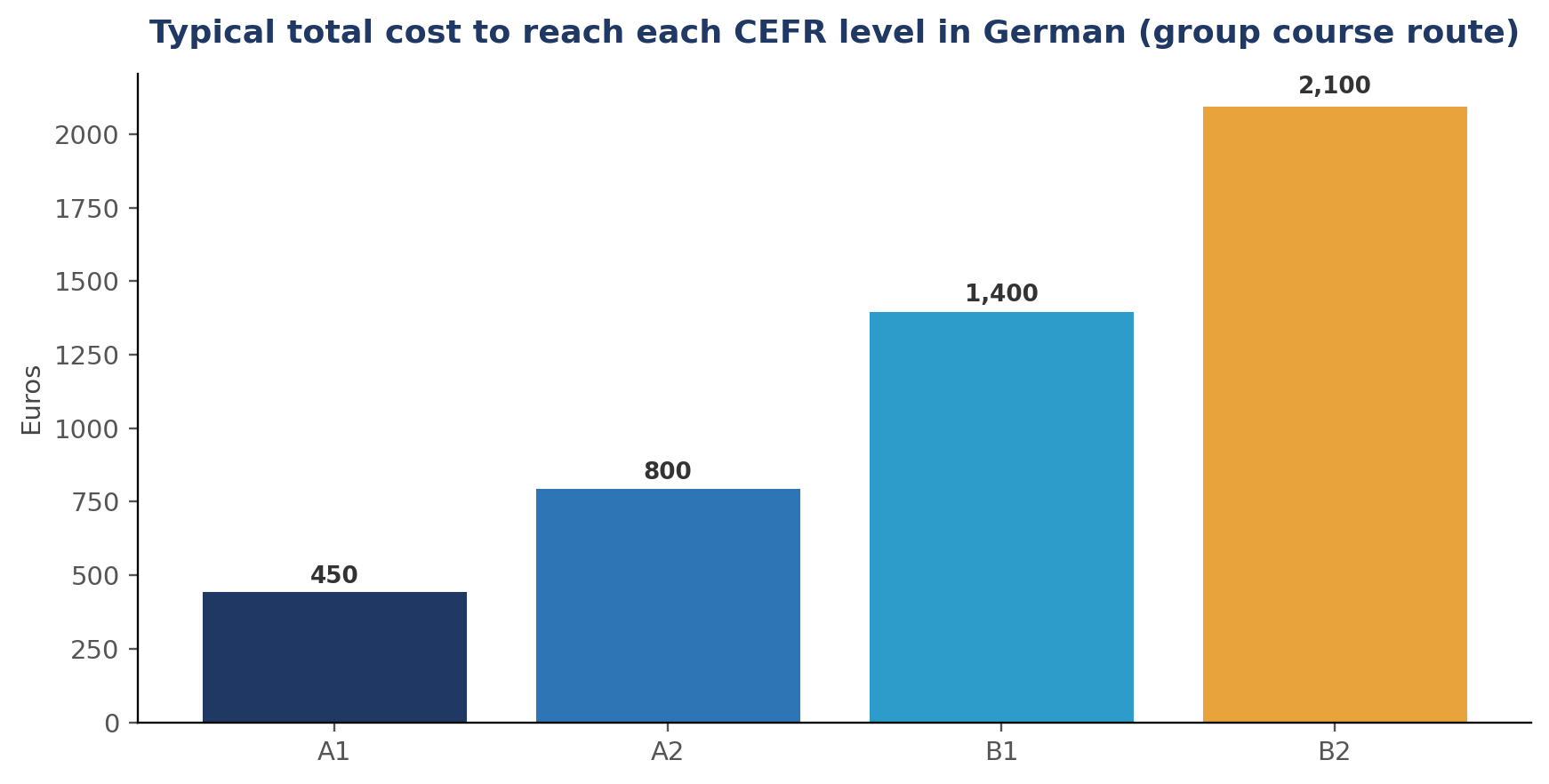
A single level from A1 to A2 costs roughly €300–€700 by the group-course route. Five levels to B2 done that way lands between €2,000 and €4,500.
Cost by CEFR Level
Guided hours drive everything. Multiply hours by hourly rate and the ladder appears.
The Hidden Costs
Nobody warns you about these.
The exam line is the sneaky one. Goethe-Zertifikat and telc fees are paid every time you sit, and B2 candidates frequently sit twice.
Pay once. Skip the repeat fees.
Most learners overspend on retakes and scattered courses. A structured course pass gives you the full A1–B2 path with a personal AI voice tutor, so your budget goes into teaching instead of exam fees. See German course plans →
Start the German course →Create a free accountFree German That Is Genuinely Free
Free is not worthless. Deutsche Welle's Nicos Weg covers A1 to B1 with video, exercises, and a full transcript — at zero cost. The Goethe-Institut's own practice materials are free. Public libraries in Germany and Austria lend graded readers for nothing.
What free cannot give you is a human who corrects you mid-sentence. That correction is the product.
What Changes the Price Most
Four levers, in order of impact.
Budget Scenarios That Actually Happen
Three real shapes, three real totals for reaching conversational B1.
The middle row is the sensible one. It finishes, it is exam-ready, and it costs roughly what a used car costs — except it never loses value.
Stop paying per level. Start paying per result.
A single pass covers the whole German ladder (A1–B2) with a personal AI voice tutor and a clear finish line. It is the cheapest route to steady progress that does not reset every time you upgrade your app. Start your German course →
Start the German course →Create a free accountFrequently Asked Questions
Can I learn German for free? Yes, to about B1 receptive level. Deutsche Welle's Nicos Weg and the Goethe-Institut's free practice material are genuinely complete. Free routes stall on production — speaking and writing — because nobody corrects you. Budget for at least a speaking component.
Is a private tutor worth five times the price? Only if your problem is speaking under pressure or an imminent exam. One-to-one hours are best spent on output, not grammar explanations you could read for free.
How much should I budget from zero to B1? Plan €1,500–€2,500 on the group route including one exam fee. Anything under €1,000 usually means you are supplying structure yourself, which is fine — just be honest about whether you will.
Do Goethe-Institut courses cost more than they are worth? They are priced at a premium and deliver consistent quality, standardised levels, and exam familiarity. If you need a certificate, that alignment saves you a retake.
References & Further Reading
- Goethe-Institut — exam fees and course pricing: https://www.goethe.de/en/spr/kup/prf.html
- Deutsche Welle Nicos Weg free German course: https://learngerman.dw.com/en/overview
- Common European Framework of Reference for Languages, Council of Europe: https://www.coe.int/en/web/common-european-framework-reference-languages
- telc language tests — exam fees and levels: https://www.telc.net/en/
- LanguageSkills.net German course plans: https://languageskills.net/german