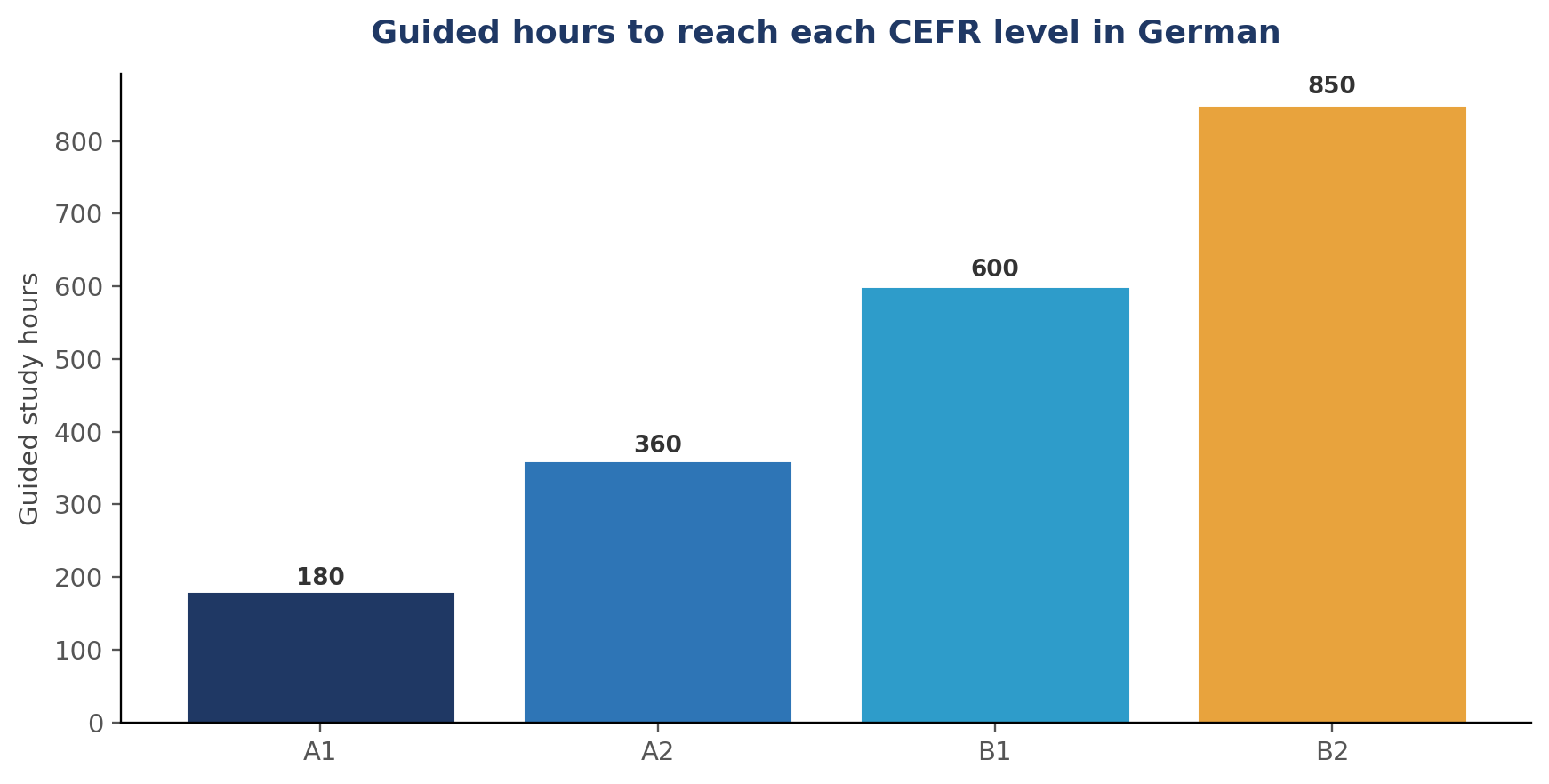
German has a reputation it does not fully deserve. The grammar is front-loaded and the genders are unfair, but the spelling is honest, the vocabulary is familiar, and there are no tones to memorise. For an English speaker, German is a medium-sized mountain with a steep first hour.
Here is the real difficulty picture, split by what actually hurts and what quietly helps.
What you will get from this guide
- How German ranks against other languages for English speakers
- The four features that genuinely slow learners down
- The features that make German easier than you fear
- Techniques that shorten the timeline by months
The Difficulty Ranking, With Real Numbers
The US Foreign Service Institute groups languages by how long its diplomats need to reach professional working proficiency in full-time study. German sits in a middle category, alongside Indonesian and Swahili, commonly cited at around 30 weeks — roughly 750 hours of intensive class time. Compare that with Category I languages and Category IV.
Two caveats. These figures describe full-time diplomats in immersion, not a commuter studying twice a week. And Dutch beats German for English speakers — the two are close cousins.
What Actually Makes German Hard
Four things. All four are learnable, and three of them stop being problems around B1.
The cases are the headline complaint, and they deserve context. German has four. Russian has six, Polish seven, Finnish fifteen. Four boxes to sort words into is work, not cruelty.
Word order deserves special attention because it breaks English instincts. In a German main clause the verb takes second position, so Heute fahre ich nach Berlin is correct and Heute ich fahre is not. In a subordinate clause the verb marches to the end: Ich bleibe zu Hause, weil ich müde bin.
What Actually Makes German Easy
Now the good news, and it is substantial.
That cognate list is bigger than you expect. Kindergarten, Rucksack, Zeitgeist and Angst already live in English. Vocabulary is where German gives you free progress in week one, which is exactly when motivation needs it.
Three Myths Worth Killing
Myth one: German sounds harsh, so it must be hard. Sound and difficulty are unrelated — and German has plenty of soft sounds once you leave Achtung behind.
Myth two: cases mean you must memorise endless tables. You memorise patterns applied to articles and adjectives, and error tolerance is high. Germans understand der Mann where den Mann was needed.
Myth three: adults cannot learn a language well. Adults learn grammar and vocabulary faster than children. Children win on accent. Everything else is time and method.
Cut the guesswork out of a hard language
A personal AI voice tutor explains cases and word order as patterns you can hear, not tables you memorise. Study at your own pace, any time, with speaking practice and AI feedback.
See the German course →Create a free accountTechniques That Shorten the Timeline
Method matters more than talent. These five decisions change the speed.
Chunking is the underrated one. Native speakers do not assemble sentences from grammar rules; they deploy pre-built blocks and swap the pieces. Learn Ich hätte gern... as one block and you can order anything in Germany by week two.
A Realistic Timeline
Honesty beats hype. Here is what steady effort produces, assuming two hours of study a week with the AI voice tutor.
Learners who study daily in shorter bursts consistently beat learners who binge for four hours on Sunday. Frequency beats duration, every time.
The hardest part is the first month — do not do it alone
Structured AI-tutor lessons, a level check on day one, and speaking practice with AI feedback from your very first week. Start with a free account.
Start free →Create a free accountFrequently Asked Questions
Is German harder than Spanish or French? For English speakers, yes, but only moderately. Spanish and French share more vocabulary and have simpler grammar for English speakers. German needs roughly an extra few months of study to reach the same level.
How long until I can hold a conversation? Most consistent learners manage a simple conversation within four to six weeks. Comfortable, unscripted conversation usually arrives somewhere around A2 to B1.
Do I need to master the cases to be understood? No. Wrong cases sound foreign but rarely break meaning. Get the verb right and the vocabulary right, and listeners will fill in the rest.
What is the single biggest mistake beginners make? Avoiding speaking until they feel ready. There is no ready. Produce imperfect German early with feedback, and the fear fades within weeks.
References & Further Reading
- US Foreign Service Institute — language difficulty categories and required study hours
- Council of Europe — Common European Framework of Reference for Languages (CEFR)
- Duden — Die Grammatik, the standard reference for German grammar
- Goethe-Institut — course level descriptions from A1 to B2
- Deutsche Welle — free Nicos Weg course from A1 to B1
Find your level and your plan in one free session at languageskills.net/register.