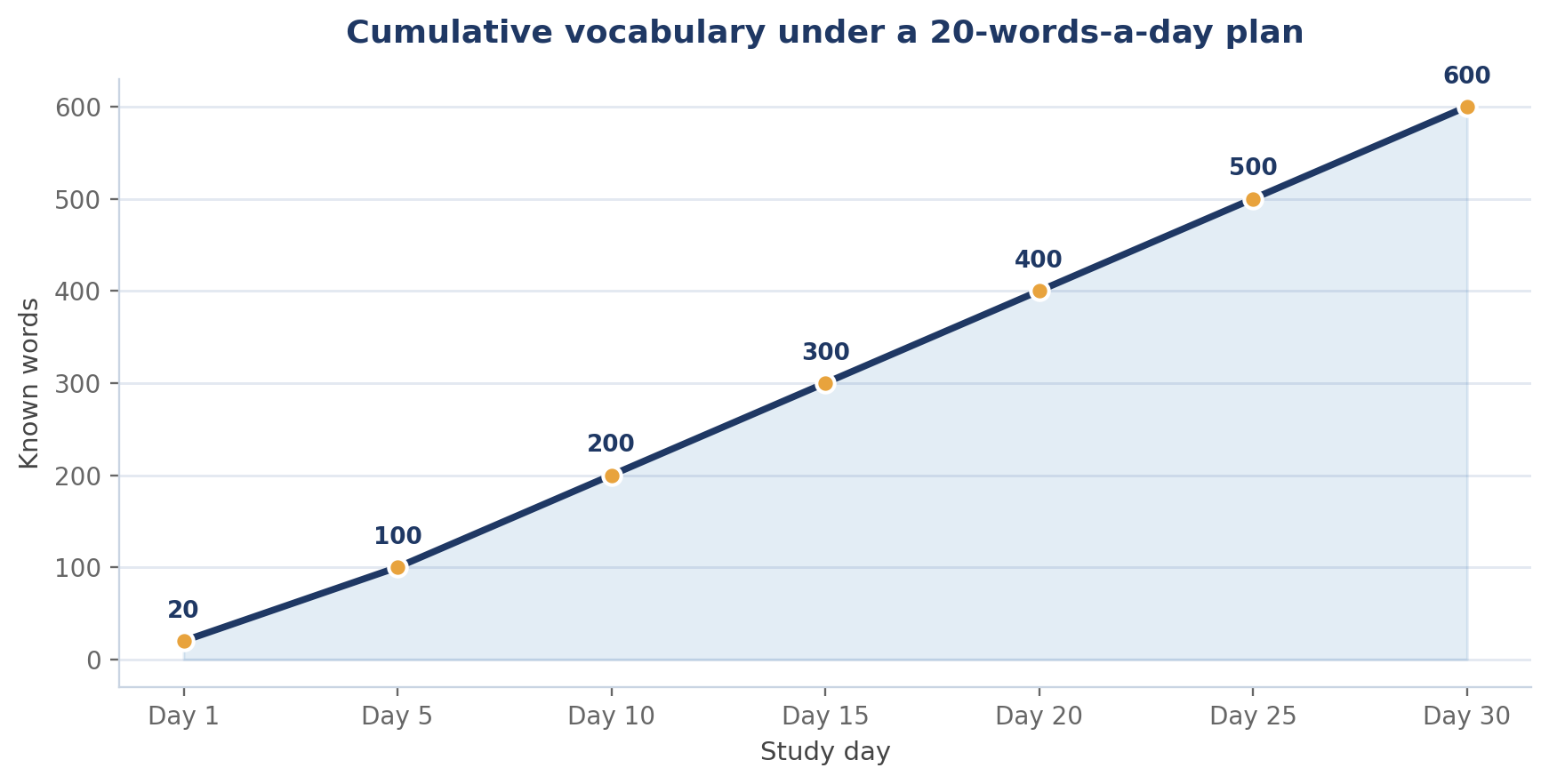
Yes, you can learn German in 30 days — just not all of it. By day 30 you can order coffee, introduce yourself, ask directions, understand slow spoken German, and survive a real conversation for two minutes. You will not be reading Kafka, and anybody promising that is selling you a fantasy.
What you will get from this guide
- A week-by-week plan with daily tasks and hour targets
- A realistic CEFR checkpoint for day 30
- Cramming traps that waste entire weeks
- The one daily habit that decides whether this works
What 30 Days Actually Buys You
German is honest about itself. Its grammar is rule-bound and its spelling is predictable, which makes it faster to start than it looks. But three things decide your ceiling: daily hours, whether you speak aloud, and whether anyone corrects you.
One guided hour a day for a month is roughly 30 hours. That is a genuine, defensible A1 launch — and A1 typically runs 80–200 guided hours from zero, so treat 30 days as the first victorious slice, not the finish line.
The Week-by-Week Architecture
Four weeks, four missions. Resist the urge to make week one about articles and gender endings. Week one is about saying things.
The Daily Hour, Broken Down
Most people fail at "study German" because it is not a task. It is a fog. Turn the fog into four blocks you can actually finish.
That is 60 minutes. If you only have thirty, cut the writing block first, never the speaking block. Silent study is how you end up reading German beautifully and freezing the moment a barista replies.
The Crammer's Trap List
Month-long sprints break in predictable places. Here is where the wheels come off.
Your Day-by-Day Schedule
Here is the whole month in one table. Print it. Cross off days — the tick marks are half the motivation.
The plan works fastest with a voice tutor on the other end
Thirty days of solo drills gets you grammar. Thirty days of guided speaking practice gets you grammar plus a voice — AI feedback that catches the mispronounced ch and the wrong article before they harden. A German course pass pairs the schedule above with a personal AI voice tutor and structured lessons you study at your own pace.
Compare German courses →Create a free accountHow to Not Quit on Day 9
Day nine is where most month-long plans die. Novelty is gone; fluency still feels far off. Three defences.
First, shrink the promise. "One hour today" beats "become fluent" every single time. Second, attach the hour to an existing habit — coffee, commute, lunch break — so it does not need willpower to start. Third, get a witness. A classmate, a tutor, a friend learning with you. Accountability beats motivation because it does not require you to feel like it.
Thirty days from now, you could already be speaking
You have the schedule, the daily blocks and the trap list. What turns it from a personal challenge into a result is structured instruction: a personal AI voice tutor, guided lessons, and speaking practice with feedback. Pick a start date this week and give the month something to prove.
Start your German course →Create a free accountFrequently Asked Questions
Can I really learn German in 30 days? You can reach a functional A1 launch: introductions, ordering, directions, simple past. Full conversational fluency is a months-to-years project. Anyone selling fluency in a month is selling a product, not an outcome.
How many hours a day should I study? Sixty minutes daily is the highest-value target for most learners. Two hours accelerates noticeably if you can sustain it. Twenty minutes produces a taste of the language, not a usable level.
What should I learn first? Sounds, greetings, sein and haben, personal pronouns, and the present tense. Then articles and cases, always inside real sentences rather than abstract tables.
Do I need a tutor for a 30-day sprint? Not strictly — but corrections are the difference between thirty days of progress and thirty days of fossilised mistakes. Even a few sessions of speaking practice with AI feedback in the month changes the outcome.
References & Further Reading
- Goethe-Institut. Course level descriptions and A1 syllabus information, goethe.de.
- Council of Europe. Common European Framework of Reference for Languages: Companion Volume, 2020.
- Deutsche Welle. Nicos Weg A1 German course, dw.com.
- Duden. Die Grammatik — standard reference on German verb and case structures.
- telc gGmbH. Examination regulations and level descriptions, telc.net.