Most people fail Goethe-Zertifikat A2 for a boring reason. They fail one module by two points, then have to retake the whole exam and pay twice.
Not because their German is bad. Because nobody told them the exam has a shape, and the shape rewards specific behaviours. Learn the shape and you can pass with the German you already have.
What you will get from this guide
- The exact Goethe-Zertifikat A2 module structure, timings, and pass rules
- A study plan built backwards from your exam date
- The four scoring traps that quietly bleed marks
- How to practise each skill so preparation transfers to exam day
What Goethe-Zertifikat A2 Actually Tests
The Goethe-Zertifikat A2 is the second rung of the six-level Goethe scale, aligned to the Council of Europe's CEFR. It proves you can handle routine, predictable exchanges: shopping, work, family, travel, and short written messages.
It has four modules. You can take them together or separately, and you can retake a single failed module — which is the single most useful thing to know before you book.
Sixty points. That is the number. Not perfection — 60%.
The Real Difficulty Ranking
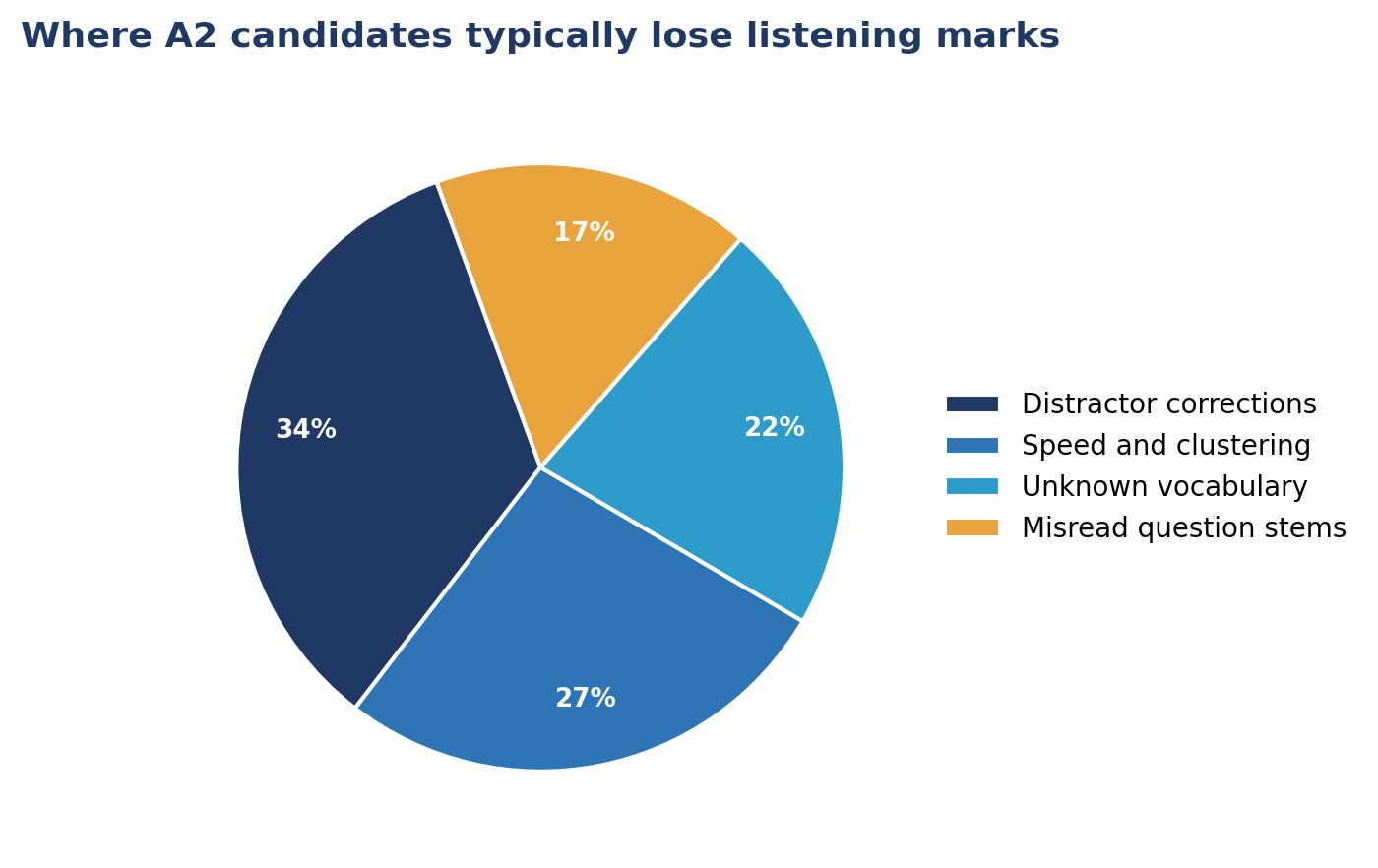
Ask a hundred candidates which module scared them most and you get a clear pattern. Reading looks easy and is not. Listening destroys people. Writing is the most winnable. Speaking is the most improvable in the shortest time.
Here is the insight: Hören and Schreiben are opposites. Listening is the hardest skill to improve quickly and the easiest to lose marks on through panic. Writing feels hard but is almost entirely template-driven at A2. Spend your panic budget on listening, your confidence budget on writing.
Hören: Where Candidates Bleed Points
Goethe A2 listening plays each audio twice — except in Part 1, which is played once. That single detail changes your whole approach.
The classic trap is the correction sentence. A speaker says Ich fahre um acht and then adds Nein, warte, um halb neun. Candidates hear the first number, write it, and move on. The second half of the sentence is where the answer lives.
Practise with the Goethe-Institut's own free practice materials so your ear learns the exam's pace, not a podcast's pace.
Schreiben: Two Tasks, Two Templates
Writing at A2 is not creative writing. It is a formula, and formulas are learnable in days.
Teil 1 is an informal message to a friend — you are given three content points you must include. Teil 2 is a short formal note, usually to an institution, using Sie.
Two golden rules. First, answer all three bullet points — skip one and you lose content marks that no amount of beautiful grammar recovers. Second, stay inside the word limit. At A2 that is roughly 30–40 words per task. Overlong answers bring no extra credit and increase your error count.
A Backwards Study Plan
Count backwards from your exam date. Twelve weeks is comfortable; six works if you are already at A2.1.
That "no new material" week is not laziness. It is the single most ignored piece of exam advice. New vocabulary in the final week displaces the vocabulary you already had.
Practice without feedback is guesswork
You need structured feedback on why your writing lost content points, and regular speaking practice with AI feedback to drill the speaking parts out loud. That is what a self-paced A2 course with a personal AI voice tutor does.
Prepare for Goethe A2 with an AI voice tutor →Create a free accountSprechen: The 15 Minutes That Decide Your Confidence
Speaking runs in three parts, usually with a partner. The examiner is looking for communication, not poetry.
Part 3 is the one people underestimate. You must negotiate with your partner: Wollen wir um sechs treffen? Wie wäre es mit Samstag? Candidates who make decisions unilaterally lose interaction marks. It is a conversation, not a presentation.
The Four Scoring Traps
Trap one: leaving blanks. Never leave a listening or reading item blank. Wrong answers do not subtract points. Blanks do.
Trap two: writing in the wrong register. Du grammar inside a Sie letter costs marks in the very first line. Decide the register before you write a word.
Trap three: practising only in silence. Reading and writing in a quiet room is comfortable. The exam has a clock, a room, and other people. Simulate that.
Trap four: learning words you cannot pronounce. Your passive vocabulary and active vocabulary diverge with every list you only read. Say every new word aloud once.
Free Materials You Should Be Using
The official model papers are non-negotiable. Do all of them, timed, before your exam. Nothing else predicts the format so precisely.
Build your skills steadily before exam day
A self-paced Goethe A2 course with a personal AI voice tutor gives you guided lessons, speaking practice with AI feedback, and printable study materials you can work through any time. Sixty points stops feeling like a gamble.
Start a self-paced Goethe A2 course →Create a free accountFrequently Asked Questions
How long does it take to prepare for Goethe-Zertifikat A2? From a solid A2.1 base, six to twelve weeks of focused preparation is realistic. From scratch, allow roughly 180 guided hours total to reach A2, then add a month of exam-specific work.
Can I retake just one module? Yes. Goethe allows you to repeat a failed module individually rather than the whole exam, and results from passed modules remain valid. Check current terms with your local Goethe-Institut when you register.
Is Goethe-Zertifikat A2 hard? The German is not hard. The format is where people struggle. Candidates who do four or more timed mocks pass at far higher rates than those who only study textbooks.
Do I need A2 for a German visa? For many family-reunion visa routes, proof of German at A1 is the baseline requirement, and A2 strengthens applications. Requirements vary by consulate and year — verify with the German mission handling your case.
References & Further Reading
- Goethe-Institut — Goethe-Zertifikat A2 exam page, modules and pass criteria: https://www.goethe.de/en/spr/kup/prf/prf/gza2.html
- Goethe-Institut — free official practice materials and model papers: https://www.goethe.de/en/spr/kup/prf/prf/gza2/ueb.html
- Deutsche Welle — Nicos Weg A2 free video course: https://learngerman.dw.com/en/nicos-weg/c-36519789
- Council of Europe — CEFR A2 global scale descriptors: https://www.coe.int/en/web/common-european-framework-reference-languages
- telc gGmbH — comparison of German certificate systems and CEFR alignment: https://www.telc.net/en.html