Sixty-five minutes of exam time decides whether you walk out with a Goethe-Zertifikat A1 or a bill for a retake. Most candidates fail not because their German is weak, but because they never learned how the thing is scored.
The Goethe-Zertifikat A1 — officially Start Deutsch 1 — is a four-part exam built by the Goethe-Institut. It checks whether you can handle the absolute basics: introduce yourself, ask for prices, understand a slow announcement, fill in a form. Nothing exotic. The format, though, is unforgiving in specific places, and knowing those places is free marks.
What you will get from this guide
- The exact structure and timing of all four A1 modules
- How the 100-point scale works and where the pass line sits
- The scoring traps that cost real candidates real points
- A realistic study plan for reaching exam level
What the Goethe-Zertifikat A1 Format Actually Looks Like
The exam has four modules: Listening, Reading, Writing, and Speaking. The first three are sat together in one written session, usually with no break. Speaking is examined separately, often the same day, with two candidates sitting in front of two examiners.
Notice the imbalance. You get twenty-five minutes to read fifteen items but only twenty minutes to produce two pieces of writing. Time pressure, not grammar, is the villain in the Writing module.
The 100-Point Scale, Decoded
Each module is worth 25 points, scaled from the raw items. You need 60 out of 100 to pass the whole exam.
Here is where most people get confused. Since 2019 the Goethe-Institut awards the certificate per module. You can pass Listening in March, bomb Writing, and retake only Writing in June. Your passed modules stay banked. That single rule has rescued thousands of candidates.
Reading and Listening: The Half-Answer Trap
Both modules use a mix of multiple choice and true/false. The true/false tasks are not neutral coin flips — some include a "not in the text" option, and guessing wrong costs you as much as leaving it blank.
Writing: Where 30 Words Decide Everything
The A1 writing tasks are brutally short. A form to complete, then a message of roughly 30 words covering three given points. Examiners mark three criteria: task fulfilment, communicative design, and language correctness.
Thirty words is not much. Missing one content point can drop you below the pass threshold for the whole module. Count your points on your fingers before you write.
Stop guessing what examiners want
Our AI voice tutor gives you instant feedback on your writing against the official criteria, line by line, before the real examiners ever see it.
Get your writing marked →Create a free accountSpeaking: Two Candidates, Two Examiners, One Conversation
The speaking exam feels gentle and is not. You introduce yourself, spell your name or a word, give a number, then ask and answer questions, then make a request and respond to one.
The single biggest scoring loss here is silence. A wrong sentence earns more than no sentence. Examiners cannot award points for words you did not say.
How Long Does It Take to Be Ready?
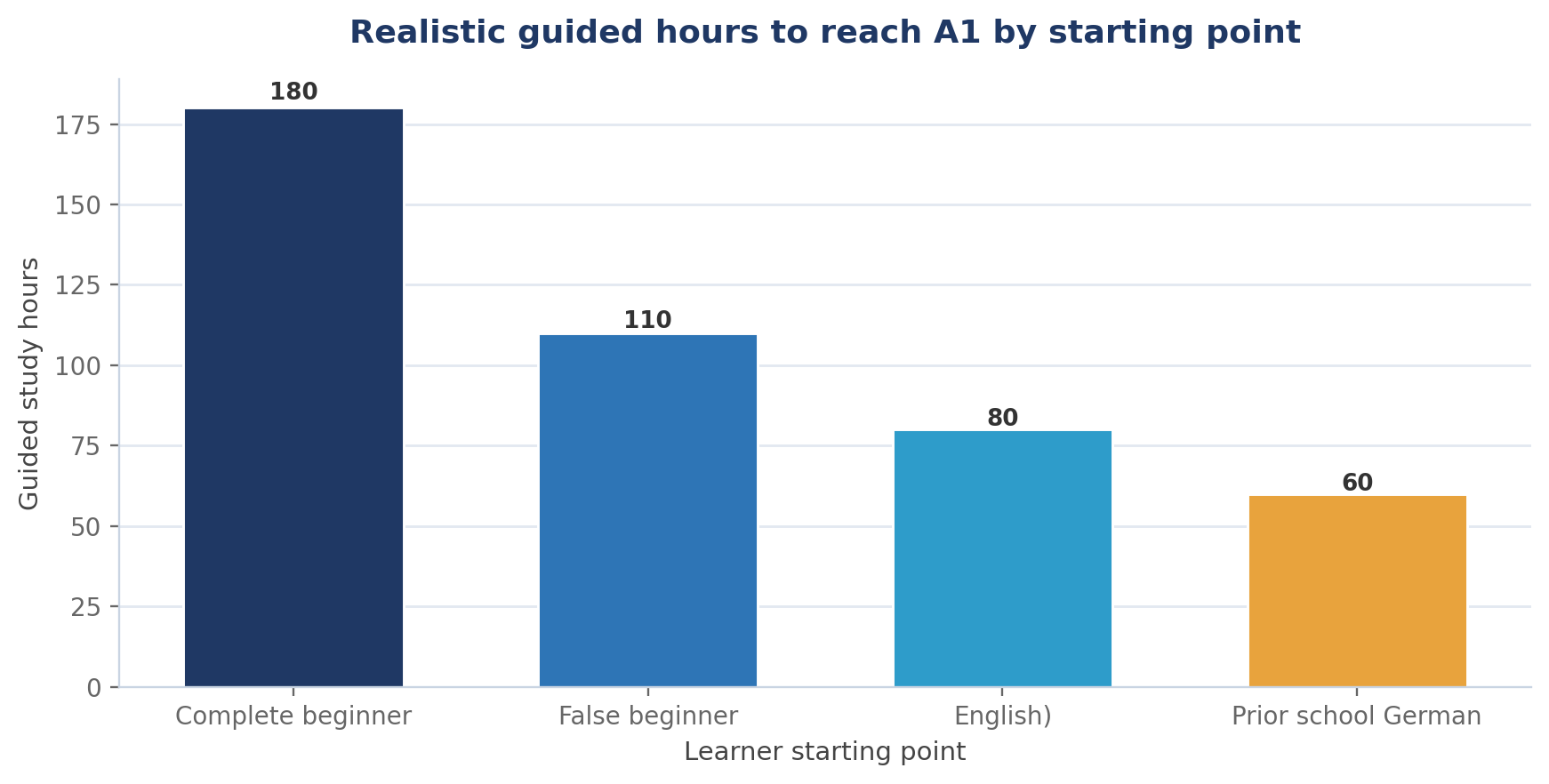
A1 is a beginner level, but "beginner" hides a real range. CEFR-aligned planning figures put A1 around 80 to 200 guided hours, depending on your starting point and how much class you attend.
Notice the last bar. If you studied German at school years ago, you are not starting from zero — you are restoring, which is far faster. An honest level check before you book saves months.
What It Costs and What Comes Next
Exam fees vary by country and centre, and the Goethe-Institut publishes them locally rather than globally. Expect a retake fee per module roughly equal to the per-module share of the full price.
A1 is also a real-world gateway. It is the level required for the family reunification visa in Germany for spouses, which is why so many candidates sit it under deadline pressure.
A1 first try, without the drama
Self-paced AI-guided lessons, speaking practice with instant feedback, and printable study materials. Start free and see how fast you move.
Explore the German course →Create a free accountFrequently Asked Questions
Can I fail one module and still get the certificate? Not for the certificate itself — you need all four modules passed. But you keep the modules you passed and retake only the rest, which is far cheaper and faster than repeating everything.
How many points do I need to pass speaking? Speaking is scored out of 25 like every other module, and you need roughly 60 percent of the available points in each module you wish to pass. Exact thresholds are set by the Goethe-Institut and published in the exam guidelines.
Is the A1 exam harder than it looks? The vocabulary is small, but the format is tight. Candidates who practise full timed mock papers almost always outperform candidates with better grammar who never rehearsed the timing.
How long is my A1 certificate valid? Goethe-Zertifikat certificates do not expire. Some visa authorities request a recent certificate, so check the specific requirement before you assume an old one will do.
References & Further Reading
- Goethe-Institut — Start Deutsch 1 exam page and official Modellsatz (practice exam)
- Goethe-Institut — Prüfungsordnung / examination regulations, current edition
- Common European Framework of Reference for Languages (CEFR), Council of Europe
- Goethe-Institut — exam fees and registration information by country
- Deutsche Welle — Nicos Weg A1 course, free official learner material
Ready to practise the real thing? Create a free account at languageskills.net/register and start learning with your personal AI voice tutor.