Fifteen minutes decides whether your A1 file ends in a certificate or a retake. The good news: the Goethe-Zertifikat A1 speaking section is the most predictable exam in the German system. Every task is rehearsable, the vocabulary is small, and examiners are rooting for you to get through it.
What you will get from this guide
- The structure of the oral exam, part by part, in plain terms
- Sample answers you can actually say out loud, word for word
- The scoring reality, plus a two-week practice plan
What the Oral Exam Looks Like
The Sprechen module of the Goethe-Zertifikat A1 (Start Deutsch 1) takes about fifteen minutes and is normally taken in a pair with another candidate, in front of two examiners. One examiner leads the conversation; the other scores quietly.
You are not expected to be elegant. You are expected to be intelligible, understandable, and interactive. Always confirm the exact format against the current Goethe Modellsatz for your exam, because regulations get updated.
Teil 1: Introducing Yourself
You get keyword cards. The examiner asks, you answer. Then you are usually asked to spell your surname and give your telephone number or postal code. That spelling moment has failed more A1 candidates than any grammar error.
Cover the whole grid in practice. Four sentences per topic, no more. Examiners are checking that you can respond, not that you can monologue.
Teil 2: Ask, Answer, Repeat, Answer
This is the heart of the exam. Each candidate gets a card with a theme — Essen und Trinken, Wohnen, Freizeit, Einkaufen — and a keyword. One of you asks a question, the other answers, then you swap. You do this twice.
Three sentence patterns carry all of it: Was …?, Wo …?, Wann …? Build a question skeleton, then drop in any noun from the card.
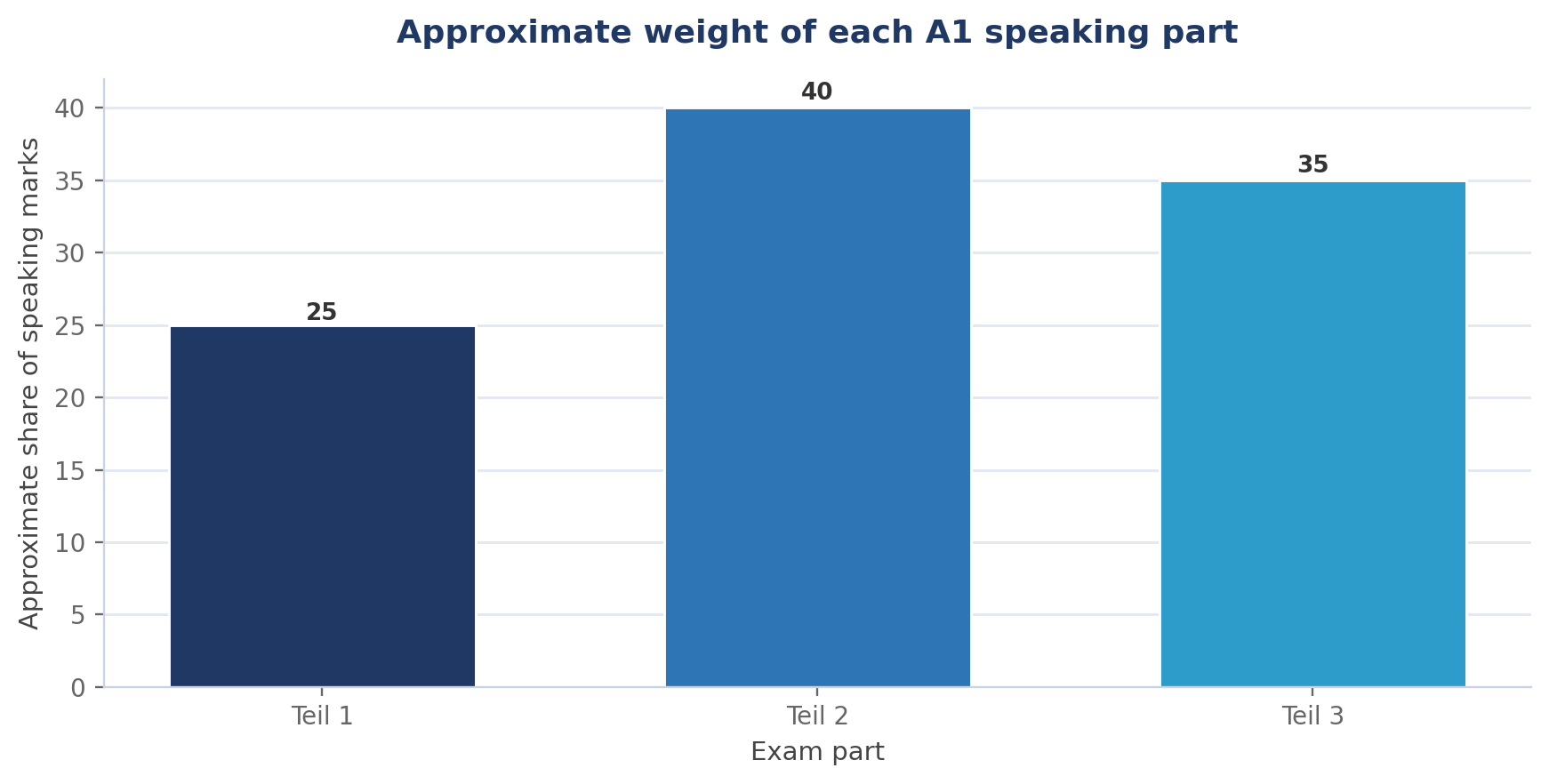
Teil 2 carries the most weight. If you have ten practice hours left, spend six of them there.
Teil 3: Requests and Reactions
You get picture cards showing everyday objects or actions, and you must ask your partner for something. Then your partner asks you. The examiners want to hear the request formula and a natural response.
Master two frames — Kannst du bitte …? and Kann ich bitte …? — and one refusal softener: Tut mir leid, ich habe keinen. That is the entire part.
Rehearse with your AI voice tutor, not a mirror
The oral exam is a conversation, and conversations cannot be memorised alone. Self-paced A1 lessons with an AI voice tutor let you practise speaking any time, with instant feedback on every nervous pause.
Prepare for Goethe A1 →Create a free accountHow You Are Scored
Speaking is one of four modules, and the certificate requires 60% of the total. No single skill can drag you under on its own, but a silent speaking module is very expensive.
Pronunciation does not need to be native. It needs to be understandable. A slow, clear Ich heiße beats a fast, mangled one every time.
The Two-Week Plan That Works
Three full timed run-throughs is the difference between hoping and knowing. Schedule them early, because practising alone conceals exactly the weakness you need to find.
Silence is the only unrecoverable error. If you do not understand, say Wie bitte? Können Sie das wiederholen? — that is a normal, expected, entirely forgivable sentence, and it costs you almost nothing.
Book the exam, then train for it
A fixed date sharpens everything. Get a level check, start your self-paced A1 lessons with an AI voice tutor, and rehearse the actual format until it feels boring.
Start A1 exam prep →Create a free accountFrequently Asked Questions
How long is the Goethe A1 speaking exam? About fifteen minutes, usually taken with a partner and two examiners. Confirm details in the current official Modellsatz for your exam.
Can I fail the speaking part but still pass? The Goethe-Zertifikat A1 requires 60% overall across the written and oral modules. A weak speaking section can be compensated by strong listening and reading, but it is a risk worth removing.
Do I have to spell my name in German? Typically yes, in Teil 1, and candidates are often asked for a telephone number or postal code too. Practise saying letters aloud until it is reflex.
Should I answer in long sentences? No. Short, complete, correct sentences beat long, broken ones. One idea per sentence at A1 is exactly right.
References & Further Reading
- Goethe-Institut, Goethe-Zertifikat A1: Start Deutsch 1 — exam regulations and Modellsatz — goethe.de
- Goethe-Institut, Sprechen task descriptions and rating criteria for A1 — goethe.de
- telc gGmbH, comparable A1 oral exam specifications for format comparison — telc.net
- Council of Europe, CEFR Companion Volume (2020) — A1 spoken interaction descriptors
- Deutsche Welle, Nicos Weg A1 for level-appropriate listening and dialogue practice — dw.com/deutschlernen