Most people prepare for telc Deutsch B1 the same way: buy a practice book, work through it alone, feel reasonably confident, and then discover in the exam that the oral part is a paired discussion and the letter is marked against a rubric nobody explained.
The best preparation is not more German. It is targeted German — aimed at the exact tasks the exam sets, practised in the exact conditions you will face them.
Here is how to prepare properly, with a plan you can actually follow.
What this guide covers
- The week-by-week preparation plan
- Skill priorities, in the order that pays
- How to use practice exercises without burning them early
- The four mistakes that cost real marks
- How self-paced AI-tutor practice supports exam readiness
The honest priority order
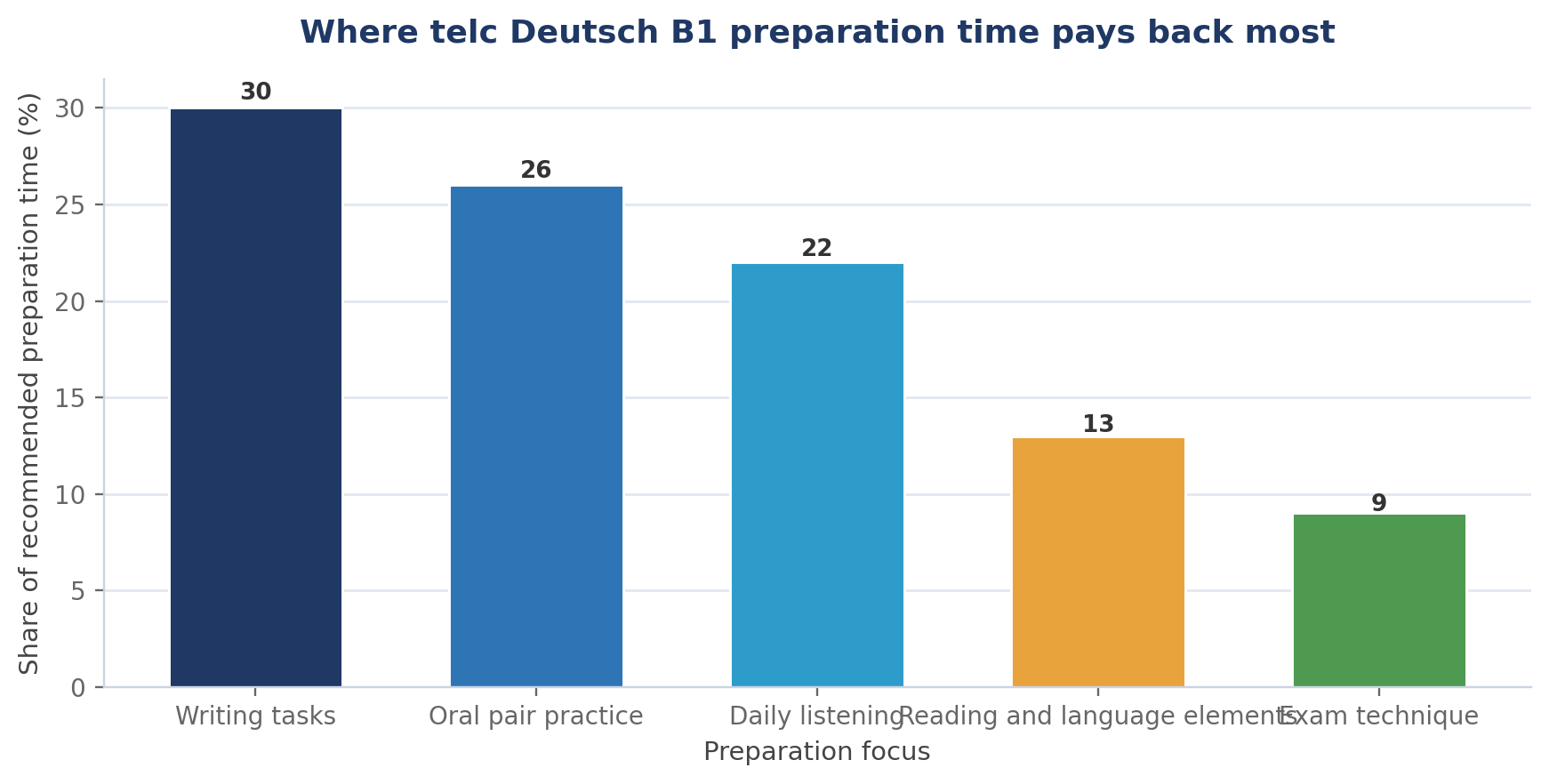
Not all sections respond equally to preparation time. This is where the points actually come from.
Most candidates invert this. They do reading exercises because reading feels comfortable, and neglect writing and speaking because those feel exposed. That is exactly backwards.
The ten-week plan
Two design decisions matter here. The daily listening habit starts in week two and never stops, because listening is the slowest skill to build. And the second mock sits at week eight, leaving two weeks to act on what it reveals.
Writing: the most winnable section
The letter or email task is around 45 points and it is almost entirely a technique problem. Here is what the rubric rewards.
Learn a reusable skeleton and adapt it. The exam scenarios repeat: rescheduling, apologising, inviting, complaining, requesting information. Five skeletons cover almost every task they can set.
Speaking: rehearse with a partner, always
The oral exam is a pair exam. You will not present to an examiner — you will interact with another candidate, and examiners reward interaction directly.
The discussion is where marks are won. Practise phrases that hand the conversation back: Was meinst du?, Da hast du recht, aber…, Das sehe ich anders, weil… A candidate who invites their partner to speak will outscore one with better grammar who does not.
In the oral exam, your partner is not your competition. They are your instrument. Help them speak and you both score higher.
Ready to turn reading into real German? Start your self-paced course today.
Start the German course →Create a free accountRehearse the real exam, with an AI voice tutor
A self-paced German course with a personal AI voice tutor lets you practise the telc B1 letter, presentation and paired discussion against the actual rubric — with instant AI feedback, any time, until the format stops being frightening.
Button: Explore the German Course Pass →
Listening: build a habit, not a cram
Listening cannot be crammed. The exam uses everyday announcements, monologues and conversations at normal speed, and the only way in is volume over time.
Dictation is the underrated drill. Writing exactly what you hear exposes every gap in segmentation, and it directly trains the same skill the listening section tests.
Free material from Deutsche Welle's Deutsch lernen library maps closely to the exam's everyday topics and is genuinely level-appropriate.
Using practice exercises properly
Sit exactly two full mocks: one in week one as a diagnostic, one in week eight as verification. Everything in between is targeted practice on what the diagnostic revealed.
The four mistakes that cost real marks
That last one decides most outcomes. Candidates who only self-assess improve slowly, because they keep rehearsing their own errors. Candidates with feedback improve fast, because every mistake is corrected the first time it appears.
Ready to turn reading into real German? Start your self-paced course today.
Start the German course →Create a free accountStart with a diagnostic, not a guess
A free languageskills.net account includes a level check and diagnostic practice, so you know whether writing or speaking needs the work before your exam date arrives.
Button: Create your free account →
Frequently Asked Questions
How long does it take to prepare for telc Deutsch B1? From a solid A2, around two to four months with regular practice. Ten weeks is a realistic plan if you study most days.
Do I need a course, or can I self-study? You can self-study the reading sections fully. Writing and speaking benefit enormously from correction, which a self-paced course with an AI voice tutor provides.
What is the pass mark for telc Deutsch B1? Around 60% overall, with the written and oral sections each needing to be passed independently.
How important is the oral exam? Very. It is a pair exam, and examiners reward interaction. Rehearse the discussion with a partner rather than preparing a monologue.
References & Further Reading
- telc gGmbH — Official telc Deutsch B1 specifications, mock tests and exam dates
- Goethe-Institut — German exams, levels and practice materials
- Deutsche Welle — Deutsch lernen: free courses and listening practice
- Duden — Grammar and usage reference
- Council of Europe — CEFR levels and descriptors