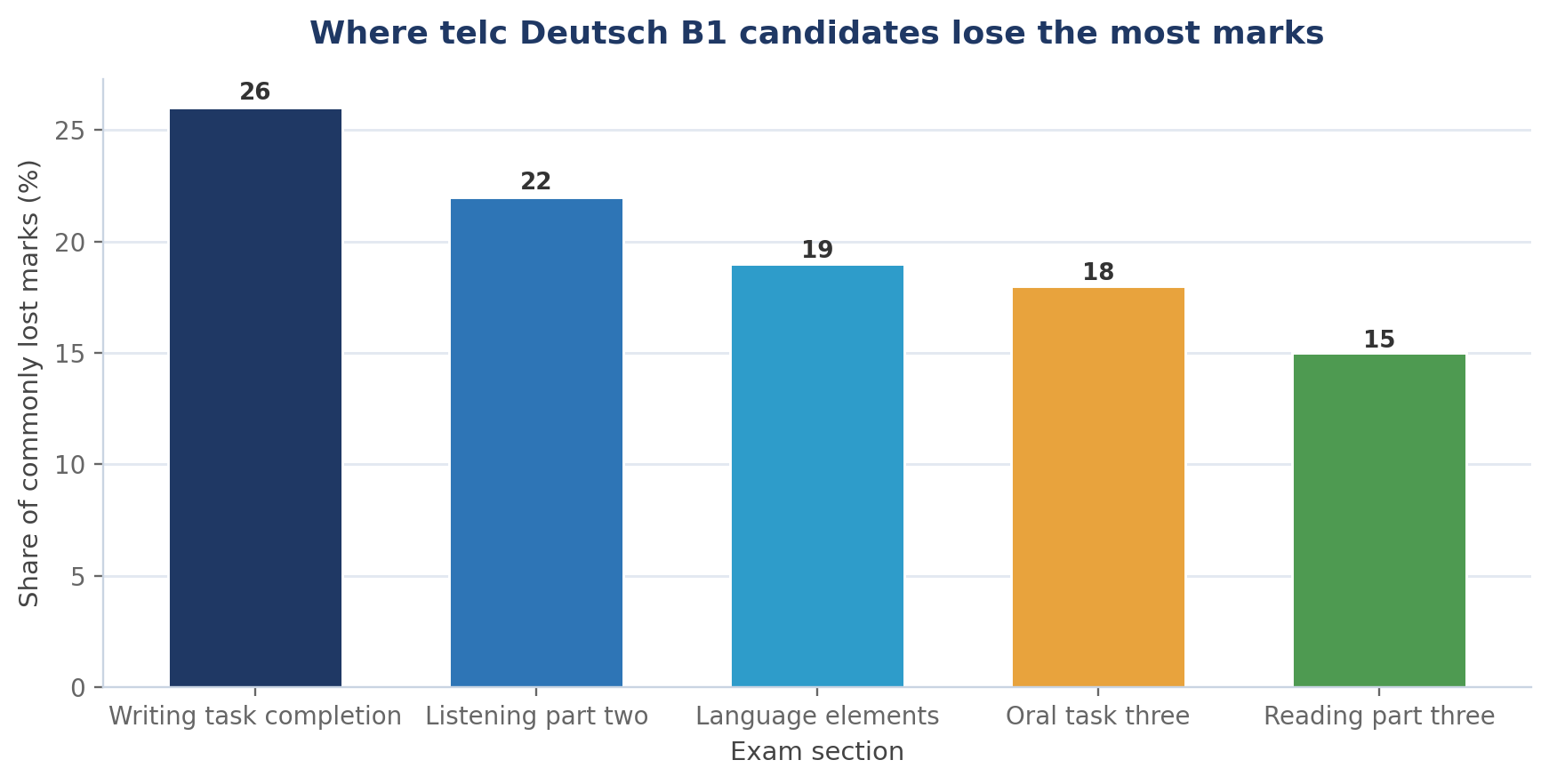
Most people who fail telc Deutsch B1 do not fail because their German is too weak. They fail because they walked in without knowing how the exam was built — how long each part lasts, what the examiner is trained to reward, and where the points actually sit.
That is a fixable problem. This is the map: the whole format, the whole scoring system, and the specific places candidates bleed marks they did not need to lose.
What this breakdown covers
- The full written and oral exam structure
- How writing is marked with a task-based rubric
- How the oral pair exam works, and your partner's role
- Pass marks, weighting and what a gut actually requires
- Where candidates most often lose easy points
The exam at a glance
Telc Deutsch B1 is made up of two halves — a written exam and an oral exam — and you must perform in both.
The written exam is normally taken first, with the oral examination either on the same day or a separate date, depending on the test centre.
The written exam, part by part
The writing task is the one candidates most often underprepare. It is a fixed situation — you are reorganising a meeting, apologising for a delay, inviting someone — and the marking rubric rewards three things: completeness of the task, communication, and accuracy.
How writing is actually marked
This is where the rubric matters more than the prose.
Two practical consequences. First: answer all the bullets, even briefly. Second: attempt complex structures rather than hiding in simple sentences — the rubric rewards range, and errors on ambitious grammar cost less than people fear.
The oral exam: a pair, not a duel
This is the part candidates fear most and understand least. You are examined in a pair with another candidate, often someone you have never met.
The third part is the one that surprises people. You are not being asked to present beautifully to the examiner — you are being asked to talk with your partner: react, ask, disagree politely, suggest. Examiners are trained to reward interaction, which means a candidate who talks only in monologue loses marks even with excellent German.
In the oral exam, your partner is not your competition. They are your instrument. Help them speak, and you both score higher.
Pass marks and grading
The independent-pass rule is the one that catches learners out. A brilliant oral performance will not rescue a failed written section. Both halves must clear the threshold, which is why balanced preparation beats playing to your strengths.
Always confirm current details and dates with telc gGmbH directly — regulations and test-centre arrangements can change.
Where candidates bleed easy points
Ready to turn reading into real German? Start your self-paced course today.
Start the German course →Create a free accountWalk in knowing exactly what they want
Self-paced German lessons with a personal AI voice tutor rehearse the real telc B1 task types — the letter, the presentation, the paired discussion — with structured lessons and speaking practice with AI feedback, at your own pace.
Button: Explore the German Course Pass →
A preparation plan that matches the scoring
Note the ordering. Writing gets six weeks because it is the most predictable, trainable part of the exam. Listening gets a daily habit because listening is a slow skill that cannot be rushed. Oral practice starts early enough that interaction becomes natural rather than rehearsed.
Free authentic listening is easy to find: Deutsche Welle's Deutsch lernen library and slow news broadcasts map closely to the exam's everyday topics.
Ready to turn reading into real German? Start your self-paced course today.
Start the German course →Create a free accountSit a mock before you sit the exam
A free languageskills.net account includes a level check and diagnostic practice, so you know whether your written or oral half needs the work before the real date arrives.
Button: Create your free account →
Telc B1 vs Goethe-Zertifikat B1
Both certificates certify B1 and both are widely recognised. The practical difference is the oral format — if speaking alongside a stranger makes you nervous, that is a reason to practise it, not necessarily to avoid it.
Frequently Asked Questions
What is the pass mark for telc Deutsch B1? You need 60% overall, and both the written and oral sections must be passed independently. Strong performance in one half cannot compensate for the other.
How long is the telc B1 oral exam? Around 15 minutes, taken with another candidate, covering an introduction, a short presentation and a discussion.
Is the writing task hard? It is the most predictable part of the exam. Address every bullet point in the prompt and use some varied structures, and you are already scoring well.
Can I use simple German and still pass? Yes, but range is rewarded. Aim for accurate simple sentences plus one or two more ambitious structures per paragraph.
References & Further Reading
- telc gGmbH — Official telc Deutsch B1 examination specifications and dates
- Goethe-Institut — German exams, levels and free practice materials
- Deutsche Welle — Deutsch lernen: free courses and listening practice
- Duden — Grammar and vocabulary reference
- Council of Europe — CEFR levels and descriptors