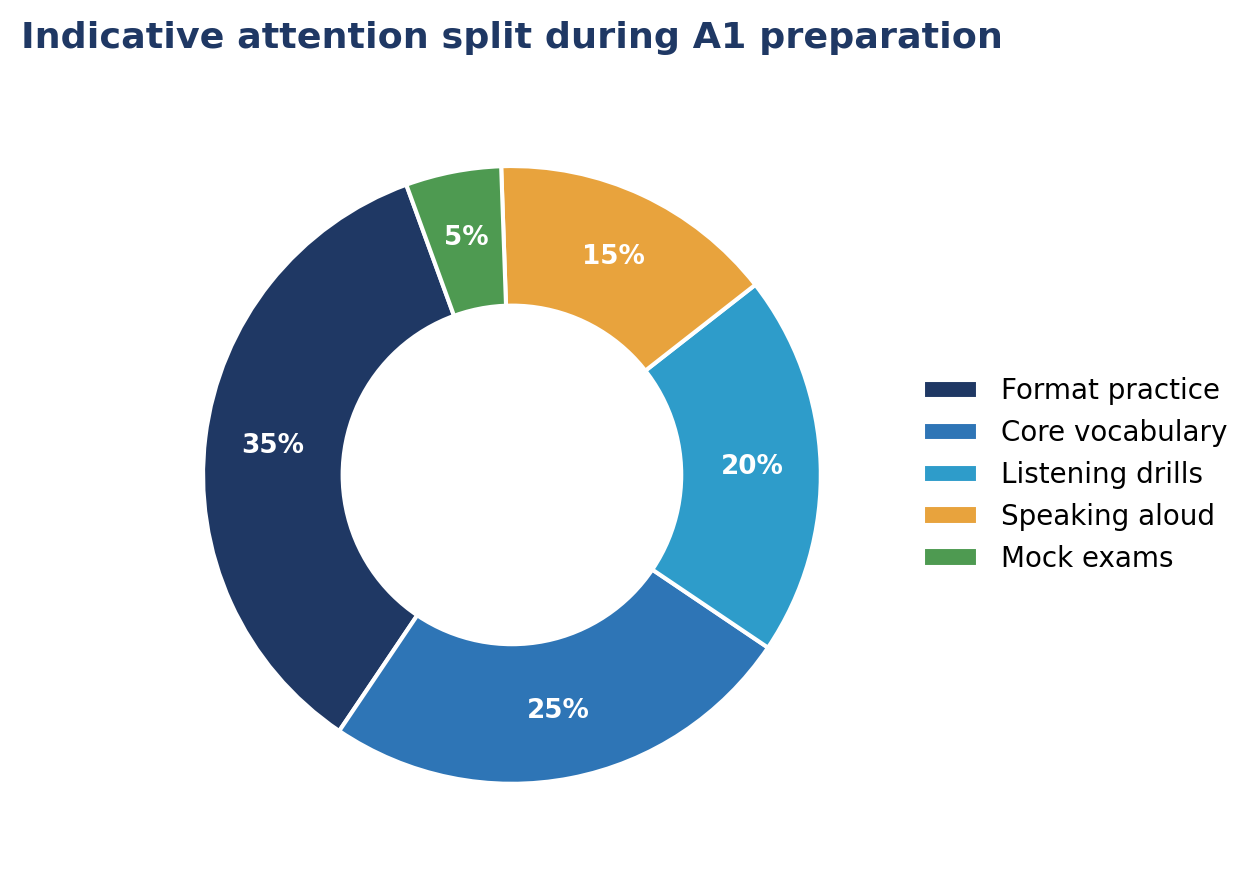
Roughly 80 per cent of Goethe-Zertifikat A1 candidates who fail do not fail because their German is weak. They fail because they never once sat the exam format before the real thing. Preparation is not extra study — it is a separate skill.
Here is how to prepare for Goethe-Zertifikat A1 with a plan instead of panic.
What you will get from this guide
- The exact module structure and timings of the A1 exam
- A four-week preparation schedule that fits around work
- The five scoring traps that quietly drain marks
- When to choose Goethe A1 over telc or ÖSD alternatives
What the Goethe-Zertifikat A1 Actually Tests
The A1 exam is also known as Start Deutsch 1. It certifies the very first CEFR band: you can introduce yourself, ask and answer simple questions about home, family, shopping and work, and handle short routine exchanges. It is commonly required for family reunification visas and as a first formal proof of German.
The exam has four modules, and here is the part people misjudge — at A1 levels the whole exam is usually taken in one sitting, with no module retakes.
Speaking is examined in pairs or small groups with two examiners. That surprises candidates who rehearsed alone in a bedroom.
The Pass Mark Nobody Mentions
Each module is scored as a percentage, and the exam is passed when the total reaches 60 per cent. That means one disastrous module can sometimes be rescued by three strong ones — but only if you know your own weak spot before you sit down.
A Four-Week Preparation Plan
Four weeks is enough if you already have A1-level German. If you are starting from zero, budget three to five months of study first, then come back to this plan.
The cold paper in week one is deliberately uncomfortable. It tells you the truth about your listening speed before you have invested a month.
Sitting alone with a PDF is how marks disappear
A1 speaking is examined live, in pairs, with a clock running. Practise it with an AI voice tutor that gives instant speaking feedback — and tells you exactly what to fix.
Prepare with AI speaking practice →Create a free accountFive Traps That Cost Easy Marks
- Writing too much. The A1 writing task asks for roughly 30 words. Triple that and you multiply your errors. Short and clean wins.
- Ignoring the form section. Filling in a form is marked, and it is the most learnable task in the entire exam.
- Freezing in speaking. Exam-ready candidates memorise three repair phrases: Wie bitte?, Können Sie das wiederholen?, Einen Moment, bitte.
- Skipping the audio pre-read. You get a moment before each listening item. Use it to predict what you are listening for.
- Never timing yourself. A1 modules are short. Twenty-five minutes for reading punishes anyone who dawdles.
Choosing Your Exam
Goethe-Zertifikat A1 is not the only door. Pick deliberately.
Book the exam, then build your plan
The paper is predictable. Your preparation should be too. Get a placement check and a self-paced plan built around your exam date.
Start your A1 prep →Create a free accountFrequently Asked Questions
How long does it take to prepare for Goethe-Zertifikat A1? From a solid A1 course, four to six weeks of focused format practice is usually enough. From absolute zero, expect roughly 80 to 100 guided study hours before you are exam-ready.
What score do I need to pass? You need 60 per cent overall across the four modules. Each module is weighted as a percentage of the total, so a strong reading and writing score can offset weaker listening.
Can I retake just one module at A1? At the A1 level, the exam is generally taken as a whole and retaken as a whole. Modular retakes become standard at higher levels such as B1 and B2.
Is Goethe A1 accepted for a German visa? Start Deutsch 1 is widely accepted as basic German proof for family reunification applications. Always confirm the current requirement with the relevant German embassy or consulate before booking, as rules are updated periodically.
References & Further Reading
- Goethe-Institut — Goethe-Zertifikat A1: Start Deutsch 1, exam details and model sets: https://www.goethe.de/en/spr/kup/prf/prf/sd1.html
- Goethe-Institut — Practice materials and exam regulations: https://www.goethe.de
- telc gGmbH — telc Deutsch A1: https://www.telc.net
- ÖSD — Austrian Language Diploma exams: https://www.osd.at
- Council of Europe — CEFR A1 descriptors: https://www.coe.int/en/web/common-european-framework-reference-languages