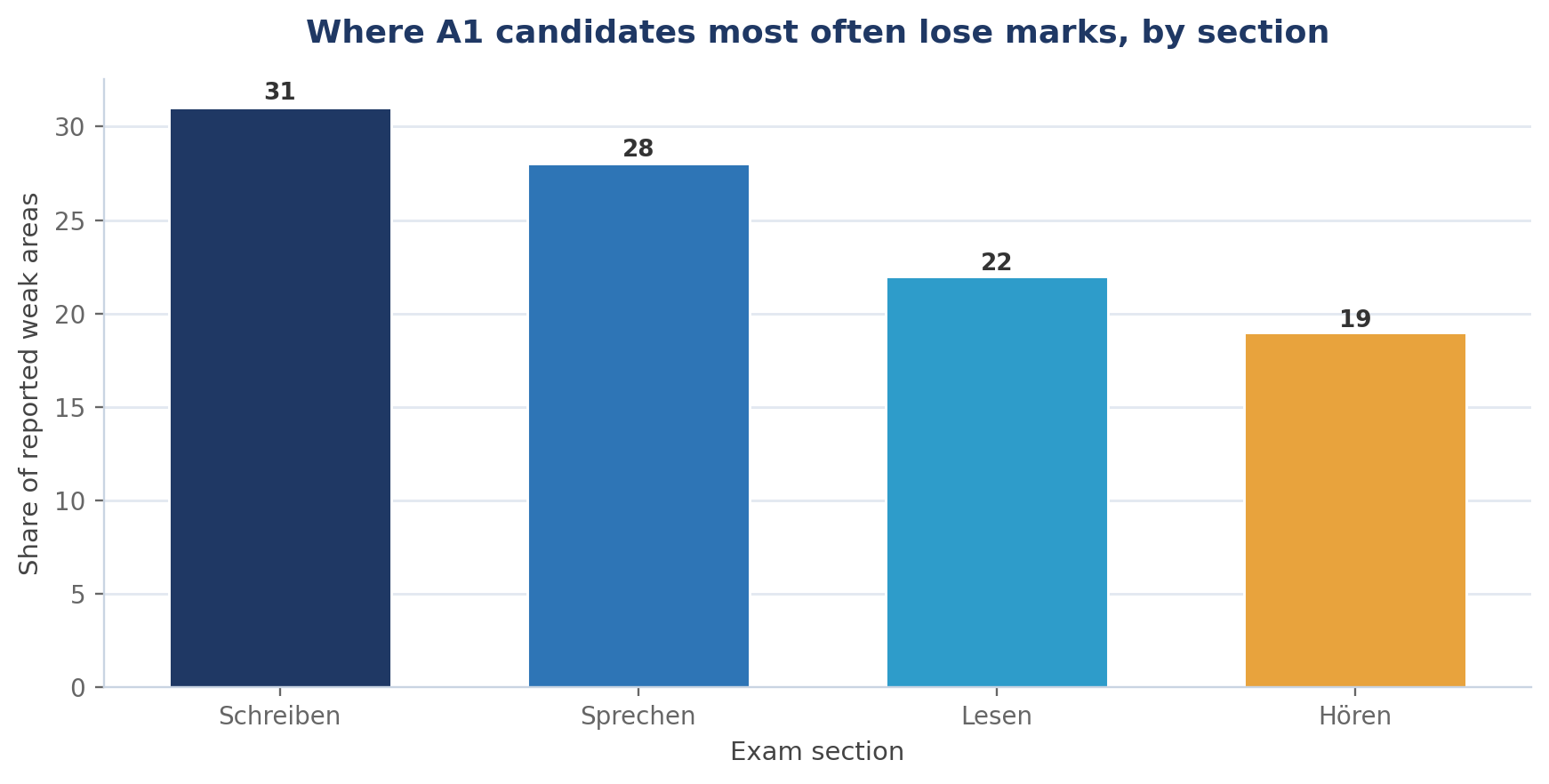
Most people who fail the Goethe-Zertifikat A1 do not fail because their German is weak. They fail because they ran out of time in the reading section, wrote a postcard without a greeting, or answered a speaking prompt with one word. The exam is a game with rules, and the rules are learnable.
What you will get from this guide
- How the A1 exam is scored, plainly
- The timing mistakes that sink candidates most often
- The exact writing and speaking habits that lose free marks
- A two-week preparation routine that fits around work
How the Exam Is Actually Scored
The Goethe-Zertifikat A1 — also known as Start Deutsch 1 — tests four skills. Each is worth 25 points, 100 in total, and the pass mark is 60 points. That is the single most useful number in your preparation, because it means a disaster in one section is survivable.
Scaled scores and pass requirements are set by the exam provider, and the format is published in the Goethe-Institut's official A1 examination guidelines — always check the current version before your test date.
The Timing Mistakes
The exam is short and the sections are short. Reading runs roughly 25 minutes across three parts; listening about 20 minutes, often played once; writing about 20 minutes; speaking about 15 minutes. These are tight windows and the most common failure pattern is spending eleven minutes on one difficult reading notice.
The Writing Section: Free Marks You Are Leaving on the Table
The A1 writing task asks for a short message — a postcard, an email, a note — covering a small set of given content points. The examiner is checking three things: did you cover the points, is the language comprehensible, and is the format appropriate.
The Speaking Section: Short Answers Are the Trap
This is where confident candidates stumble. The speaking part usually runs in a small group, and it asks you to introduce yourself, ask and answer questions, and make a request or respond to one. A one-word answer is technically not wrong. It is also nearly untestable, so it earns almost nothing.
One practical gift: you are allowed to be simple. Ich heiße Ana. Ich komme aus Brasilien. Ich lerne Deutsch. That is a full-mark introduction. Nobody is waiting for philosophy.
The Listening Trap Nobody Warns You About
A1 listening is often played once, and the speakers speak at natural speed with normal accents. Candidates who try to translate every word into English fall behind in the first ten seconds and never catch up.
Train differently. Listen for the shape of the question — is it asking where, when, how much, who? Then hunt only for that piece of information. Numbers, times and days are the most commonly tested items, and they are also the easiest to train with audio drills.
The fastest way to stop making these mistakes is to have them named
Reading a list helps. Having an AI voice tutor listen to your A1 speaking and say "you just answered in one word again" changes everything. Self-paced German lessons with instant AI feedback turn each of these traps into a habit you never form.
Browse German courses →Create a free accountGrammar Errors That Cost Marks at A1
At A1 you are not expected to be accurate in complex structures. You are expected to control a small set well.
That last one is free marks and purely mechanical. Every German noun is capitalised. Practise until your hand does it without your brain.
A Two-Week Preparation Routine
Do not learn new grammar in the last three days. Consolidate what you have and rehearse formats. Exam performance is a skill separate from language ability, and it is the one most candidates neglect until it is too late.
Walk in knowing exactly what the exam will do to you
You know the scoring, the timing traps and the format mistakes. What remains is repetition with feedback. A self-paced German course gives you structured lessons and speaking practice with an AI voice tutor — the difference between hoping and being ready.
Create your free account →Create a free accountFrequently Asked Questions
What score do I need to pass the Goethe-Zertifikat A1? The four sections are worth 25 points each, 100 in total, and the pass mark is 60 points. A weaker section can be offset by stronger ones, so never abandon a paper you think went badly.
Is the A1 listening section played once or twice? Most A1 listening items are played once, in line with the exam's everyday-communication design. Train with single-play audio from the start rather than pausing and repeating.
Can I take the four sections separately? At A1 the exam is generally taken as a single sitting covering all four skills. Modular booking becomes more common at higher levels such as B1 and above, so confirm the current rules with the centre you book with.
How long should I prepare for Goethe A1? Most learners arrive at A1 with roughly 80 to 200 guided hours of German behind them. If you are exam-ready in level terms, two to three weeks of format-focused practice is usually enough to convert that into a pass.
References & Further Reading
- Goethe-Institut. Goethe-Zertifikat A1: Start Deutsch 1 — examination guidelines and model papers, goethe.de.
- Goethe-Institut. Practice materials and A1 exam training sets, goethe.de.
- telc gGmbH. Comparable A1 level descriptions and test specifications, telc.net.
- Council of Europe. Common European Framework of Reference for Languages: Companion Volume, 2020.
- Deutsche Welle. Nicos Weg A1 course for everyday listening and speaking practice, dw.com.