The B2 oral exam is only about fifteen minutes long, and that is exactly why it feels so terrifying. There is no time to warm up, no time to hide behind a grammar table, and no time to think in English first and translate afterwards. You walk in, you speak German, and you walk out. The good news? Those fifteen minutes reward preparation far more than talent. Candidates who know the structure, hold a small toolkit of Redemittel, and have rehearsed out loud three or four times routinely outperform people with bigger vocabularies — because the exam measures performance, not potential.
This guide breaks the whole thing down: what happens, what examiners listen for, sample answers you can adapt, and the mistakes that quietly cost points.
What Actually Happens in the B2 Oral Exam
The Goethe-Zertifikat B2 speaking paper has two parts and is usually taken with a partner, though a solo format exists at some exam centres. You get roughly fifteen minutes of preparation time beforehand with a task sheet, and you may make notes — but you may not read them aloud word for word.
Examiners score four criteria, each weighted equally: Erfüllung (task completion), Kohärenz (cohesion and structure), Wortschatz (range and precision of vocabulary) and Strukturen (grammatical accuracy and complexity). Notice that two of the four have nothing to do with grammar drills. Structure and word choice carry you.
Teil 1: The Presentation (Präsentation)
You receive a topic and a mind map with a handful of bullet points. Your job is to turn those bullets into a short, structured talk. The safest skeleton is a five-move arc, and it works for almost any topic.
Sample opening at full speed: "Ich möchte heute über das Thema ‚Homeoffice' sprechen. Ich habe mich dafür entschieden, weil ich selbst zwei Tage pro Woche von zu Hause arbeite. Zuerst erzähle ich von meinen eigenen Erfahrungen, danach beschreibe ich die Situation in meinem Land, und zum Schluss nenne ich Vor- und Nachteile."
That single sentence already ticks the structure box. Learn three or four of these frames and you will never open with silence again.
Turn fifteen nervous minutes into your easiest points
Our German course drills the exact presentation frames, Redemittel and pronunciation habits that B2 examiners reward. Stop guessing what sounds right — rehearse it with AI feedback until it is automatic.
Start Speaking German with Confidence →Create a free accountTeil 2: The Discussion (Diskussion)
Teil 2 is where shy candidates lose points they deserve. You do not need to win the argument. You need to interact: react to your partner, ask a follow-up question, disagree politely, and offer a compromise.
The trick is volume of turns, not length of turns. Five short, reactive contributions beat one three-minute monologue. If your partner is dominating, interrupt politely: "Darf ich kurz etwas dazu sagen?"
Sample Answers You Can Steal and Adapt
Take the discussion prompt "Sollen Handys in der Schule verboten werden?" A strong B2 response sounds like a real person thinking aloud:
"Auf der einen Seite kann ich verstehen, warum viele Schulen Handys verbieten wollen. Sie lenken im Unterricht ab, und Studien zeigen, dass Konzentration darunter leidet — wobei ich hier vorsichtig sein muss, denn die Zahlen sind oft unterschiedlich interpretiert. Auf der anderen Seite sind Handys auch ein Werkzeug: Wörterbücher, Recherche, Lern-Apps. Meiner Meinung nach wäre ein Kompromiss sinnvoller: Handys während des Unterrichts weg, in den Pausen erlaubt. Wie siehst du das?"
Notice the hedging — "ich muss hier vorsichtig sein" — which examiners love, because it signals you know the difference between fact and opinion. Never invent statistics as if they were confirmed; attribute them honestly ("ich habe gelesen, dass…", "laut einer Umfrage, an die ich mich erinnere…").
The Redemittel That Make You Sound B2
B2 is less about exotic vocabulary and more about connectors. Learn these in sets, and use them at least twice each in the exam.
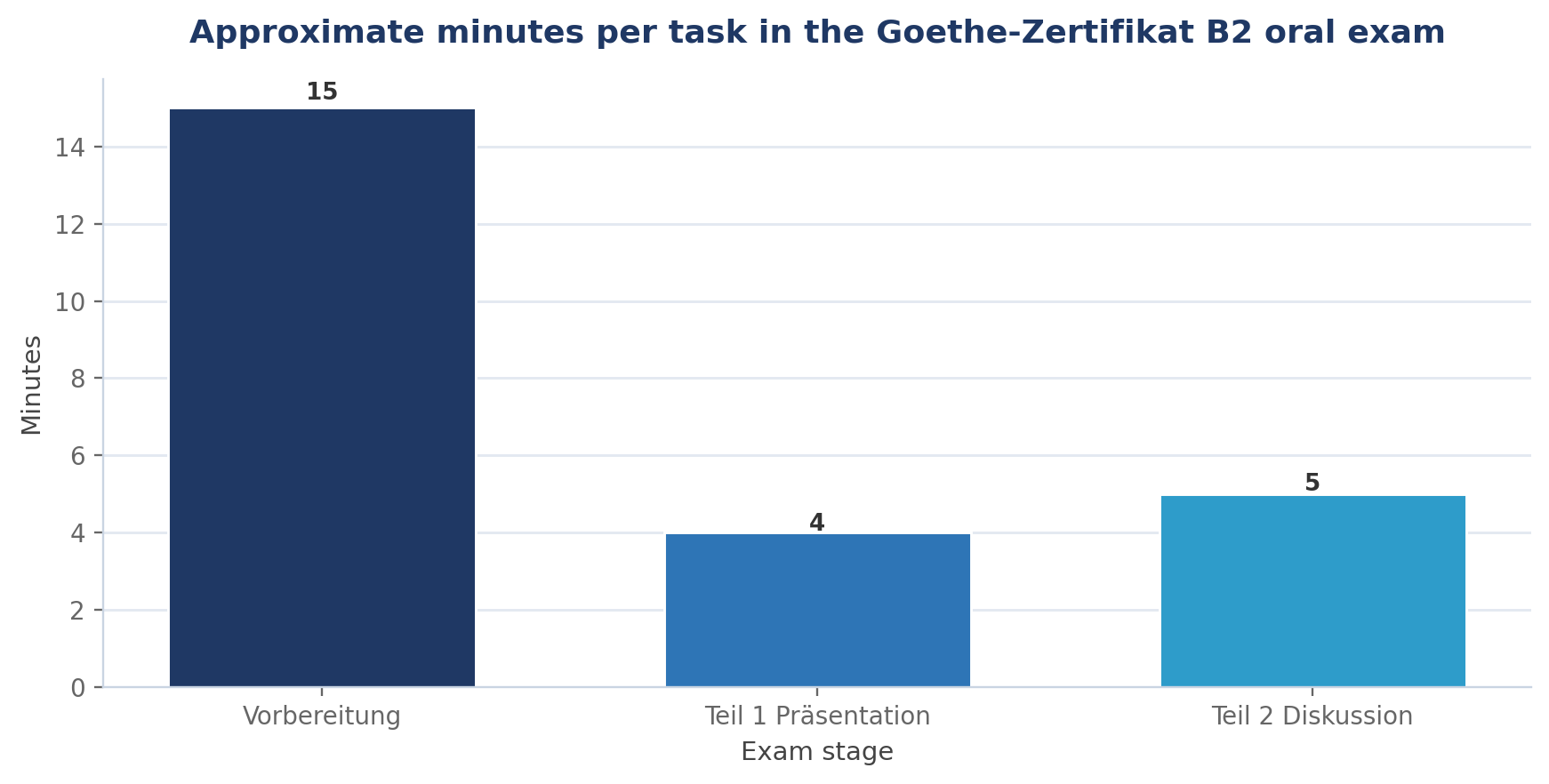
Estimated exam timings above follow the published Goethe-Institut format; treat them as approximate, since individual exam centres and examiners vary slightly in pacing.
Common Mistakes and Instant Fixes
A Four-Week Practice Plan
You do not need months. You need repetitions that actually mimic exam pressure.
Recording is non-negotiable. Most learners are shocked by how many sentences they restart. Fixing that single habit can lift a borderline result. If you want structure, accountability and an AI tutor that corrects you in real time, create your free account and put the plan on a calendar.
The rhythm to aim for is simple, and you can see it at a glance:
Frequently Asked Questions
How long is the Goethe-Zertifikat B2 speaking exam? About fifteen minutes of actual examining, plus roughly fifteen minutes of preparation time. Teil 1 lasts around four minutes and Teil 2 around five, with the remainder used for instructions and greetings.
Can I choose my own topic for the presentation? No. You receive a topic with a mind map on the task sheet, and you must work from it. You can, however, shape it with personal experience, which is exactly what examiners want to hear.
What happens if my partner is much stronger or weaker than me? Examiners grade you individually, so a weak partner cannot drag you down — but a silent one can, because Teil 2 needs interaction. Ask questions, react, and keep the conversation alive on your side.
Is a B2 speaking certificate really worth the effort? For work, university admission and permanent-residence pathways in Germany, yes — B2 is the threshold most institutions name. Confirm the exact requirement with the institution you are applying to before booking.
References & Further Reading
- Goethe-Institut: Goethe-Zertifikat B2
- Goethe-Institut: Übungsmaterialien zum Goethe-Zertifikat B2
- Council of Europe: Common European Framework of Reference for Languages
- DW Learn German: free courses and placement
- Goethe-Institut: Prüfungsvorbereitung
Walk in knowing exactly what you will say
Our German course pairs AI feedback with exam-style speaking drills, so your first real B2 presentation is a rehearsal — not a surprise. Join learners who turned B2 nerves into confident speaking.
Get Your German Course Pass →Create a free account