Candidates rarely fail Goethe-Zertifikat B2 because their German is too weak. They fail because of a handful of repeatable errors that quietly drain marks across four modules: an under-developed bullet point, a formal letter written in an informal register, a speech delivered at a partner instead of with one.
These are procedural mistakes, and procedural mistakes are the cheapest kind to fix.
What you will get from this guide
- The mistakes that cost the most marks, module by module
- The B2-level grammar errors examiners notice most
- Writing and speaking habits to build before exam day
- A short self-check to run on your practice tasks
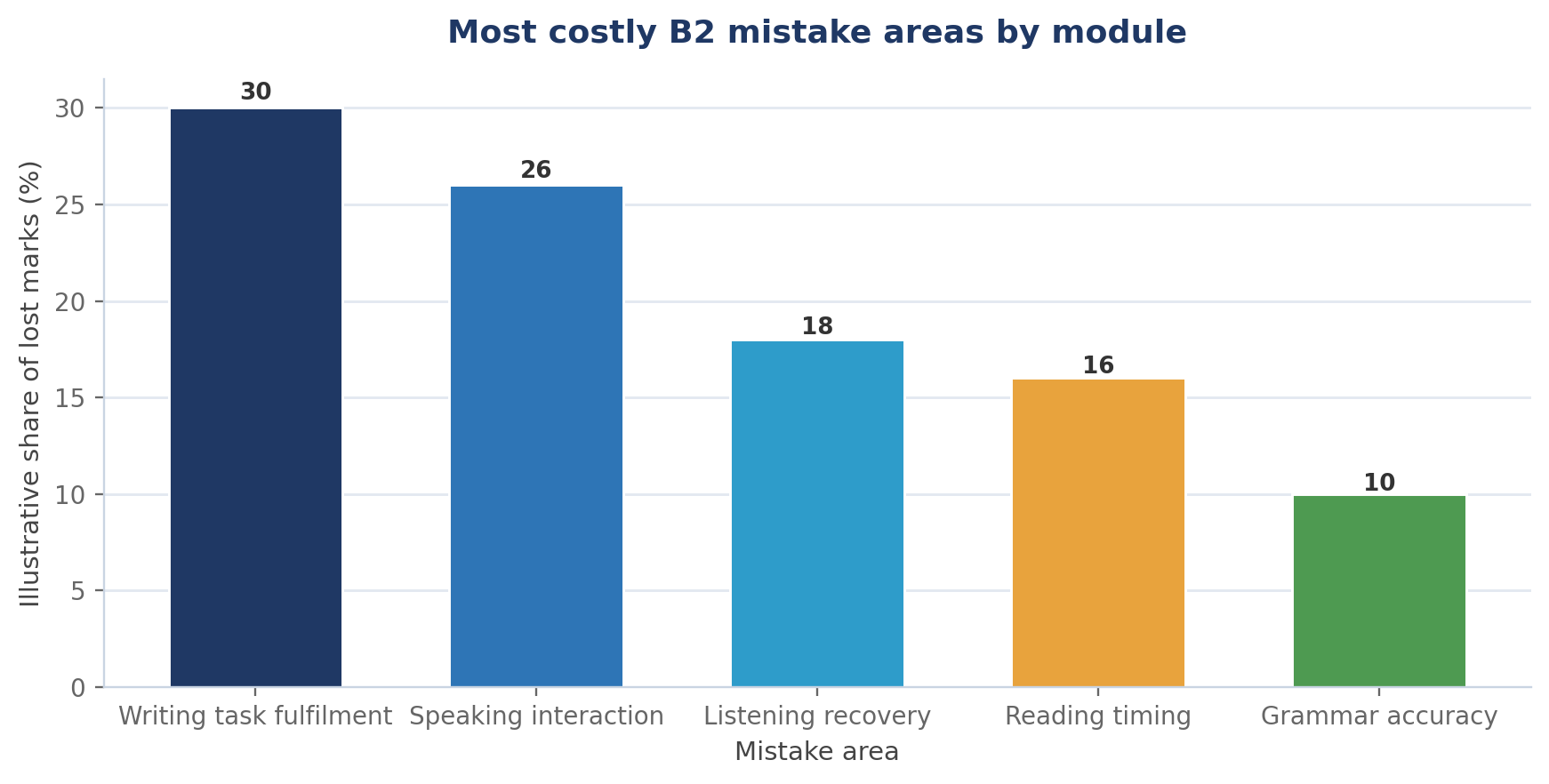
Where candidates actually lose marks
Notice how few of these are grammatical. That is the point.
Writing mistakes in detail
The highest-return habit in the whole exam: underline every bullet point in the task before you write a single word, then tick each one off afterwards. Candidates who do this almost never lose task-fulfilment marks.
Speaking mistakes that are entirely avoidable
B2 speaking is scored on interaction as well as language. A candidate who speaks fluent German at a partner is losing marks that a less fluent candidate who genuinely discusses will collect.
Grammar errors examiners notice at B2
At B2, examiners are not hunting for errors. They are assessing whether your control is reliable enough for professional use — which means recurring patterns matter far more than isolated slips.
Find out which of these mistakes are yours
Self-marking hides register errors, because they sound natural to you. A personal AI voice tutor gives you structured feedback on your writing against the real criteria and tells you exactly which bullet you under-developed.
Get B2 feedback from a tutor →Create a free accountListening and reading: technique errors
Both modules are as much about pacing as language. Candidates who practise with a timer improve more than candidates who study more vocabulary.
Building the habits before exam day
Marked writing in week two is the single most valuable item on that table. It converts a vague sense of "I should be better at this" into a specific, correctable list.
Rehearse the exam, not just the language
Self-paced B2 practice gives you timed tasks, AI feedback on your speaking, and structured lessons — the three things that decide whether a strong candidate passes comfortably.
Book B2 exam preparation →Create a free accountFrequently Asked Questions
What is the most common reason candidates fail Goethe-Zertifikat B2? Under-developed writing tasks and weak interaction in the speaking module. Both are procedural and fixable with marked practice.
Do grammar mistakes fail me at B2? Isolated errors do not. Recurring patterns that affect clarity — verb position, case, adjective endings — reduce your accuracy score.
How should I practise listening for B2? Daily native-speed audio without subtitles, plus timed practice where you deliberately skip an item and continue. Recovery is a skill.
How many practice exercises should I do? Two or three timed papers in the final month, plus one untimed diagnostic earlier. Volume beyond that has diminishing returns compared with marked feedback.
References & Further Reading
- Goethe-Institut — Goethe-Zertifikat B2: format and sample papers
- Goethe-Institut — Exam regulations (Prüfungsordnung)
- Council of Europe — CEFR B2 level descriptors
- Deutsche Welle — Free CEFR-aligned German courses
- Duden — Reference for German grammar and usage