The Goethe-Zertifikat A1 is the most widely accepted beginner German certificate in the world. It is also the one exam where preparation strategy matters more than raw ability — because A1 tests a small, finite syllabus, and every question on the paper comes from it.
Miss the strategy and you can be a genuinely capable beginner who still fails. Learn the strategy and you can walk in prepared, calm, and walk out with the certificate. Here is the complete playbook.
What the Goethe-Zertifikat A1 Actually Is
Start Deutsch 1 is the A1 examination of the Goethe-Institut. It certifies that you can handle very simple everyday situations in German: introducing yourself, asking and answering basic questions, and managing routine transactions. It is recognised worldwide and is explicitly acceptable for several German visa and family-reunification purposes.
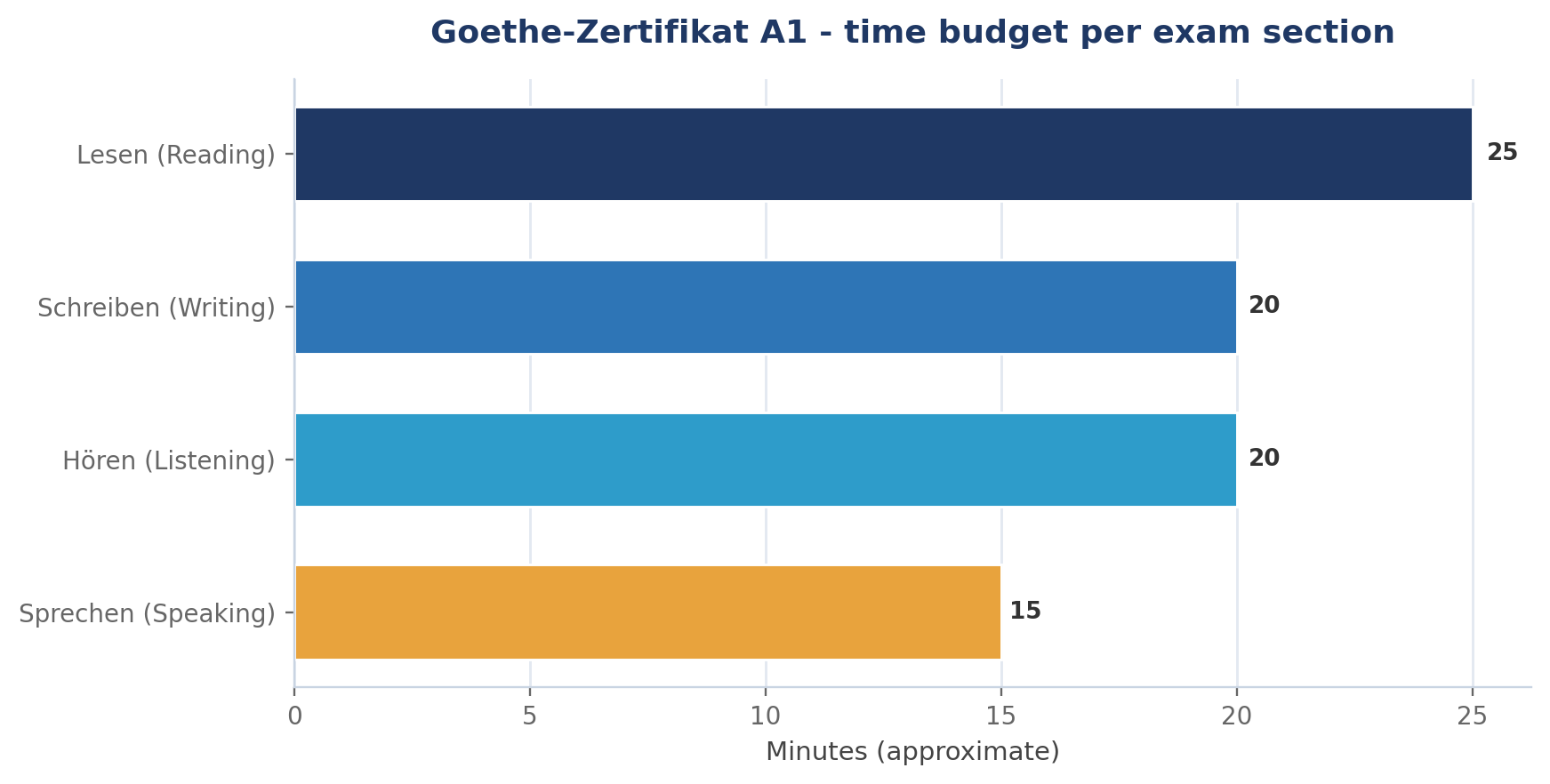
Notice how tight the timing is. You have roughly one minute per reading item. Candidates who fail rarely fail on knowledge — they fail on pacing.
The pass mark in one line
You need 60 out of 100 points to pass, with all four skills assessed. That means you can be weak in one section and still pass — but you cannot ignore two.
What Goethe A1 Actually Tests (And What It Doesn't)
Beginners over-prepare the wrong things. Here is the honest boundary.
Every hour spent on B1-level grammar for an A1 exam is an hour stolen from listening practice. Stay inside the syllabus.
Hören (Listening): The Section Most Candidates Underestimate
Listening is where unprepared candidates lose the most marks, because the audio plays at a pace you do not control.
The strategy:
- Read the answer options before the audio starts. You get a quiet moment — use every second of it.
- Listen for numbers, names, times and places. A1 listening questions overwhelmingly ask for concrete details.
- Expect distractors. If the speaker says a time and then corrects it, the second time is the answer.
- Do not panic when you miss one. Audio does not rewind; a stuck candidate loses the next three items.
- Practise with Deutsche Welle's Langsam gesprochene Nachrichten and A1 dialogue audio daily — but also practise at full native speed once a week so nothing surprises you.
Lesen (Reading): Speed Is the Whole Skill
Reading at A1 is not about comprehension depth. It is a scanning exercise.
The strategy:
- Train the "sign-reading" reflex. A1 texts include notices, labels, timetables and short ads, and the question usually asks where would you see this? — not what it means in detail.
- Underline the keyword in the question before reading the text.
- Do the easy items first and circle back. Every A1 paper has three or four gifts; bank them.
- Watch for the two classic traps: nicht and kein. Negation flips meaning and is the single most common source of careless errors.
Schreiben (Writing): Two Tasks, Both Highly Predictable
The writing section has two parts — filling in a form with personal details and writing a short message of roughly 30 words on a given everyday topic.
The strategy:
- Memorise the form vocabulary in advance: Name, Vorname, Geburtsdatum, Geburtsort, Staatsangehörigkeit, Adresse, Telefonnummer, Unterschrift. These are free marks.
- Use a fixed message template and adapt the details. A reliable shape: greeting → reason for writing → one or two details → closing.
A model answer worth copying:
Liebe Anna, ich kann am Samstag nicht kommen. Ich muss arbeiten. Können wir uns am Sonntag um 15 Uhr treffen? Viele Grüße, Ravi
That is roughly 25 words, uses only A1 grammar, includes a reason, a question and a correct closing. It would score well. Build three or four such templates and you can handle almost any prompt.
Get your writing corrected before the examiner sees it
Grammar that looks fine to you can cost you marks an AI tutor would spot in five seconds. On the LanguageSkills.net German A1 track, every message you write is corrected by an AI voice tutor with annotated feedback, plus you can practice with guided lessons and speaking practice.
Prepare for Goethe A1 with an AI tutor →Create a free accountSprechen (Speaking): Three Parts, All Scripted
The speaking section is conducted with a partner and has three parts: introduce yourself, ask and answer questions using given keywords, and make and respond to requests.
The strategy:
- Prepare your introduction as a polished 60-second script — name, age, country, city, job, languages, hobby. Rehearse it until it is automatic, because it directly earns marks.
- Learn the question words cold: Wer? Was? Wo? Wann? Wie? Warum? Woher? Wohin? Part two is built entirely on them.
- Memorise the polite request patterns: Kannst du…? Können Sie…? Ich möchte…, bitte. Part three rewards them.
- Speak slowly and clearly. Examiners are assessing control, not speed. A calm, simple sentence beats a rushed, broken one.
- If your partner stumbles, help them. Cooperative candidates consistently perform better than competitive ones.
Scoring: Where the Marks Really Come From
The pattern across all four is the same: A1 rewards communication, not sophistication. A simple sentence that answers the question always outscores an ambitious sentence that doesn't.
A Six-Week Goethe A1 Prep Plan
The error log is the unglamorous hero of this plan. Every mistake you make goes into one notebook with the reason. By week six you will see your pattern — and patterns can be fixed.
Sit the real exam having already passed it twice
Our German A1 course includes guided lessons, speaking practice with AI feedback, listening practice, and printable study materials. Learners who complete the full course pass on the first attempt far more often than those who only self-study.
Book your Goethe A1 prep course →Create a free accountFrequently Asked Questions
What score do I need to pass Goethe-Zertifikat A1? You need 60% overall — 60 out of 100 points. All four skills are assessed, and some visa categories specify a minimum requirement, so confirm your own requirement before booking.
How long should I prepare for Goethe A1? If you already have around 80–100 guided hours of German, four to six weeks of focused exam preparation is usually enough. Starting from zero, expect about three months of study before the exam.
Is Goethe A1 hard? The content is easy; the format is not. Almost everything that trips candidates up is exam technique — timing, listening once-only audio, and written task requirements.
Can I take Goethe A1 online? The Goethe-Institut offers selected exams in digital form, and availability varies by country. Many candidates abroad sit the paper-based version at a licensed centre.
Does Goethe A1 expire? No. Goethe-Zertifikat certificates do not carry an expiry date.
Is Goethe A1 enough for a German visa? It is accepted for certain categories, including some family-reunification routes. For skilled-worker and study visas, expect requirements of B1 or B2, and check the current rules for your specific case.
The Takeaway
Goethe-Zertifikat A1 is a small, tightly bounded exam. Everything it tests is learnable, and everything it asks is predictable. The candidates who pass are not the most talented — they are the ones who knew the format, practised under time pressure, and got their writing corrected by someone qualified.
That last part is the one most people skip, and it is the one that changes the result.
Pass Goethe A1 on the first attempt
Self-paced AI voice tutor, speaking practice with AI feedback, listening practice, and printable study materials — the complete German A1 exam package, from one place.
Get your German A1 Course Pass →Create a free accountReferences & Further Reading
- Goethe-Institut, Start Deutsch 1 — examination regulations and Modellsatz practice materials
- Goethe-Institut, Wortliste for A1 — prescribed vocabulary list
- Council of Europe, CEFR Companion Volume (2020) — A1 descriptors
- telc gGmbH, telc Deutsch A1 specifications — for comparison of exam formats
- Bundesamt für Migration und Flüchtlinge (BAMF), language certificate guidance
- Deutsche Welle, Deutsch lernen — Nicos Weg A1 listening and reading practice