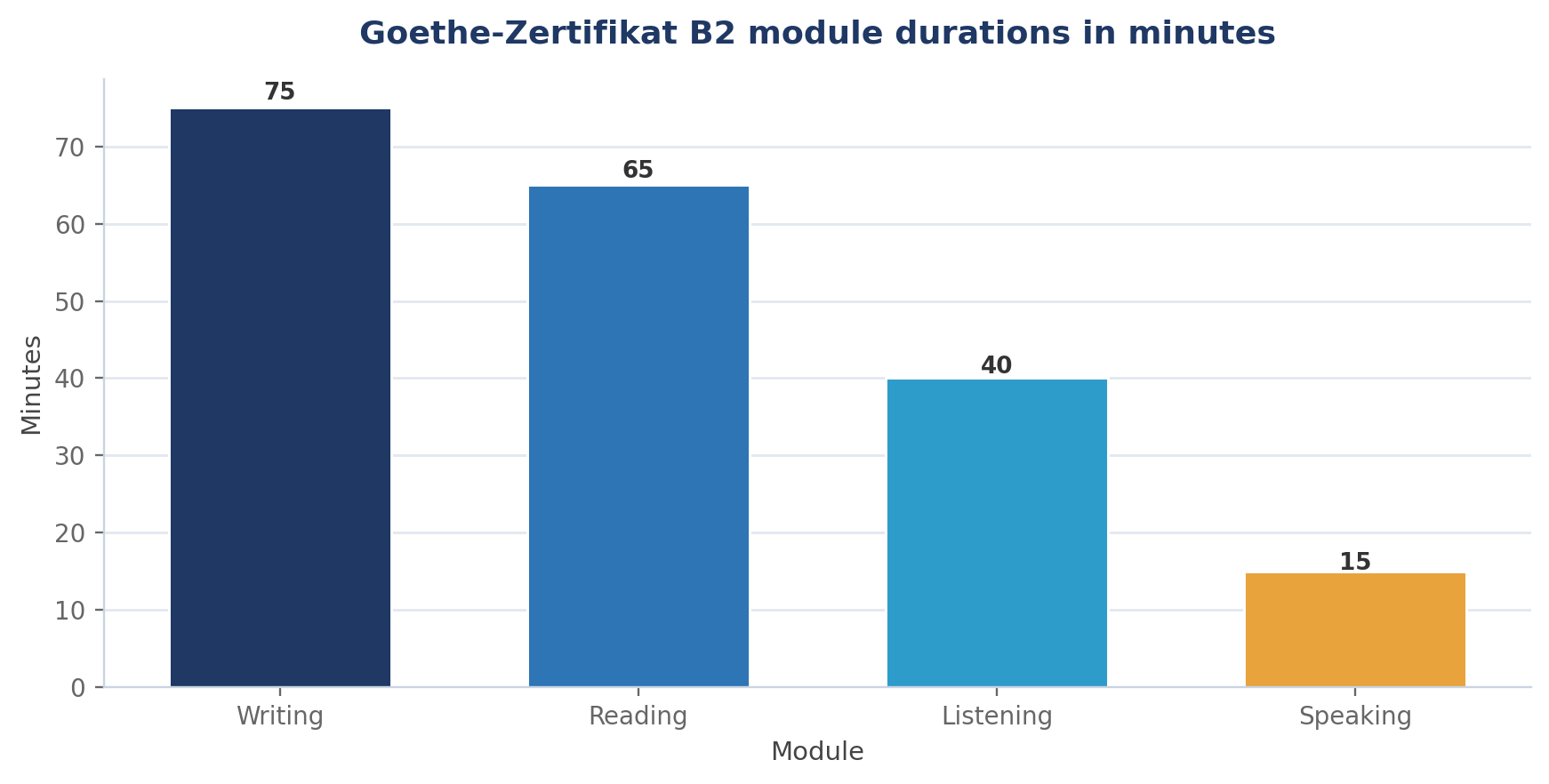
Most candidates walk into Goethe-Zertifikat B2 knowing they need to be good at German. Far fewer know how the exam is actually built — how many items in each module, how many points each is worth, and where a single careless answer costs the most.
That gap is expensive. This guide lays out the format and the scoring mechanics so you can prepare for the exam that exists, rather than the one you imagined.
What you will get from this guide
- The four modules, with timings and task types
- How marks and points are awarded in each module
- What you need to pass, and how to protect a weak module
- Where candidates most often leave points on the table
The structure at a glance
Goethe-Zertifikat B2 has four modules, normally taken in one sitting. Each module is scored out of 100 points, giving a maximum total of 300.
To pass, you need at least 60% overall. Most exam centres also advise candidates to be comfortably above 60% in every module, because a single weak module drags the total down quickly. Scoring rules are set by Goethe-Institut and can be updated — always confirm the current Prüfungsordnung when you register.
How reading is scored
Reading rewards precision, not enthusiasm. Five parts move from short notices to longer opinion texts, and most items are multiple choice or matching.
The most common reading failure is time, not comprehension. Candidates who read the passage like a novel run out of minutes in the final part — which is usually the most generous part of the paper.
How listening is scored
Listening is played at natural speed, and some texts are heard only once. That changes the strategy completely.
How writing is scored
Writing carries 100 points split across task fulfilment and language. Candidates obsess over grammar and neglect the first category — a costly mistake, because missing a bullet point is one of the heaviest deductions in the whole exam.
Build a personal connector kit — zunächst, darüber hinaus, im Gegensatz dazu, abschließend — and use it deliberately. It raises coherence and range marks at the same time.
Get your B2 writing scored the way examiners actually score it
A personal AI voice tutor gives you structured feedback on your letters against the real criteria and shows you which bullet point you under-developed. That single piece of feedback is usually worth more than another practice paper.
Start B2 exam preparation →Create a free accountHow speaking is scored
The oral module is usually taken in pairs, and it is scored on both language and interaction. Candidates who memorise a speech and ignore their partner lose marks they never see coming.
Two minutes of genuine back-and-forth outperforms five minutes of flawless monologue every time.
Protecting a weak module
The strategic point is simple: 60% overall means you do not need to be excellent everywhere. Identify your strongest module, bank it, and spend the last three weeks propping up the weakest one.
Scoring myths worth discarding
Myth: you must be error-free. Reality: examiners expect errors at B2; they penalise patterns, not one-offs.
Myth: more words mean more marks. Reality: over-long writing eats the time you need for checking.
Myth: a native accent is required. Reality: clarity and consistency are what is scored.
Myth: one bad module fails you. Reality: check the current rules and talk to your centre — scoring is a total, not four separate verdicts.
Prepare for the format, not just the language
Knowing exactly how each module is scored changes how you practise. Self-paced B2 lessons with an AI voice tutor turn vague effort into targeted preparation.
Book B2 exam preparation →Create a free accountFrequently Asked Questions
How many points is Goethe-Zertifikat B2 out of? Each of the four modules is worth up to 100 points, for a maximum total of 300.
What is the pass mark for Goethe-Zertifikat B2? You need at least 60% overall. Confirm the current scoring rules with your exam centre, as Goethe-Institut updates regulations periodically.
How long is the whole exam? Plan for roughly three and a half hours including the written modules and a short break. Some centres schedule the oral on a separate day.
Can I take the modules separately? Goethe-Institut allows candidates to repeat individual modules under conditions set by the exam centre — check the current rules when registering.
References & Further Reading
- Goethe-Institut — Goethe-Zertifikat B2: format and sample papers
- Goethe-Institut — Exam regulations (Prüfungsordnung) and updates
- Council of Europe — CEFR B2 descriptors
- Deutsche Welle — Free CEFR-aligned German courses
- telc — Comparison of German B2 examinations