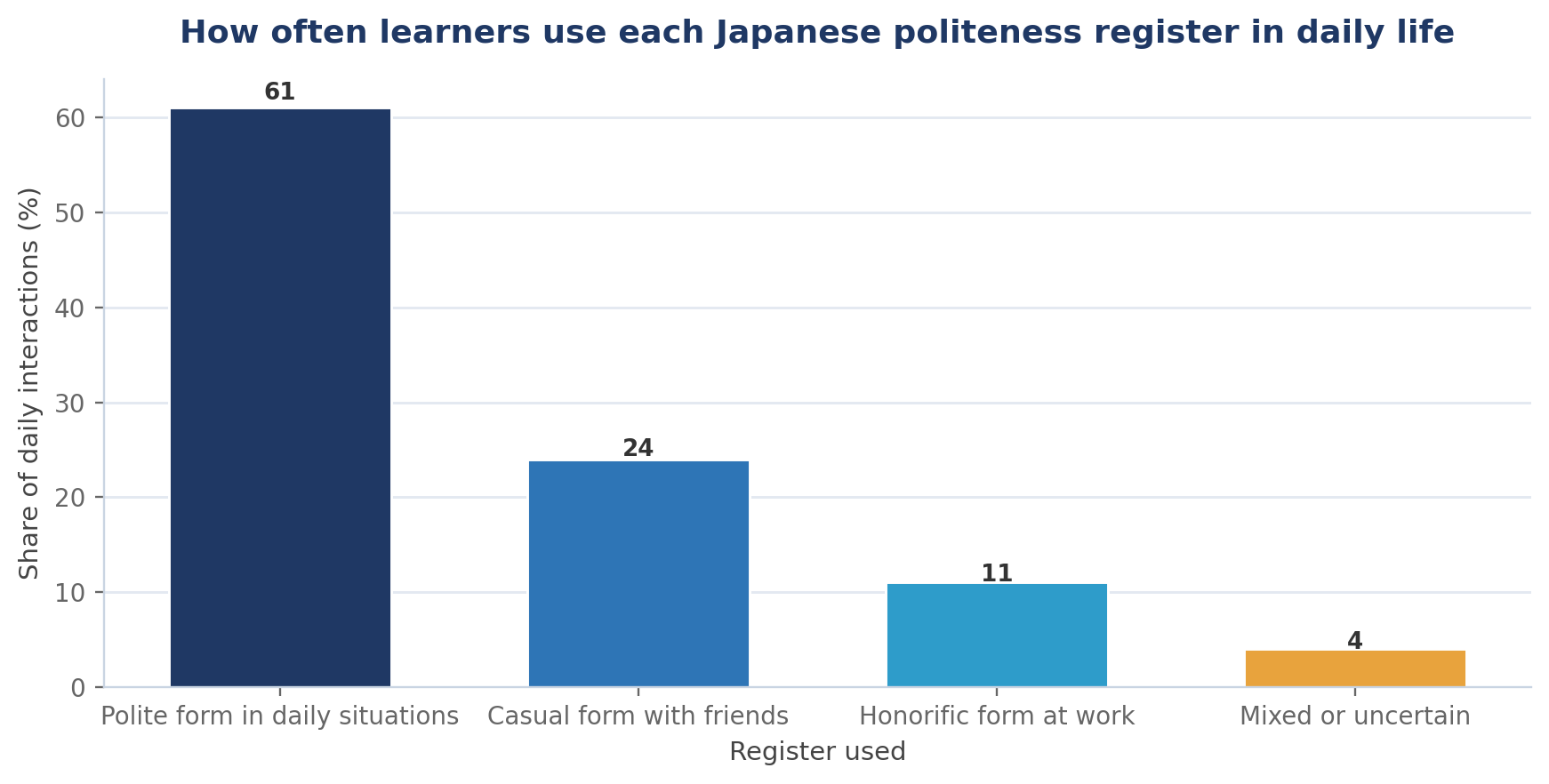
Here is a sentence that has ended more conversations than any grammar error: a learner, six months into study, using polite form with a close friend — and sounding, to that friend, faintly chilly and strange.
Japanese does not have one level of politeness. It has a system, and the choice you make in the first sentence of a conversation tells the other person exactly how you have categorised them. Get it right and you sound thoughtful. Get it wrong and you sound either stiff or rude, sometimes without knowing which.
What this guide covers
- The three politeness layers, in plain language
- Which one to use in which situation
- How to read the signals for switching
- The verb pairs you need to recognise
- Mistakes that sound rude — and ones that sound distant
The three layers
Japanese politeness is usually described as three overlapping systems. You do not need to master all of them to communicate well, but you do need to recognise all three.
The first two you will use daily. The third — keigo — is the formal system that splits further into humble and respectful forms, and it is genuinely a career skill.
When to use which
This is the practical table. If you remember nothing else, remember this.
The default is polite. When in doubt, be polite — it is never offensive, only possibly formal. Starting casual with the wrong person, on the other hand, can land badly.
Reading the signals for switching
Nobody announces a switch. You read it.
They use plain form with you first | You may switch | The relationship is years old | Casual is usually fine | They are significantly older or senior | Stay polite | You are in a workplace with customers | Stay formal | The topic becomes sensitive | Return to polite | They are a peer and you spend time socially | Casual becomes natural |
The mirror rule covers most of it: match the register you are given. If someone writes to you in plain form, replying in plain form is usually correct. If they use polite form, they are either being cautious or setting a boundary — respect it.
Politeness in Japanese is not about how much you like someone. It is about how well you know them.
The verb pairs worth recognising
You do not need to produce every honorific form early. You do need to recognise them, because they appear constantly.
Notice the pattern: each verb has a form that elevates the other person and a form that lowers you. In keigo, politeness is created by moving in both directions at once.
The structures that build politeness
Beyond single verbs, three grammatical moves do most of the work.
That last one is worth learning early. 〜ていただけますか is the polite request that never fails, in almost any workplace situation.
Ready to turn reading into real Japanese? Start your self-paced course today.
Start the Japanese course →Create a free accountLearn when to switch, not just how to conjugate
Register choice is a social skill, and it is learned by using it with someone who reacts. Self-paced lessons with a personal AI voice tutor let you rehearse exactly these switches — polite with a stranger, casual with a peer, formal at work — with instant feedback the moment it sounds off.
Button: Explore the live Japanese Course Pass →
Mistakes that sound rude
Using plain form with a superior | Reads as dismissive | Skipping the greeting entirely | The greeting carries much of the politeness | Using お前 for "you" | Blunt and confrontational outside close friendship | Correcting someone's Japanese formally | Condescending without softeners | Refusing too directly | Use 大丈夫です or ちょっと難しいですね |
Mistakes that sound distant
There is a mirror set of errors, and they are more common among diligent learners.
Using polite form with a close friend | Sounds cold or sarcastic | Over-apologising for small things | Creates awkwardness | Never relaxing into casual speech | The relationship never gets closer | Using keigo with peers your age | Feels like a performance |
The second set is the one that surprises people. Learners who study hard often over-correct, and the result is a relationship that never quite warms up — because intimacy in Japanese is expressed partly by dropping formality.
Ready to turn reading into real Japanese? Start your self-paced course today.
Start the Japanese course →Create a free accountFind out which register you are stuck in
Create a free languageskills.net account for a level check and guided register practice — polite, casual and workplace Japanese, with feedback on which one you reach for by habit.
Button: Create your free account →
A practical default strategy
First month in Japan | Polite form, always | First year | Polite with everyone new; casual with friends who initiate it | Workplace | Polite as baseline, keigo with customers and superiors | Long-term | Mirror the register you are given, and relax deliberately |
The single rule that covers every situation: polite by default, casual by invitation. Nobody has ever been offended by a learner who was slightly too polite.
Frequently Asked Questions
Is polite or casual Japanese better for beginners? Polite form. It is never offensive, it is usable in almost every situation, and it gives you time to work out how close a relationship actually is.
**What is keigo?** The honorific system used in business and formal settings, made up of respectful forms that elevate the other person and humble forms that lower yourself.
How do I know when to switch to casual? Wait for the other person to use plain form with you first, then mirror it. Switching first risks sounding presumptuous.
Can I sound rude by being too polite? With close friends, occasionally — excessive formality can read as coldness. Mirroring is the safest guide.
References & Further Reading
- Japan Foundation — Japanese-language education and sociolinguistic guidance
- NHK World — Easy Japanese, including polite expressions
- JLPT — Official test levels and language-use descriptors
- JASSO — Study in Japan and daily-life guidance
- Council of Europe — CEFR levels and sociolinguistic descriptors