Japan runs on two calendars at once: the official one printed in every office planner, and the deliciously lively one of local matsuri — shrine festivals with lanterns, drums, and grilled food on skewers. Learn both, and the country stops feeling like a postcard and starts feeling like a place you actually live in.
Here is your plain-English map to Japan festivals, public holidays, and the traditions that stitch a year together. No jargon, no gatekeeping — just what happens, when, and what to say.
Why Japan's Calendar Feels So Alive
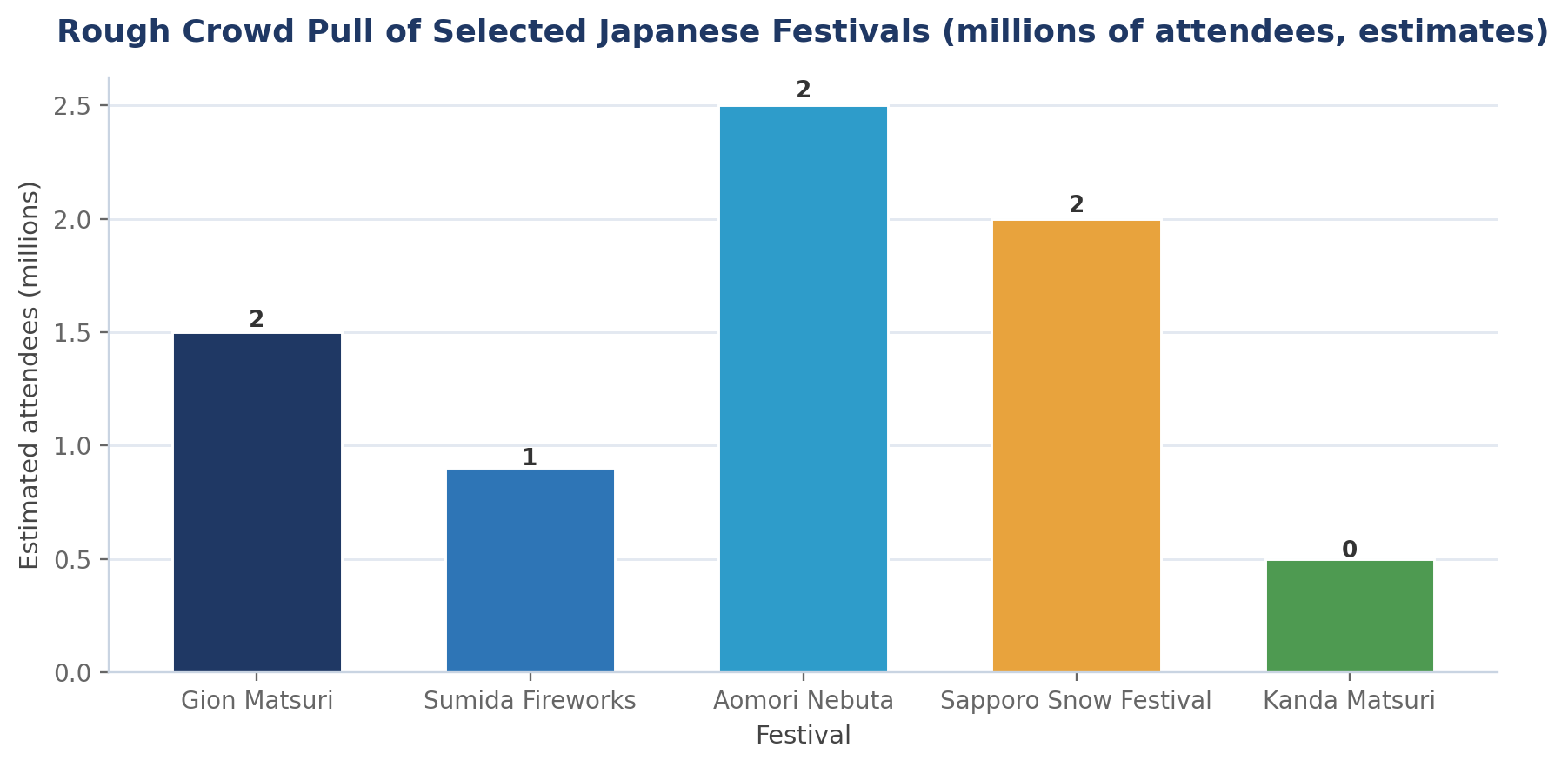
Japan has 16 national public holidays, a handful of them clustered into "Golden Week" in late April and early May. Add thousands of local matsuri — some tiny neighborhood affairs with twenty people, some colossal events pulling in millions — and you have a country that seems to celebrate constantly.
A quick reality check on scale: the Japanese government's own tourism statistics report tens of millions of inbound visitors annually in recent years, and matsuri attendance figures are usually local estimates rather than exact counts. When you read "two million visitors," treat it as a proud approximation, not a census.
New Year: The Quiet Giant
If you learn one holiday, learn this one. Shōgatsu (お正月) runs from January 1 through the first few days of the month, and it is the emotional anchor of the year. Families gather, eat osechi boxed dishes, send nengajō greeting cards, and visit a shrine for the year's first prayer — hatsumōde.
Trains are packed, many shops close, and everyone asks the same useful phrase:
あけましておめでとうございます — Akemashite omedetō gozaimasu ("Happy New Year").
Spring: Cherry Blossoms and Golden Week
Late March to early April belongs to hanami — blossom viewing. It is not an official holiday, but offices empty out for park picnics anyway. Then comes Golden Week, a stretch where four public holidays collide and the whole country travels at once.
Note that April 29 is Shōwa no Hi and May 4 is Midori no Hi — names tourists often mix up. If you plan travel, book everything well ahead; Golden Week accommodation sells out months early.
Speak the season, not just visit it
Learn the greetings, shrine etiquette, and small talk that turn a tourist trip into a real conversation. Our Japanese course builds exactly this everyday vocabulary, from New Year phrases to festival food names.
Start learning Japanese today →Create a free accountSummer: Matsuri Season in Full Blast
Summer is matsuri season. Neighborhood associations haul portable shrines (mikoshi) through the streets, taiko drums echo until late, and everyone wears yukata. Headline events like Kyoto's Gion Matsuri (July) and Tokyo's Sumida River Fireworks (late July) draw enormous crowds — again, official or press attendance numbers are estimates, so plan for crowds rather than trusting a figure.
Two cultural notes worth knowing: Obon in mid-August is not a public holiday, but many businesses close so families can honor ancestors. And festival food is half the fun.
Autumn and Winter: Shrines, Rituals, and Quiet
Autumn brings Shichi-Go-San in November, when children aged three, five, and seven dress up and visit shrines. It is not a national holiday, but it is one of Japan's most photogenic traditions. Labor Thanksgiving Day (November 23) is the official day off.
Winter closes the loop: Christmas is widely celebrated as a commercial, romantic event rather than a religious one, and New Year's Eve temple bells ring 108 times to mark Joya no Kane.
How to Actually Enjoy a Matsuri
Show up curious, bring cash for stalls, and follow a few simple courtesies. At shrines, bow at the gate, avoid walking through the center of the path, and follow the crowd's lead during rituals. If you want to dig deeper into the linguistic layer — the honorifics, the set phrases, the polite refusals — a structured course helps far more than memorizing vocab lists.
Turn festival phrases into fluent moments
From asking stall prices to thanking a shrine volunteer, our Japanese course drills the real sentences you'll say out loud. Join thousands of learners and start with a free account today.
Get your Japanese course pass →Create a free accountFrequently Asked Questions
What is the biggest festival in Japan? There is no single winner — Gion Matsuri in Kyoto and Aomori's Nebuta Matsuri are both regularly described as among the largest, and crowd figures are organizer estimates rather than official counts.
Are matsuri religious events? Most began as Shinto shrine observances, and many still carry ritual elements like mikoshi processions, even though today they are also social and street-food events.
How many public holidays does Japan have? Japan has 16 national public holidays, and when one falls on a Sunday a substitute day off is usually observed.
Do I need Japanese to attend a festival? No, but even basic phrases — greetings, thanks, and simple questions — make interactions warmer and get you far at food stalls.