A seven-year-old will not sit through a vocabulary list. But she will hunt for あ on every cereal box in the kitchen and shriek when she finds it.
That is the whole trick behind japanese games for kids (子供向け日本語ゲーム). Japanese is unusually friendly to young learners. The sounds are few, every syllable is even, and the writing system starts with a set of shapes that look like drawings. Play is the delivery method.
Why Japanese suits young children so well
Japanese has five vowel sounds and no tones. Children who speak English already own most of them. And hiragana is a closed set of 46 base characters — a finite treasure hunt, not an ocean.
Finite is a gift. A child can literally finish hiragana — and finishing something is what turns a game into a habit.
Game one: the hiragana hunt
Stick six large hiragana cards around one room: あ, か, さ, た, な, は. Say a sound, and the child races to touch the right card. Reward speed, not perfection.
When the child runs the game, she is doing the remembering. That switch is where learning quietly doubles.
What you will get from this guide
- Five screen-free games that teach real Japanese
- A three-week rotation so nothing turns stale
- How to support it with the Japan Foundation's free resources
Game two: karuta, the classic card slap
Karuta (かるた) is a Japanese card game older than most schools. Lay picture cards on the floor. Read a phrase. First player to slap the matching card keeps it.
You need no special equipment. Print twenty cards with a kana and a picture, read the word aloud, and let the chaos do the teaching. It trains listening, speed and recognition at once.
Karuta is loud, competitive and slightly chaotic. That is why it works.
Game three: memory pairs with pictures
Twelve cards face down: six pictures, six kana words. Turn two, say what you flipped, and keep the pair if it matches.
Every turn forces a spoken word. Say it out loud even on a failed turn — repetition without pressure is exactly what young memory needs.
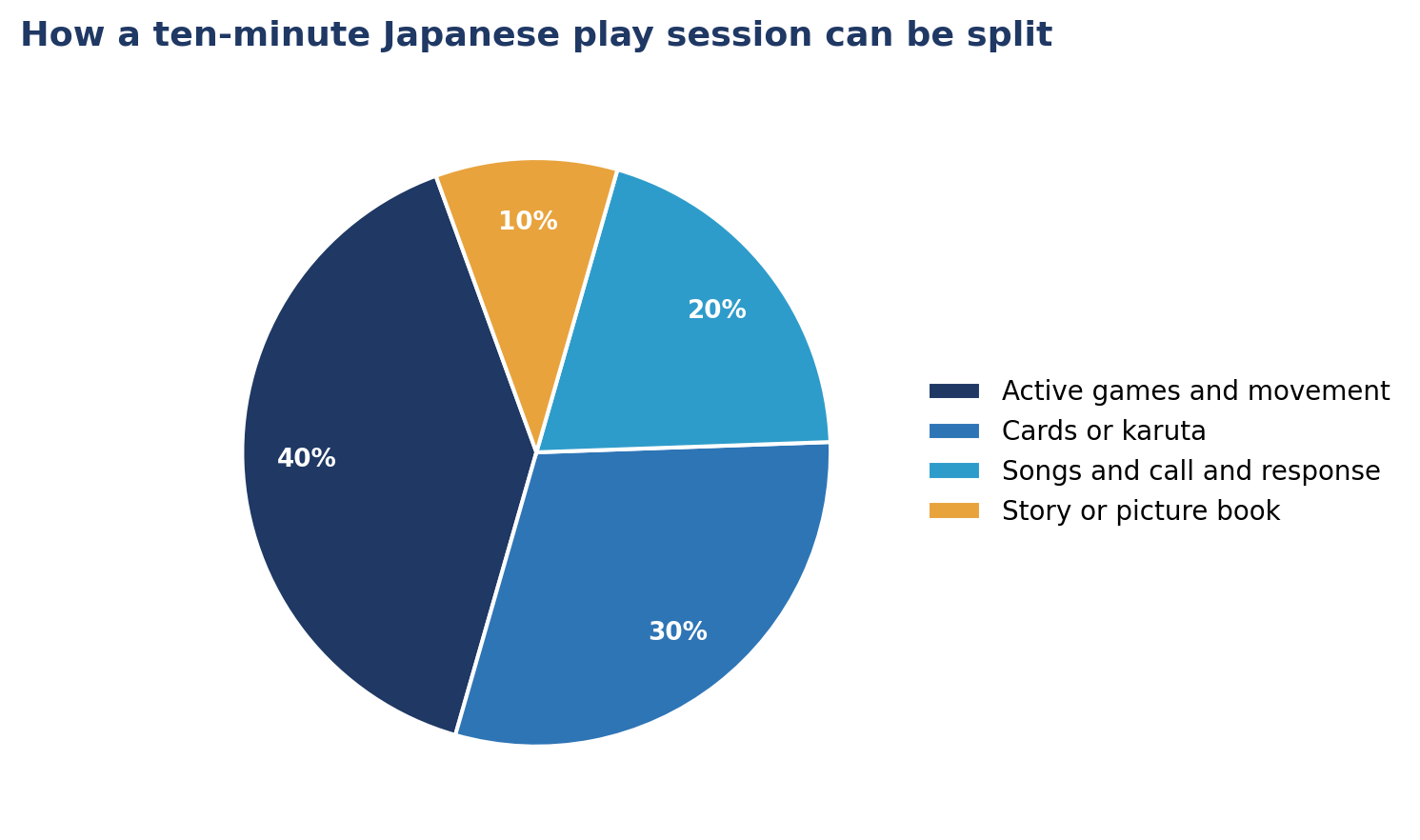
Ten minutes is the sweet spot for ages four to eight. Longer sessions lose more than they add.
Want an AI tutor to play along?
Our self-paced Japanese lessons for children are built on songs, cards and movement — guided by an AI voice tutor that can hold a six-year-old's attention for a whole session. Start with a free account and see how your child reacts.
Create a free account →Create a free accountGame four: songs with actions
Songs carry grammar children never notice they are learning. Pair each line with a movement.
Sing the same three songs for a month. Repetition is not boredom for a child — it is comfort, and comfort is where pronunciation settles.
Game five: しりとり, the word chain
Shiritori (しりとり) is simple: say a word, the next person starts with its last syllable. ねこ → こま → まめ → めがね.
Young learners only need pictures. Lay out image cards and build a chain across the floor. When the chain reaches the sofa, celebrate. This game teaches vocabulary, syllable awareness and turn-taking at once — and it never ends the same way twice.
A three-week rotation that avoids boredom
Children tire of anything repeated too fast. Rotate on a schedule.
Keep the props in one box and bring it out only at Japanese time. Scarcity keeps the box magical. The Japan Foundation publishes free teaching resources and picture materials worth bookmarking, and their overseas offices often run family events.
Frequently Asked Questions
At what age should a child start Japanese? Ages four to seven are ideal for sounds and kana, because young ears copy pitch easily. Older children from eight upward move faster through vocabulary and can start preparing for the JLPT N5 later on.
Do children need to learn kanji straight away? No. Spend the first year on hiragana, listening and speaking. Introduce a handful of pictographic kanji such as 山, 川 and 日, because their shapes tell a story a child can see.
How long should a play session last? Ten minutes for ages four to six, fifteen for ages seven to nine. Stop while your child still wants more. Ending on enthusiasm protects tomorrow's session.
Can my child learn Japanese without a native speaker at home? Yes. Songs, cards and picture books build a strong base, and self-paced lessons with an AI voice tutor add the one thing games at home cannot provide: a patient tutor that only speaks Japanese.
References & Further Reading
- Japan Foundation — Japanese-language education and free resources: https://www.jpf.go.jp/e/
- Japan Foundation — Marugoto: Japanese Language and Culture course: https://www.marugoto.org/en/
- JLPT — Japanese-Language Proficiency Test official site: https://www.jlpt.jp/e/
- NHK — Easy Japanese free lessons for beginners: https://www.nhk.or.jp/lesson/en/
- Japan Foundation — Hirogaru resources for teachers of young learners: https://www.jpf.go.jp/e/project/japanese/education/
Turn ten minutes a day into a language your child keeps.
Self-paced Japanese lessons for kids mix songs, karuta and conversation with gentle AI feedback. Create a free account and watch your child play their way into Japanese.
Start free →Create a free account