Your four-year-old can already say arigatou and kawaii. Then you open a hiragana chart with 46 characters, and the dream quietly collapses. Where do you even start with 子どもに日本語を教える when the writing system alone looks like a wall?
Here is the good news: children learn Japanese the way they learned to walk. Badly, cheerfully, and fast. Your job is not to teach grammar. It is to build a small daily ritual, protect it for a year, and let the language grow into it.
What you will get from this guide
- What to teach at each age, from 2 to 12
- The hiragana order that avoids tears
- Ten-minute routines that fit real family life
- The five mistakes that stall bilingual kids
What to teach, by age
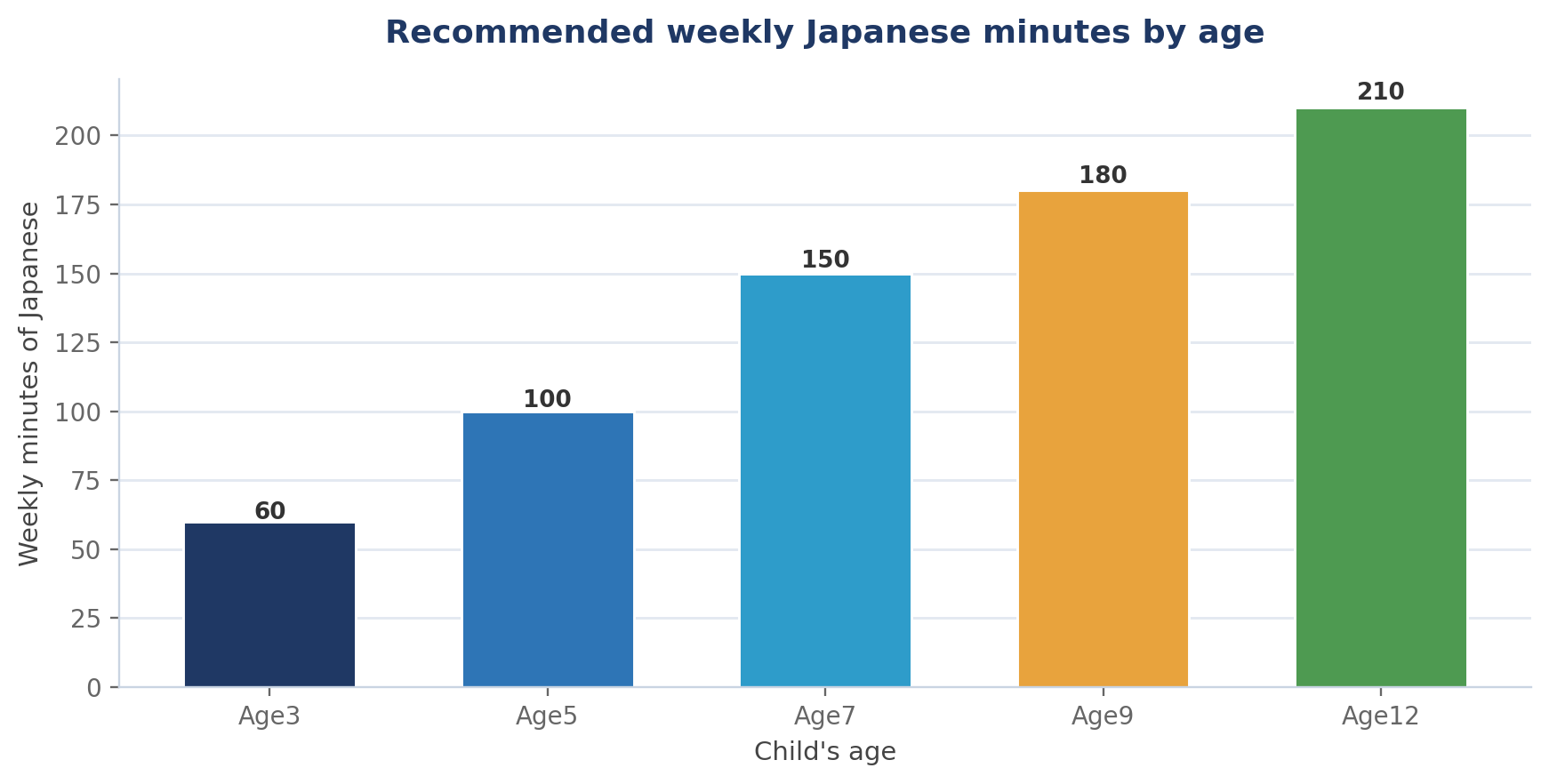
Children can't absorb everything at once, but they absorb the right thing extremely well. Match the target to the stage.
Notice the pattern: ears first, then eyes, then hands. A child who hears mizu for two years writes it in one afternoon. A child who is handed a pencil at three just learns that Japanese equals frustration.
Hiragana in the order that works
The wall is smaller than it looks. 46 base characters, and they arrive in families.
Five characters a week. Forty minutes total. By week nine your child reads ねこ and feels like a wizard — which, developmentally speaking, they are.
You don't have to be the teacher
If your own Japanese stops at konnichiwa, a self-paced AI voice tutor for kids keeps the momentum going — guided lessons, songs, games and speaking practice with AI feedback, any time.
See Japanese courses →Create a free accountThe ten-minute engine
Bilingual children are not made by heroic weekends. They are made by boring Tuesdays. Pick three of these blocks and repeat them daily.
Ten to twenty minutes. Same time, same place, every day. Consistency is the whole technique — a child's grammar is built from repetition, not explanation.
Reading aloud: the highest-value habit
Read the same book five nights in a row. Predictable text lets a child finish your sentences out loud, and that moment of I said it myself is worth more than a hundred worksheets.
Keep three categories on the shelf:
Ask questions in Japanese, but accept answers in whatever language they come in. Meaning first, output later.
Five mistakes that stall kids
The fourth one is the quiet killer. A child who reads beautifully but never speaks ends up a tourist in their own heritage language.
When a teacher beats a parent
You should absolutely run the daily ten minutes. But around age seven, most children need one thing a parent can't fake forever: a speaker who isn't you, expecting real answers at full speed.
A self-paced AI voice tutor gives your child that, and gives you a plan to follow between sessions. Twenty minutes a day at home plus regular guided AI-tutor lessons is the combination that survives the teenage years — the stretch where most heritage speakers quietly stop.
Frequently Asked Questions
What age should I start teaching Japanese to my child? Any age from birth to twelve works. Zero to seven is the fastest window for listening and pronunciation; eight and up is fine for reading and kanji, because older children study more efficiently.
Should children learn romaji first? No. Romaji teaches the brain to route every Japanese word through the Latin alphabet. Start with hiragana sounds and pictures, and let romaji stay out of the way.
How long until my child can read hiragana? Around eight to ten weeks at five characters a week with daily review. Keep sessions to ten minutes — short and frequent beats long and rare.
What if I don't speak Japanese myself? You still run the routine, the songs and the reading. Pair yourself with a self-paced AI voice tutor for the speaking half. Children imitate input, not enthusiasm alone.
Start the routine tonight. Three songs, five flashcards, one bedtime story.
Give your child a teacher who speaks like a native
Create a free account, start a kids' self-paced AI-tutor lesson, and let a structured approach do the heavy lifting while you keep the ten minutes at home.
Start free →Create a free accountReferences & Further Reading
- The Japan Foundation — Japanese-language education programmes worldwide: https://www.jpf.go.jp/e/
- The Japan Foundation — Marugoto: Japanese Language and Culture textbooks and levels: https://www.marugoto.org/en/
- Japanese-Language Proficiency Test (JLPT) — official levels and sample questions: https://www.jlpt.jp/e/
- The Japan Foundation — Erin's Challenge! I Can Speak Japanese free learning site: https://www.erin.jpf.go.jp/en/
- NHK World Japan — Easy Japanese lessons with audio and video: https://www.nhk.or.jp/lesson/