A five-year-old in Tokyo chatters happily in Japanese, understands her grandmother in English, and then refuses to say a single word of English to her father. Nothing is wrong. She has simply discovered that Japanese gets the job done.
Raising a Japanese–English bilingual is a different project from a Spanish–English one, because Japanese throws a wall at your child that European languages never do: three writing systems and a lifetime of kanji.
What you will get from this guide
- Why Japanese is a harder bilingual target than European languages
- What hoshuko weekend schools do, and who needs them
- Realistic milestones, split by spoken and written Japanese
- How many contact hours a week actually work
The Three-Script Problem
Spoken bilingualism and written bilingualism are separate achievements in Japanese, and they diverge dramatically.
A child can be perfectly fluent in spoken Japanese and functionally illiterate in it. That is the most common outcome for children raised abroad — and it is fixable, but only with deliberate effort.
The honest rule: speaking follows exposure, but literacy follows instruction. You cannot absorb 2,000 kanji by osmosis.
Hoshuko: The Weekend School That Saves Literacy
In cities worldwide, Japanese families send children to hoshokō — supplementary Saturday schools. Most follow a curriculum set by Japan's Ministry of Education, designed to keep children in step with Japanese schools.
If you might return to Japan, hoshuko is close to essential. If not, a conversation-focused heritage class plus daily home practice delivers more pleasure per hour.
Milestones: Spoken and Written
Two points reassure parents. Mixing languages is normal and not confusion. And the teenage refusal phase is common — children push back hardest around 13–15, and it usually passes if the language has stayed associated with pleasure.
Note that the written side needs the hours more than the spoken side at older ages. It is the kanji that keep demanding time.
What Works and What Fails
That fifth row deserves emphasis. Children who read manga or chapter books in Japanese build kanji knowledge without noticing. A comic is a curriculum in disguise.
Some things a parent cannot teach
Children often resist the language their parent pushes — and almost every parent hits a wall with kanji by age nine. A personal AI voice tutor changes the dynamic: Japanese becomes a game with a new voice rather than a chore from mum or dad.
Start Japanese lessons for kids →Create a free accountWhat Not to Do
- Do not correct every mistake. Constant correction produces a silent child.
- Do not treat kanji as punishment. It is the hardest part, so it must be the best-taught part.
- Do not drop Japanese when English schoolwork intensifies. That is precisely when it slips away.
- Do not assume spoken fluency means literacy. They are separate projects.
- Do not use English loanwords as a shortcut at home. Baiku and sukāto will get your child understood in Japan, but they are not a vocabulary.
The Weekly Rhythm
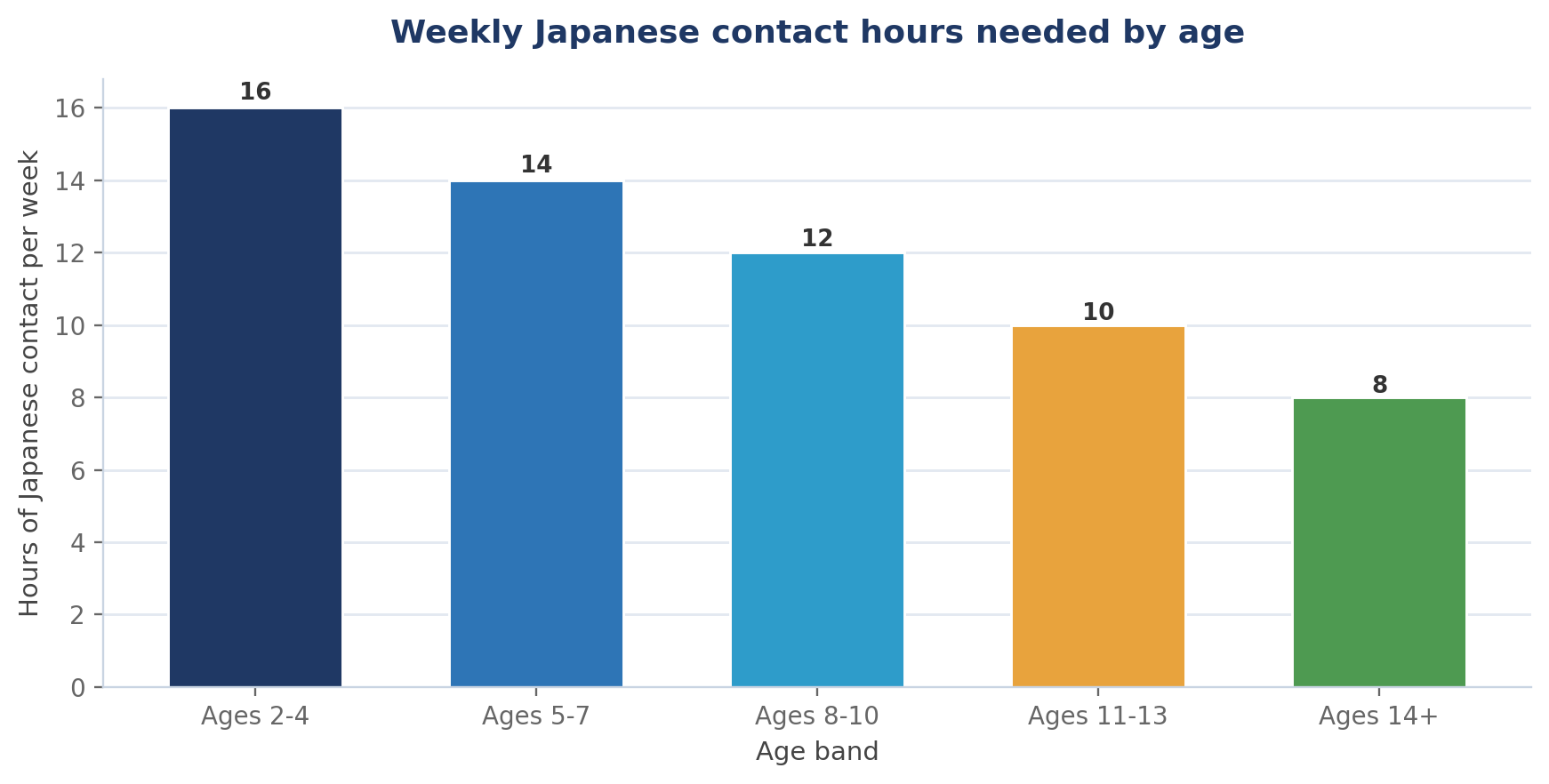
Add it up and a child is close to the contact hours the chart above demands. The single highest-value line is the third: a personal AI voice tutor gives structure and correction that even a fluent parent struggles to provide to their own child.
Keep Japanese alive through the teenage years
Motivation dips around 13, and kanji gets harder every year. A steady weekly AI voice tutor session keeps the language moving when enthusiasm alone will not.
See Japanese courses →Create a free accountFrequently Asked Questions
Will my child be confused by Japanese and English? No. Mixing languages early is a normal developmental stage, not confusion. Children separate the two systems as vocabulary grows.
Can my child learn Japanese without learning kanji? They can become conversationally fluent, but not literate. For reading and writing, systematic kanji instruction is unavoidable.
Is hoshuko necessary if we live abroad? It matters most if you may return to Japan, because it keeps a child aligned with the Japanese school curriculum. Otherwise, a heritage class plus daily home reading achieves similar spoken results.
At what age is it too late to start? It is never too late. Older children learn kanji and grammar faster than toddlers — they simply need consistent contact and a reason to speak.
References & Further Reading
- Japan Foundation — Japanese-language education and the JLPT: https://www.jpf.go.jp/e/
- Japan Foundation — Survey Report on Japanese-Language Education Abroad: https://www.jpf.go.jp
- MEXT (Ministry of Education, Culture, Sports, Science and Technology, Japan) — curriculum guidance for supplementary schools: https://www.mext.go.jp/en/
- Council of Europe — Common European Framework of Reference for Languages: https://www.coe.int
- LanguageSkills.net — Japanese courses for children and families: https://languageskills.net/japanese
The Last Word
Japanese–English bilingualism is two projects wearing one coat. Spoken Japanese is generous — give a child conversation and it grows. Written Japanese is demanding — it needs instruction, patience and years. Plan for both, keep the pleasure high, and let manga do more teaching than you expect.