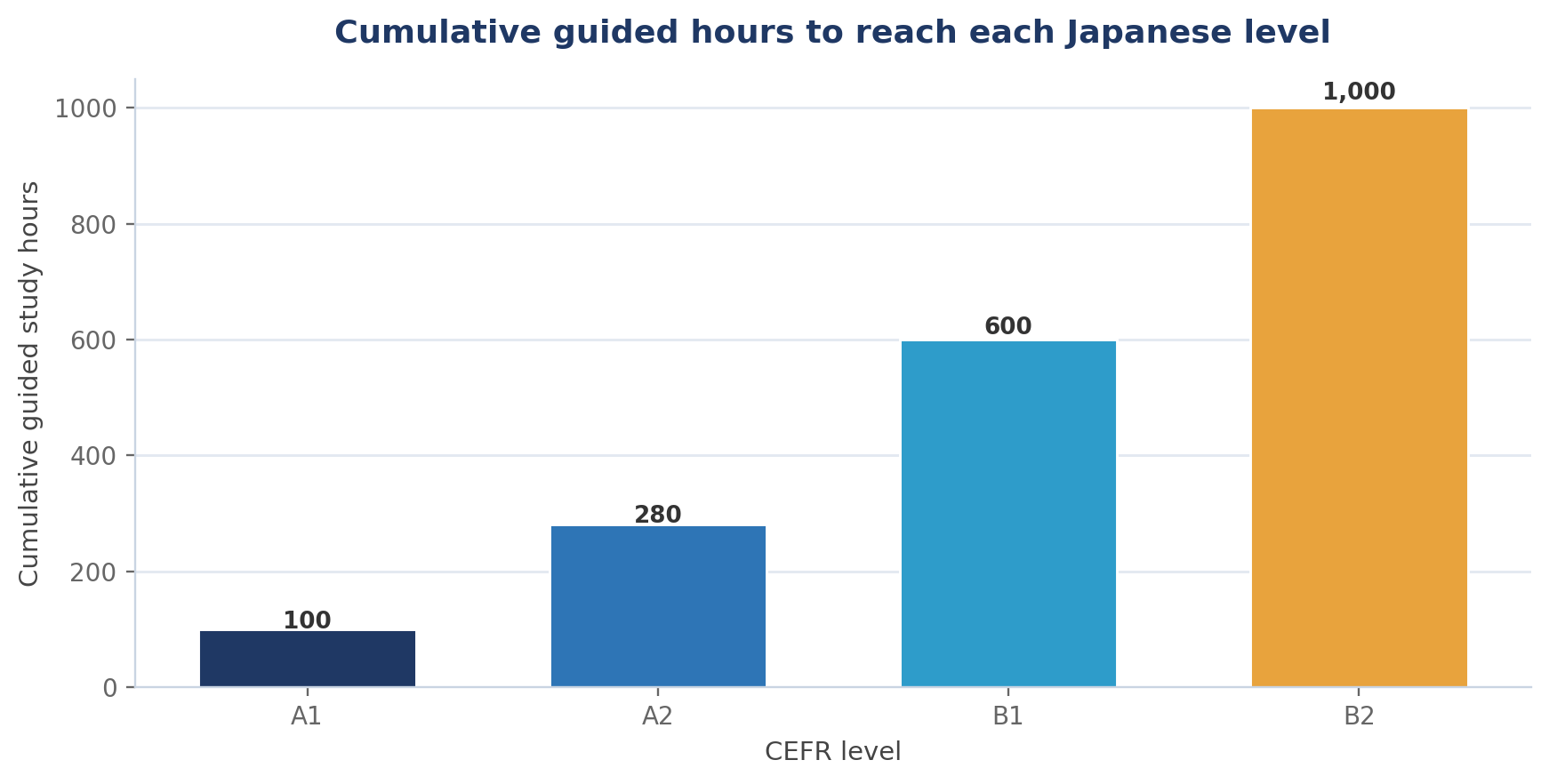
B1 is where Japanese stops being a puzzle you solve and becomes a language you use. It is the level where you stop translating in your head, start catching jokes, and can finally have a conversation that goes somewhere neither person planned.
It is also where most learners stall — sometimes for years. The A2-to-B1 gap in Japanese is genuinely bigger than in European languages, because you are not just learning structure; you are learning an entirely different writing and register system at the same time.
Here is exactly what B1 contains, what it takes to get there, and how to stop circling it.
What this guide covers
- What Japanese B1 means in can-do terms
- How it differs from A2, concretely
- Kanji and grammar targets
- JLPT N3 versus CEFR B1
- Guided hours and a realistic timeline
What Japanese B1 actually means
The CEFR describes B1 as the threshold level — independent enough to deal with most situations, express opinions, and handle unexpected input.
The last row is the real marker. An A2 learner can answer. A B1 learner can sustain — ask follow-up questions, react, disagree politely and change the subject.
How B1 differs from A2
Two shifts are worth highlighting. First, giving and receiving verbs — あげる, もらう, くれる — become essential at B1 and are notoriously slippery. Second, register awareness: you start needing to know not just what to say, but which version of it to say to which person.
Kanji at B1: the real workload
Kanji is where the hours go, so it deserves its own plan.
Two rules make this survivable. Learn kanji in vocabulary, not in isolation — 学校, not 学 then 校. And learn the radicals early; around 200 radicals unlock the logic of thousands of characters instead of leaving you memorising pictures.
Nobody learns 650 kanji as 650 drawings. They learn a system, and then they use it.
JLPT N3 versus CEFR B1
Functionally, N3 and B1 sit at similar levels of knowledge. But N3 requires no speaking at all, which is why some learners pass N3 and still cannot hold a conversation. If your goal is real communication, treat N3 as a checkpoint and B1 as the target.
Ready to turn reading into real Japanese? Start your self-paced course today.
Start the Japanese course →Create a free accountClose the A2-to-B1 gap with structured speaking practice
This is the level where self-study plateaus hardest, because what is missing is not information — it is speaking volume under correction. A personal AI voice tutor gives you structured, self-paced speaking practice with feedback, so you can catch the giving-and-receiving mistakes before they set.
Button: Explore the Japanese Course Pass →
How to actually reach B1
The grammar row deserves emphasis. Learning a structure means using it twenty times in your own sentences, not recognising it on a page. Conditionals and the passive especially must become reflex, which only happens through production.
The A2-to-B1 traps
The fourth is a genuine cultural skill, not a grammatical one. B1 is where です and ます stop being the only tools you own — and where だ, じゃない and かな become necessary for sounding like a person rather than a textbook recording.
A readiness checklist
You are at B1 when you can:
- Hold a 10-minute conversation on daily life without switching to English
- Follow the main points of a news clip at normal speed
- Read a short article and summarise it aloud
- Write a 200-character opinion and explain your reasoning
- Recognise roughly 650 kanji and read around 3,000 words
- Switch between polite and casual Japanese appropriately
Tick most of those, and you have passed the threshold. The remaining boxes are B2 work.
Ready to turn reading into real Japanese? Start your self-paced course today.
Start the Japanese course →Create a free accountFind out how far you really are from B1
A free languageskills.net account includes a level check against real CEFR descriptors, so you know whether you are close or one full band away.
Button: Create your free account →
Frequently Asked Questions
How long does it take to reach Japanese B1? Roughly 600 guided hours from zero, or about two years at a steady pace. From a solid A2, most learners need nine to fifteen months.
Is JLPT N3 the same as CEFR B1? Close in grammar and vocabulary, but N3 tests no speaking. If conversation matters, treat N3 as a checkpoint rather than the destination.
How many kanji do I need for B1? Around 650. The key is learning them inside vocabulary and mastering radicals early rather than memorising them as isolated drawings.
What is the hardest part of reaching B1? The speaking plateau. Knowledge accumulates steadily, but without regular speaking practice, production lags years behind comprehension.
References & Further Reading
- Japan Foundation — Japanese-language education and level descriptions
- JLPT — Official Japanese-Language Proficiency Test level guides
- NHK World — Easy Japanese and graded listening materials
- JASSO — Study in Japan and language requirements
- Council of Europe — CEFR levels and descriptors