Japanese A2 is the sweet spot where the language stops being a puzzle and starts being a tool. You can order, apologise, ask for help, describe your day and survive a real conversation with a patient native speaker. It is also the level where most learners quietly stall — past the beginner buzz, short of true fluency. This guide shows exactly what Japanese A2 covers, how it differs from A1, and how to cross the gap without burning out.
What Japanese A2 Actually Means in Can-Do Terms
The CEFR describes A2 as an elementary user: someone who handles routine exchanges, describes background and immediate needs, and copes with short, predictable texts. The Council of Europe CEFR framework frames it as survival-plus, not fluency. For Japanese, that translation is unusually physical — you are reading real kanji, not just kana.
A2 is not about knowing more words. It is about keeping a conversation alive when you do not.
A1 vs A2: The Gap That Trips Everyone
A1 Japanese is polite survival with a script: fixed phrases, memorised greetings, kana-only reading. A2 forces improvisation. Sentence endings multiply, casual speech appears, and suddenly a single verb has a dozen social registers. That jump — not vocabulary volume — is what stalls learners.
Kanji and Script Targets at A2
This is where Japanese CEFR levels get slippery: CEFR was not designed for a three-script language. Most schools map A2 to roughly the first 300-400 kanji — the Japan Foundation syllabus and JASSO study pathways both cluster elementary reading around this band. You need recognition speed, not perfection.
Kanji at A2 is a reading skill first. If you can recognise 350 kanji in sentences but hand-write 150, you are exactly on track. Writing catches up later.
Grammar You Can Actually Handle
Japanese A2 grammar is where sentences start breathing. You are no longer stapling nouns to です.
JLPT N4 vs CEFR A2: Not the Same Exam
People treat JLPT N4 as "the A2 test". It overlaps heavily, but the focus differs. JLPT measures receptive knowledge — listening and reading — with no speaking or writing section at all. CEFR A2 measures what you can do with the language, including productive skills.
How Many Hours Does Japanese A2 Take?
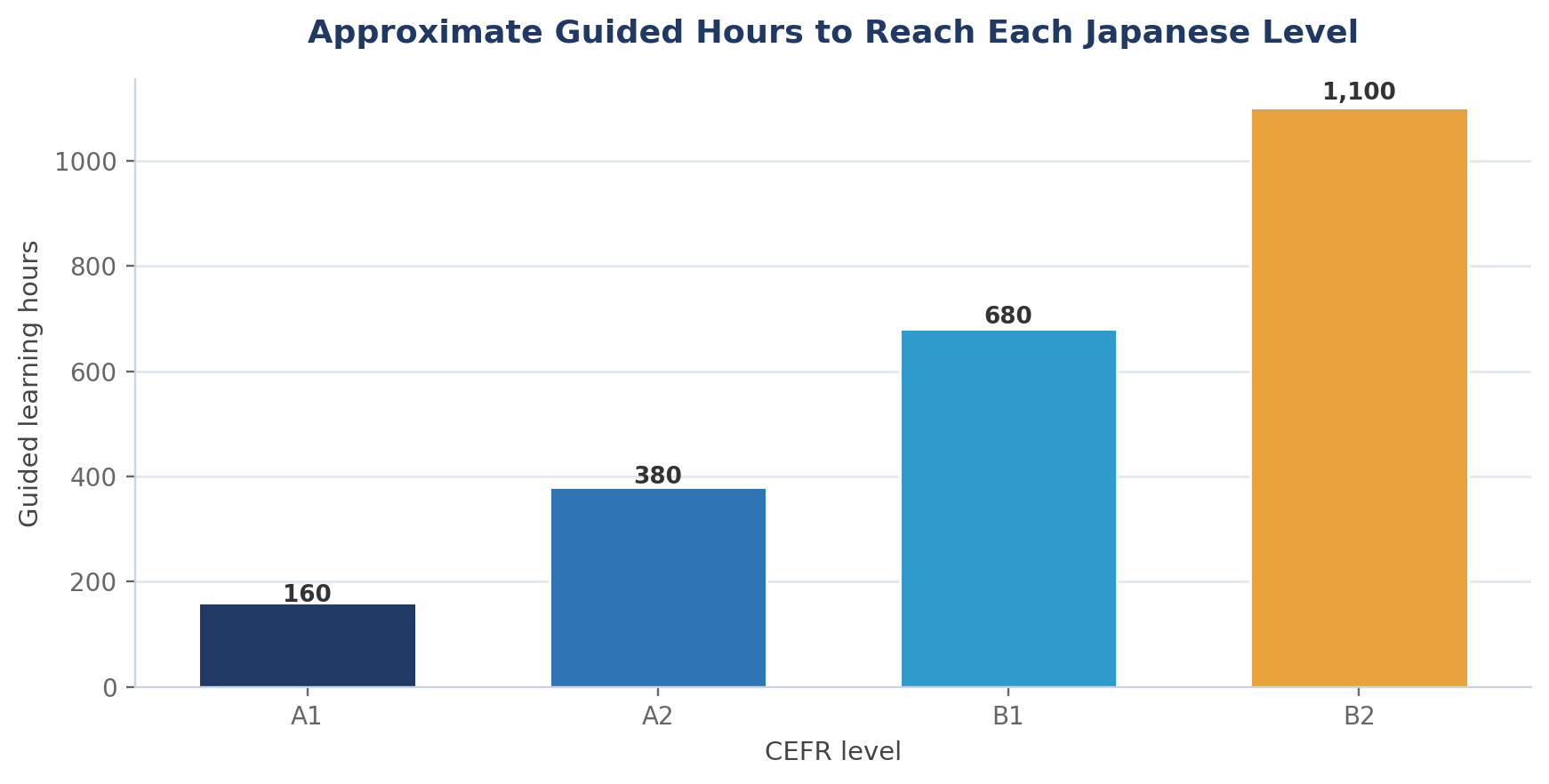
The CEFR indicative ladder suggests roughly 180-200 guided hours from zero to A1, then another 180-200 to A2. Japanese pushes higher because of script load, so figure 380-500 total hours. Learners who study solo usually need far more.
Stop guessing your way to A2
A personal AI voice tutor gives you structured speaking practice with instant feedback — the exact fuel the A1-to-A2 gap demands, at your own pace, any time.
Explore the Japanese Course Pass →Create a free accountThe A1-to-A2 Gap That Trips Learners
Three things break the momentum. First, kanji fatigue: kana-only comfort collapses when every sentence hides unfamiliar characters. Second, register shock: polite forms you drilled meet casual speech you never practised. Third, output silence: reading improves fast while speaking freezes, because nobody corrects you.
The fix is boringly effective. Speak weekly with a human, read something slightly too hard every day, and recycle grammar in new contexts instead of collecting new points. NHK World Easy Japanese is a genuinely useful free reading and listening bridge for exactly this stage.
Your Japanese A2 Readiness Checklist
Run this before you call yourself A2. Honest answers only — this is your map, not a report card.
How an AI Voice Tutor Accelerates A2
Self-study is brilliant at input and terrible at output. A personal AI voice tutor does four things a textbook cannot: gives you speaking practice under mild pressure, corrects fossilised errors before they harden, models natural speed and register, and keeps you in a steady study rhythm. That rhythm is what turns 500 scattered hours into 380 efficient ones. Pair it with a free account and a placement check, and the A2 finish line moves into view.
Find your true Japanese level in minutes
Create a free account, take a quick placement check and see exactly how far you are from A2 — then start the self-paced lessons that close the gap.
Create your free account →Create a free accountFAQ
Is Japanese A2 the same as JLPT N4? Close, but not identical. Vocabulary and kanji overlap heavily, yet JLPT N4 tests only reading and listening. CEFR A2 also measures speaking and writing, so a strong N4 reader is not automatically a confident A2 speaker.
How long does it take to reach Japanese A2? Around 380-500 guided hours for most learners, or 30-40 weeks with daily self-paced practice. Solo learners often need 12-18 months because feedback is slower.
Can I skip A1 and start at A2? You can start at A2 if you already read kana fluently and know roughly 800 words plus polite verb forms. Most learners who try to skip plateau within weeks because the te-form foundation is missing.
Do I need to hand-write 400 kanji for A2? No. Recognition is the priority — you should read 300-400 kanji in context. Hand-writing 150-200 common ones is plenty at this stage.