Japanese A1 is the moment the wall of squiggles turns into a language you can actually use. You won't be debating politics in Tokyo — but you'll order ramen, read a train sign, introduce yourself, and understand a slow, simple question aimed at you. That's real. That's A1. This guide shows exactly what Japanese A1 contains, how the scripts stack up, how many hours it takes, and how JLPT N5 compares to CEFR A1.
What A1 Japanese Actually Means in Can-Do Terms
The Council of Europe CEFR defines A1 as the breakthrough level: you interact in a simple way when the other person speaks slowly and clearly and is ready to help. Applied to Japanese, Japanese A1 looks like this.
A1 Japanese is not "a little Japanese." It is a working set of survival tools — scripts you can decode, phrases you can fire off, and grammar that lets you build your own sentences instead of parroting set lines.
If you search for japanese a1 courses, ask one question: does the course get you producing sentences in week one, or just admiring the alphabet? Production is where A1 lives.
The Three Scripts: What You Must Learn
At A1 you meet hiragana, katakana, and a first taste of kanji. Hiragana and katakana are complete, closed sets — 46 base characters each plus dakuten variants. Kanji at A1 is a starting collection, not a marathon.
The Japan Foundation's Marugoto framework treats script mastery as a companion to communication, not a prerequisite for it. Learn kana alongside phrases, never instead of them.
Core Grammar You Can Handle at A1
You are not memorising rules for their own sake. At A1 Japanese grammar gives you sentence machinery:
- The は / が / を particles — topic, subject, object.
- です / ます polite forms and their negatives.
- Present and past tense in polite speech.
- Question formation with か and question words.
- Adjective types (い and な) and simple modification.
- Position words, counters for people and objects, and quantity.
That short list unlocks thousands of sentences. It is the difference between a phrasebook and a language.
A1 Vocabulary: The Numbers That Matter
Vocabulary at Japanese A1 clusters around survival domains. Notice how the totals compound fast — the first 800 words do most of the daily heavy lifting.
A1 Japanese vocabulary is roughly 800–1,500 words. That sounds steep until you spread it across six months — under ten new words a day, with constant recycling.
How Long Does A1 Japanese Take?
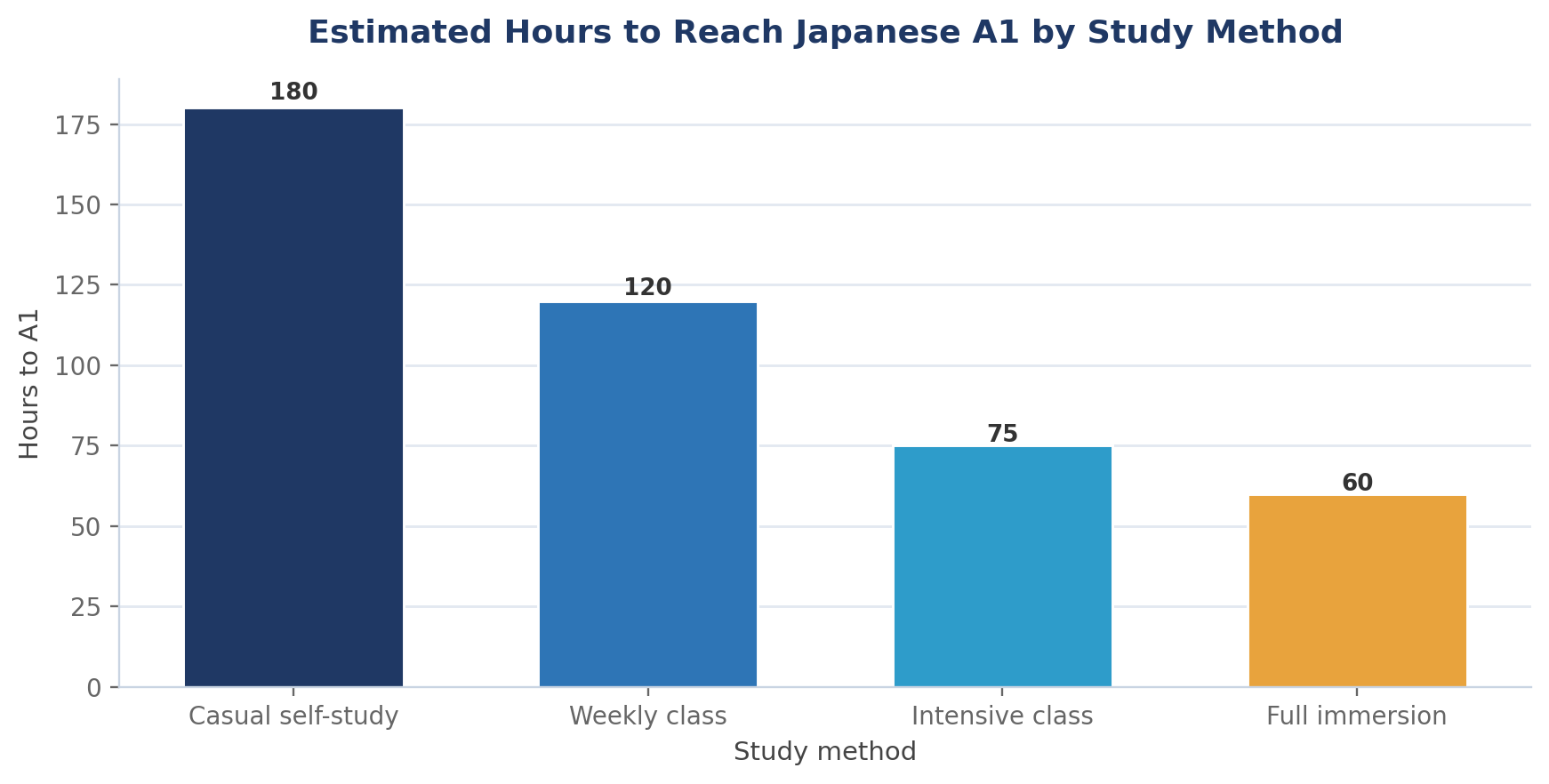
For a native English speaker, Japanese sits in the hardest tier for script and grammar distance. Realistic A1 timelines vary hugely by method and intensity.
A structured weekly class sits in the sweet spot: enough contact hours to keep momentum, enough spacing to let particles and kana stick. Add short daily review and A1 Japanese is a roughly six-to-nine-month project, not a five-year vow.
JLPT N5 vs CEFR A1
The JLPT and the CEFR measure different things. N5 is a knowledge test; A1 is a can-do descriptor. They overlap heavily at the bottom but are not interchangeable.
Clearing N5 usually means you are at or near Japanese A1 — but a learner with strong speaking and shaky kanji can be A1 without passing N5.
Stop guessing at particles alone in a textbook
A personal AI voice tutor hears your sentence, gives feedback on the particle, and pushes you to speak again — before the mistake hardens. The Course Pass gives you self-paced AI-tutor Japanese lessons built straight to A1 milestones.
See the Japanese Course Pass →Create a free accountYour A1 Readiness Checklist
Tick these before you claim the level — and check the free NHK World Easy Japanese audio lessons to test your ear honestly.
Two or three unchecked boxes? You are mid-A1 — completely normal. Fix the weakest box first, and don't polish strengths.
FAQ
Is Japanese A1 enough for travel to Japan? Yes. A1 Japanese covers ordering, shopping, directions, and basic courtesy, which handles most tourist situations comfortably.
Should I learn kanji at A1? Learn a starter set of 100–300 high-frequency kanji alongside kana. Kanji makes reading signs and menus faster, but kana remains your priority.
Can I reach Japanese A1 without a teacher? Some learners do, especially with strong discipline and audio practice. Most stall on speaking and pronunciation, which is exactly where AI speaking-practice feedback shortens the road. See how the Course Pass works before you decide.
How many hours a week do I need? Three to five focused hours weekly, spread across at least four days, keeps A1 progress steady and visible.
Try a real Japanese class before you commit
Create a free account and start a self-paced A1 Japanese lesson with your AI voice tutor. No pressure, no cost — just a clear look at what learning with an AI tutor feels like.
Create your free account →Create a free account