Your textbook taught you to say arigatou gozaimasu and sumimasen like a polite diplomat. Then you land in Tokyo, meet a group of twenty-somethings, and hear a stream of words your JLPT vocabulary list never mentioned. That gap — between textbook Japanese and living Japanese — is exactly where Japanese slang levels you up from tourist to someone people actually enjoy talking to.
The good news: slang is learnable, fun, and shockingly useful. The better news: once you know the registers, you can switch instantly between the boardroom and the bar without a single awkward silence.
Casual Everyday Expressions That Sound Instantly Native
Japanese casual speech is not "broken polite Japanese." It is its own register with its own contractions and rhythm. Sugoi becomes sugee when someone is genuinely impressed. Yabai once meant "dangerous" and now means everything from "amazing" to "terrible," depending entirely on tone.
Notice how much of this is tone, not vocabulary. Say yabai with a rising voice and it means "incredible." Say it flat and low and it means "we are in trouble." Textbooks report the grammar; real life lives in the pitch.
Stop guessing which word fits which room
Reading a slang list is one thing — nailing the register in real conversation is another. With a personal AI voice tutor on the Course Pass, you practise casual and polite Japanese out loud, get instant feedback, and never risk saying yabai to your boss by accident.
Start self-paced Japanese lessons →Create a free accountYouth and Internet Slang: Where the Language Actually Moves
Japanese internet culture is a language accelerator. New words appear, mutate and vanish within a season, and platforms like X and TikTok push them into everyday speech within weeks. If you follow Japanese creators, you have already met words like emo, kusa, wara, and gachi.
UNESCO and the Japan Foundation both treat this kind of grassroots language change as evidence of a living, healthy language — but it is also why textbook Japanese always runs a few years behind street Japanese. A word you memorised from a 2015 drama might now sound quaint, or worse, like a parent trying to be cool.
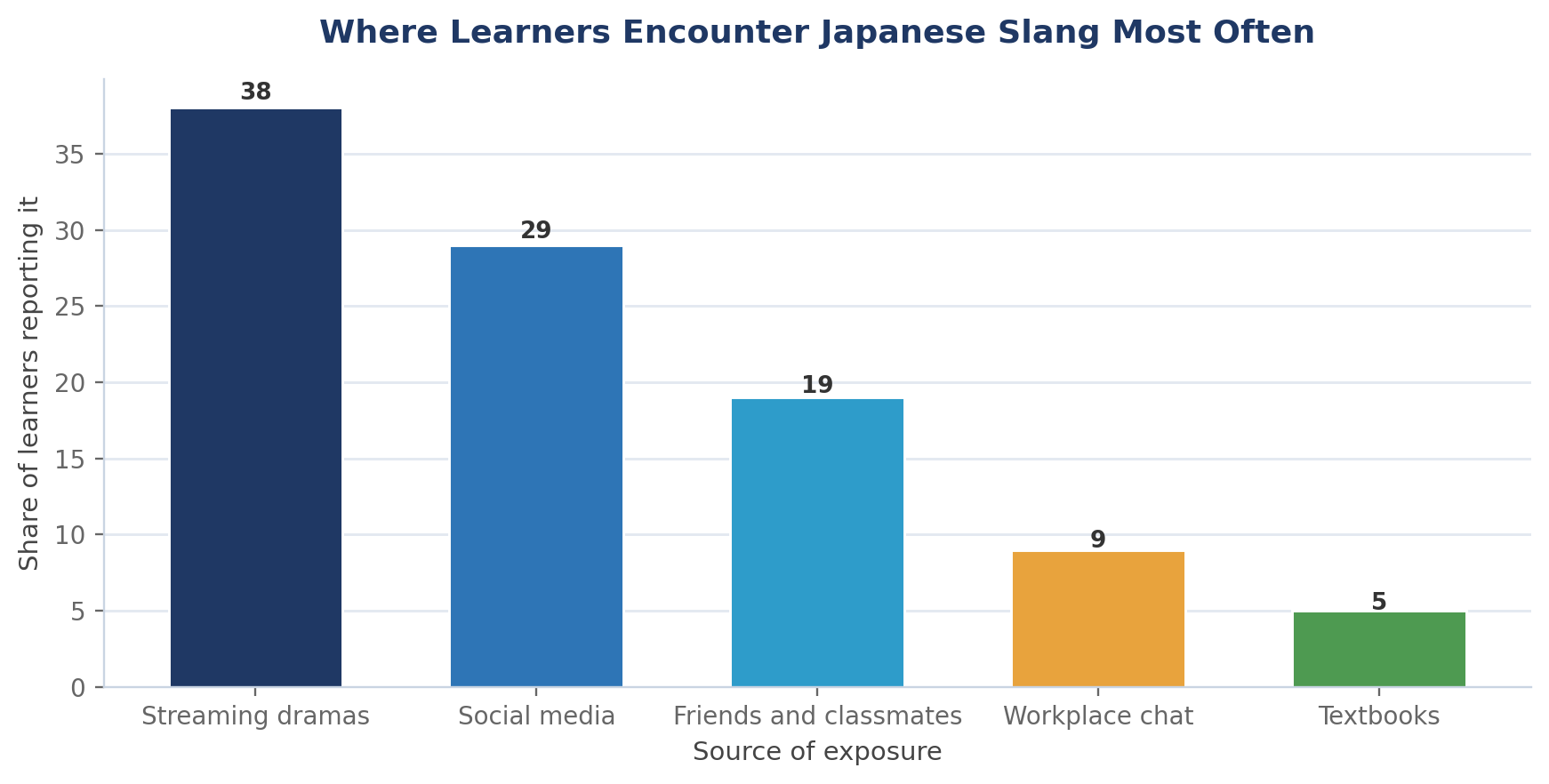
The chart above tells the real story. Only a sliver of slang exposure comes from formal study material — which means anyone who relies purely on textbooks is learning a language frozen in amber.
Workplace Registers: Casual and Polite Are Not Enemies
Here is the trap. Japanese has layers — casual (タメ口), polite (敬語 light) and honorific (敬語 heavy). Slang is not a substitute for politeness; it is a register that sits below neutral. You cannot skip a level, only choose one.
The practical rule: mirror the person you are speaking to, then move one step more polite until they invite you lower. Japanese speakers signal this constantly with yappari, soft particles like ne and yo, and the way they end their sentences.
When Slang Is Genuinely Inappropriate
Knowing slang is power; deploying it badly is a social tax. Avoid casual forms entirely with:
- Superiors and clients, where 敬語 is non-negotiable.
- Strangers on the street, especially older generations who read tameguchi as disrespect.
- Formal writing, from emails to university reports.
- Service settings, where you are the customer or the employee with a script.
- First meetings, where register is still being negotiated.
Slang is a door you open with someone, not a key you carry everywhere. Earn the casual register before you spend it.
Learn the rules before you break them
The fastest way to sound natural in Japanese is guided practice with a personal AI voice tutor that gives you feedback on your register in real time. Create a free account and explore how self-paced lessons build slang fluency alongside proper keigo — safely.
Create your free account →Create a free accountHow to Learn Slang Safely
- Track the register, not just the word. Note who says it, to whom, and where.
- Collect from conversation, not lists. Drama, variety shows and friend groups beat random blog posts.
- Test low-stakes settings first. Friends forgive a wrong word; clients do not.
- Ask native speakers directly. "Is this rude to my boss?" is always a good question.
- Keep polite Japanese sharp. Slang adds flavour; keigo keeps you employed.
The Council of Europe's CEFR framework reminds us that sociolinguistic competence — knowing when to say something — is part of real proficiency, not a bonus. Japanese slang is that skill in its purest form.
FAQ
Is Japanese slang rude? Not inherently — Japanese slang is neutral in itself. It becomes rude when used with the wrong person or in the wrong setting, such as with a manager, a client or an elder you have just met.
Can I learn slang from anime? Yes, but with caution. Anime exaggerates and often uses rough male speech that sounds aggressive in real life. Treat it as input, not as a script for your next business meeting.
How long until I can use casual Japanese comfortably? Most learners handle casual conversation around the B1 level, roughly after 300–400 hours of guided study. Politeness control tends to lag behind vocabulary, so practise both together.
Does slang help with the JLPT? Indirectly. The JLPT tests formal, standard Japanese, so slang will not appear directly — but the listening confidence and natural rhythm you build make the exam sections noticeably easier.