You have headphones, a commute, and a hundred free episodes. So why does every Japanese podcast still sound like a firehose aimed at your face?
Because listening is not a talent. It is a staircase. Step onto the wrong stair and you get soaked; step onto the right one and your ears quietly start decoding real human speech. Here is the map: the best Japanese podcasts for learners, matched to your actual level, plus the routine that turns audio into ability.
What you will get from this guide
- Podcast picks mapped to CEFR and JLPT levels
- A daily listening routine that fits a real commute
- The difference between passive listening and listening that trains your brain
Why Japanese Listening Feels Impossible at First
Japanese is mora-timed. Nearly every kana gets an equal beat, so the language machine-guns past you at a steady, merciless rhythm. Add pitch accent, where the same syllable pattern can carry different meaning, and particles that glue sentences together as quiet little function words — and your textbook vocabulary evaporates on contact.
That is not failure. That is the first stair. Beginner audio exists precisely to slow the beat down, and the Japan Foundation publishes free learner materials built exactly for that job, alongside the JLPT listening sections that test whether your ears have climbed higher.
The Podcast Map: Picks That Match Your Level
Notice the shape: as you climb, the podcast stops teaching you and starts simply being Japanese. That transition is the whole point, and it is where most learners give up too early. Push one level past comfortable and stay there.
Your ears need a coach, not just a feed
A podcast cannot hear your mistakes. With a personal AI voice tutor, you get structured lessons and speaking practice with feedback, so you can work on the sounds a podcast can't correct. Podcasts are the gym; a guided course is the coach standing next to you.
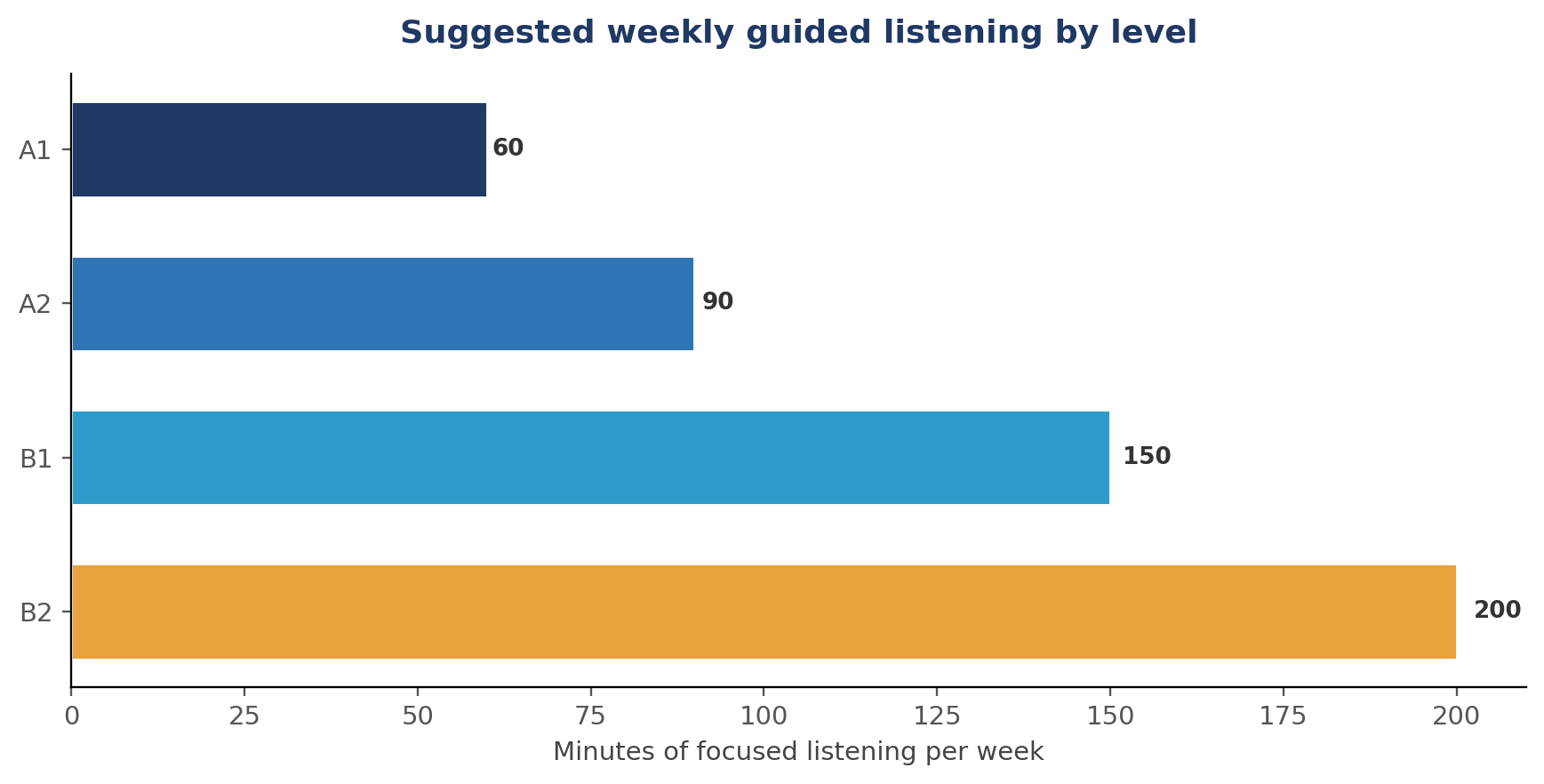
Learn Japanese with an AI voice tutor →Create a free accountHow Long Should You Listen Each Day?
Volume alone does nothing. Structure does. Split your listening into two kinds: input listening, where you simply absorb, and active listening, where you work.
The warm-up is the secret weapon. Familiar audio trains your brain to predict, and prediction is what fluent listening actually is. A stranger's voice at full speed is chaos; yesterday's voice is homework.
The Three Modes of Listening Practice
Dictation is brutal and brilliant: pause after each sentence and type exactly what you heard. You will discover you have been missing ます, が, and を for months. Shadowing fixes what dictation reveals — your mouth learns the beat your ear keeps dropping.
Five Traps That Stall Your Ears
Many learners follow the free feeds for a year and can still barely order coffee out loud, because the audio never talked back. Fix that early and everything else accelerates.
Where Coursework Beats Audio Alone
Podcasts feed you the sounds of Japanese. They do not test you, correct your pitch accent, or drag you into a conversation. The JLPT rewards exactly the skills structured study builds: timed comprehension, grammar precision, and the confidence to respond in real time.
If you want the listening work to compound, pair your daily podcast habit with structured, self-paced practice. You can create your free account and start with a placement check, then let the guided lessons catch what your headphones cannot.
Turn listening into speaking
You already know the words. The gap is speed, pitch and nerve. A personal AI voice tutor pushes you to answer at real tempo, so your next conversation in Japanese lands instead of stalling.
Start your Japanese course →Create a free accountFrequently Asked Questions
Are Japanese podcasts enough to learn the language on their own? No. Audio builds listening and vocabulary recognition, but grammar structure, pitch correction, and output need feedback. Use podcasts daily and a structured, self-paced course alongside them.
Which JLPT level do these podcasts prepare for? The lower-level picks support N5 and N4 listening, the mid-tier supports N3, and the conversational and advanced shows match N2 and N1 listening demands.
How long until my listening improves? With twenty to thirty focused minutes a day, most learners hear the first real jump in six to eight weeks. Passive-only listening can plateau for months.
Should I use Japanese or English subtitles while listening? Neither during your active pass. Listen raw, then check the transcript once to catch what you missed.
References & Further Reading
- Japan Foundation — Japanese-language education resources: https://www.jpf.go.jp/e/
- NHK World Japan — "Easy Japanese" learner audio: https://www.nhk.or.jp/lesson/en/
- JLPT official site (Japan Foundation / JEES) — test sections and levels: https://www.jlpt.jp/e/
- Nihongo con Teppei — beginner and intermediate conversation podcast
- Bilingual News — native-speed conversation podcast