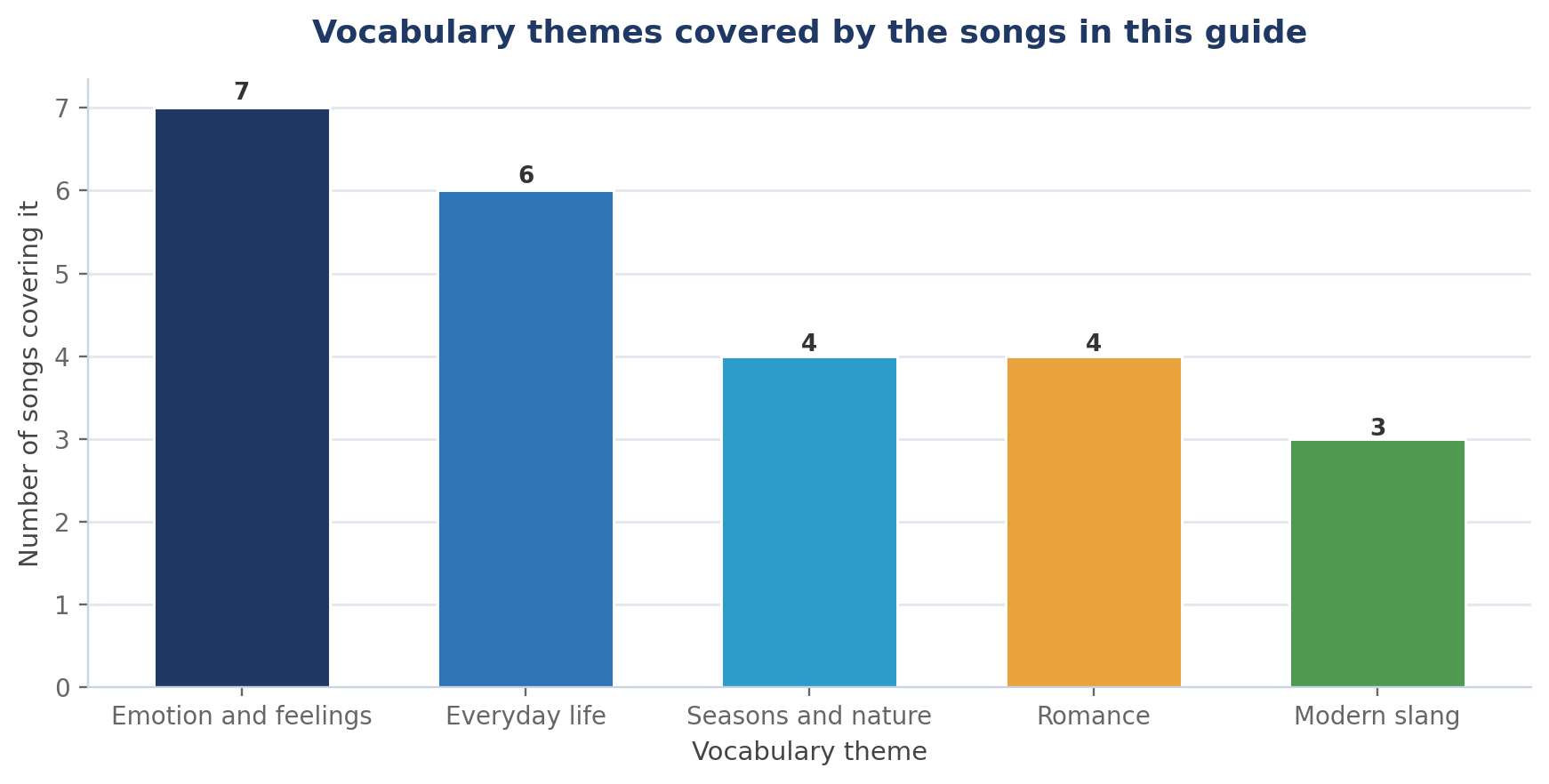
Music is the only study material you will willingly repeat fifty times. That is its superpower. A vocabulary list lasts ten minutes; a chorus you love survives for weeks in your head, arriving unbidden while you wait for a train. If you aim that repetition at Japanese, you have quietly built the most pleasant listening habit in language learning.
But music is also a slightly dishonest teacher. Lyrics bend grammar, stretch syllables and drop subjects. Used with open eyes, though, it is one of the fastest routes to a natural ear.
What you will get from this guide
- Which genres teach which skills, and which to avoid early
- Real Japanese artists and songs worth studying, with the language focus in each
- A lyric study method that turns a song into a lesson
- The traps that make music a bad primary teacher
Why music works for Japanese
Japanese has a feature that makes singing especially useful: pitch accent and mora timing. Japanese counts beats in units called morae, and each one is roughly equal in length — ni-ppon has four, tō-kyō- has a long vowel that counts double. Songs enforce this timing whether you like it or not. Sing along at speed and you stop stretching syllables the English way.
Songs also solve the vocabulary problem in the friendliest possible way. A chorus repeats four lines twenty times. You do not study them; you absorb them.
Genres, and what each one actually teaches
Start with children's songs and anime openings, even if it feels embarrassing. They have the clearest diction, the simplest grammar and the slowest vocabulary growth curve — exactly what a beginner needs.
Real songs worth studying, and why
Notice how each one plays a different role. The ballads teach vocabulary; the fast songs train speed; the retro city pop builds a bridge to adult, natural Japanese that textbooks often skip.
Turn your playlist into real listening progress
Songs build an ear; they do not build a conversation. A personal AI voice tutor takes the words you already know from music and puts them into structured speaking practice, with instant feedback that slows down, repeats and corrects.
Practise Japanese listening with your AI tutor →Create a free accountA lyric study method that actually works
Do not just sing along. Use this five-step loop on one song per week.
Step five is the one people skip, and it is the one that changes your accent. Singing forces vowel length and mora timing. If a syllable feels impossible to fit, you are almost certainly saying it wrong.
The traps: when music teaches you bad habits
Slang and contractions | Casual forms used in formal settings sound rude | Learn the polite equivalent side by side | English loanwords | Many choruses are 30% English | Count only the Japanese words as real input | Volume over accuracy | Singing fast can fossilise errors | Slow the track to 0.75x to check yourself |
Used as a supplement, music is superb. Used as your only teacher, it produces learners who can sing beautifully and order a coffee badly.
Building a listening routine around music
The Thursday session matters most. It converts recognition into production — the difference between understanding a chorus and saying something of your own.
Learn the Japanese your playlist cannot teach you
Songs give you emotion and rhythm. Structured practice gives you control. Self-paced, level-matched lessons with a personal AI voice tutor turn your musical ear into genuine speaking ability.
Explore self-paced Japanese courses →Create a free accountFrequently Asked Questions
Can I learn Japanese only from songs? No. Songs are excellent for listening, pronunciation and motivation, but they lack the systematic grammar and consistent register that full fluency needs.
Which Japanese songs are easiest for beginners? Children's songs and slow ballads with clear diction, such as Ue o Muite Arukō and First Love. Fast modern pop is better once you have a base of around 500 words.
Should I use romaji lyrics? Only for the first week. Switch to kana and kanji as soon as possible, or you will learn the sounds while ignoring the writing system.
How often should I study a new song? One song per week is plenty. Depth beats volume: five songs learned thoroughly teach more than fifty skipped through.
References & Further Reading
- Japan Foundation — Japanese-language learning resources and courses
- Japan Foundation — JF Japanese e-Learning Minato
- NHK — NHK World Japanese lessons and audio
- Council of Europe — CEFR descriptors for listening comprehension
- Japan Foundation — Survey on Japanese-language education worldwide