You will not learn Japanese from subtitles. You will learn it from the twenty minutes after the episode ends, when you rewind, shadow and steal the lines. Pick the right Japanese shows to learn from and your listening jumps a level per season — pick the wrong ones and you binge forty hours of noise.
Here is the shortlist, sorted by what you can actually handle, plus the method that makes it stick.
What you will get from this guide
- Beginner, intermediate and advanced picks with difficulty ratings
- A JLPT-level match table so you stop watching above your head
- The three-pass method: understand, shadow, harvest
- Subtitle rules that decide whether a show teaches or entertains
Match the Show to Your Level
The fastest way to waste a year is to start Terrace House at N5 and understand nothing but sugoi.
Beginner Picks (N5–N4)
Start where the language is slow, repetitive and aimed at six-year-olds. No shame in that — six-year-olds have excellent grammar.
For a structured counterpart, the Japan Foundation's Erin's Challenge! I Can Speak Japanese pairs video sketches with graded scripts. It is free and made for exactly this job.
Intermediate Picks (N3–N2)
Now the dialogue speeds up. This is where most learners plateau, because the gap between classroom Japanese and real Japanese is a canyon.
Reality shows are the secret weapon. Nobody is delivering a written script, so you hear real rhythm, real filler words (etto, ano ne) and real politeness shifts.
Advanced Picks (N1)
At this point you are not learning Japanese from the plot; you are mining it. Aim for genre variety so your ear stops expecting one register.
The Three-Pass Method
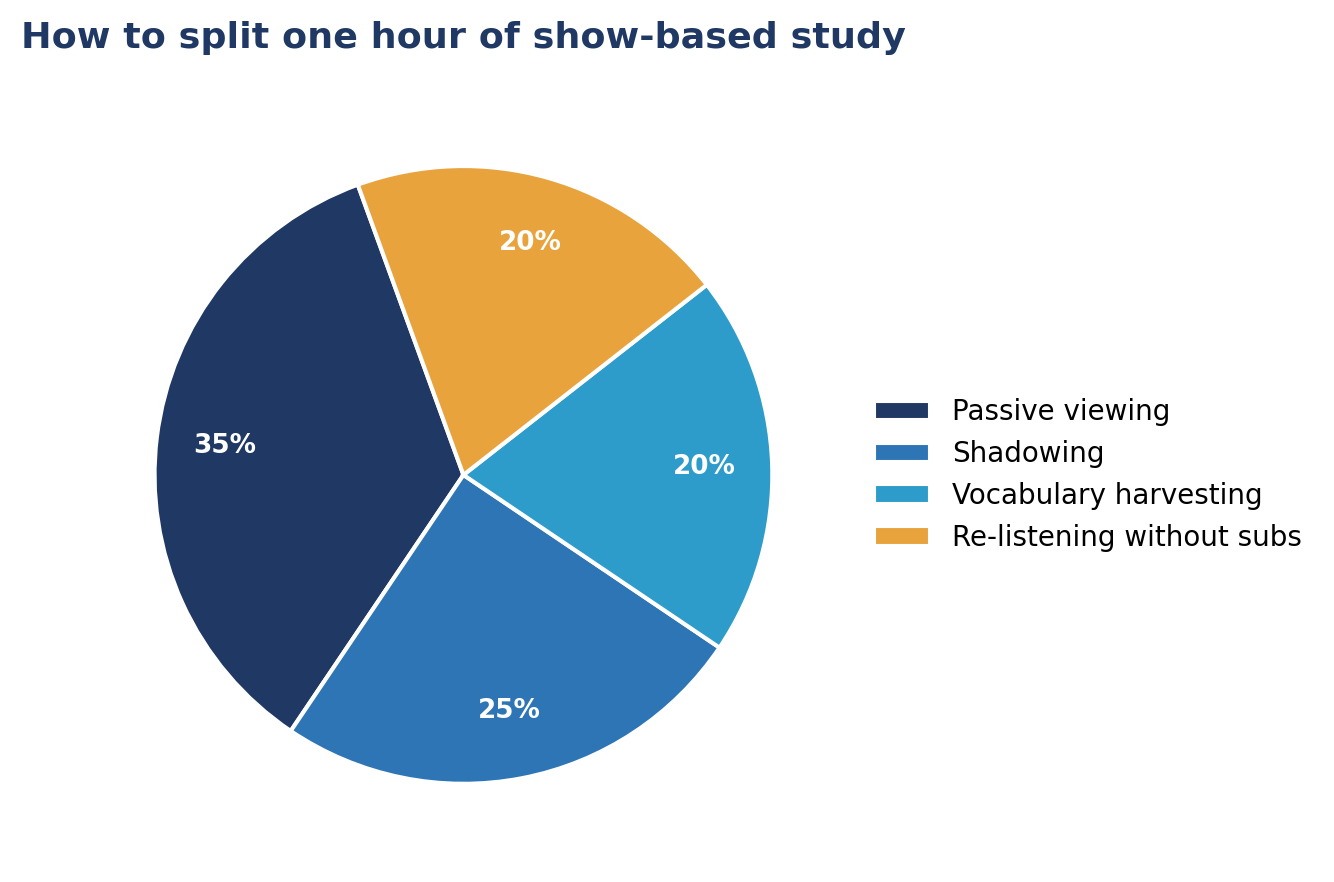
Watching once is entertainment. Watching three times is study. Same episode, three different jobs.
Total: about 75 minutes for one 22-minute episode. That is one serious study session, and it beats four hours of casual bingeing.
Shadowing alone has a ceiling
You can copy a line perfectly and still not know why it was polite, casual or rude. A personal AI voice tutor explains register, gives you speaking practice with feedback, and lets you drill at your own pace, any time.
Practise Japanese with an AI voice tutor →Create a free accountSubtitle Rules That Decide Everything
Building a Weekly Rhythm
Three episodes a week at the three-pass method equals about four hours of high-quality listening. Add flashcards for the 30–40 phrases you harvested and you have a schedule that fits a full-time life.
Rotate: one familiar show for comfort, one hard show for growth. Comfort shows make you fluent at a small world; hard shows open new ones. Two-thirds comfort, one-third stretch is the sweet spot.
For exam-takers, cross-check your level against the official JLPT level descriptions. If you cannot follow an N3 slice-of-life episode without subtitles, your listening is behind your vocabulary — and that is fixable in one season.
Turn watching into speaking
Bring your favourite scene to your AI voice tutor. It breaks it down, gives you speaking practice with feedback, and lets you use the phrases in your own sentences until they are yours.
Start a Japanese course →Create a free accountFrequently Asked Questions
Can I really learn Japanese from anime? Yes, for listening and vocabulary — with one caveat. Anime speech is exaggerated and often rude in real life. Pair it with dramas or reality shows so you do not sound like a shonen hero at the office.
How many episodes before my listening improves? Most learners notice a shift after 30–40 episodes watched with the three-pass method. That is roughly 20 hours of focused listening, not background noise.
Should I watch with Japanese subtitles forever? No. Use them for pass one only. Learners who keep subtitles on for a year get excellent reading and almost no listening, because the eyes never let the ears struggle.
**Is Terrace House too hard for N4?** Usually yes. Try one episode with Japanese subtitles. If you understand under half, drop to Chibi Maruko-chan and return in three months.
References & Further Reading
- Japan Foundation: Erin's Challenge! I Can Speak Japanese, free graded video course
- Japan Foundation: Marugoto: Japanese Language and Culture, CEFR-aligned textbooks with audio
- Japan Foundation and JEES: JLPT official level descriptions and sample questions
- NHK World Japan: Easy Japanese and News Web Easy for graded listening
- NHK: Old Enough! (Hajimete no Otsukai), simple natural Japanese with subtitles
Compare your listening level with a personal AI voice tutor in a free placement check and build a watch list that matches it.