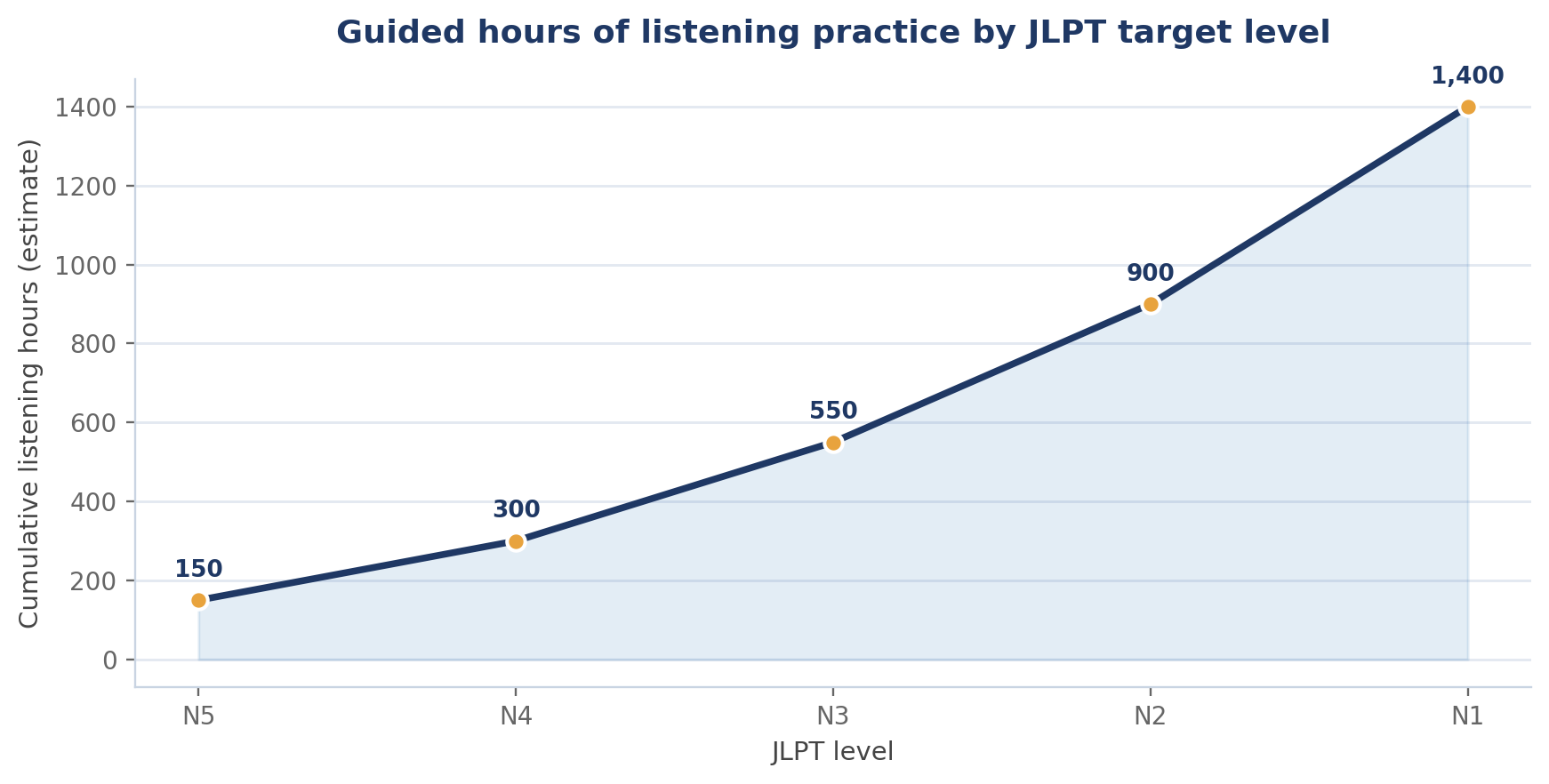
Here is the number that breaks hearts: the JLPT N5 listening section hands you roughly thirty minutes of speech. Then N3 hands you forty. Then N1 hands you a wall.
Learners who pass the reading sections fail the listening one. Every December, thousands of them stare at a score sheet wondering how a language they can read became a language they cannot hear.
The answer is not more anime. It is training.
What you will get from this guide
- Why Japanese listening breaks down into four separate skills
- A staged practice ladder from NHK Easy to native radio
- Realistic hour bands for JLPT listening levels
Why Japanese Ears Struggle More
Japanese listening is not "English listening, but with different words". Three features raise the difficulty.
First, no spaces. Foreign learners are used to audible gaps between words. Japanese delivers korewadonnakotodesuka as one breath and expects you to cut it yourself.
Second, pitch accent. Hashi can mean chopsticks, bridge or edge depending on the melody. Ignore pitch and dozens of common words blur into each other.
Third, register. Casual speech deletes sounds. Tabemashita becomes tabeta. Shitte imasu becomes shitteru. Textbook ears hear nothing.
The Four Listening Skills Nobody Separates
Treat these separately and your practice stops being a fog of "more input".
Most learners over-train only the third. They can follow a slow podcast and nothing else.
Start Where You Can Actually Hear
The ladder below is not a suggestion about difficulty. It is a suggestion about sound quality. If you cannot transcribe six consecutive seconds, the material is too hard, whatever a website claims.
That last stage sounds like a joke. It is the real test. Jokes land and die in two seconds.
Dictation: The Drill That Feels Painful and Works
Play eight seconds of audio. Write exactly what you hear in kana or romaji. Replay up to five times. Then check the script.
The gap between what you wrote and what was said is your entire curriculum. It will say things like: you missed the small っ, you heard が where it was か, you deleted a whole clause.
Ten minutes, three times a week, will do more than three hours of background listening while washing dishes.
Shadowing Without Fooling Yourself
Shadowing means speaking along with audio, half a beat behind. It welds listening to production, which is why learners improve at both together.
Hum first. Seriously. Pitch accent lives in melody, and humming exposes it faster than any diagram.
The Ceiling of Passive Listening
You can bathe in Japanese for a year and still freeze when a shop assistant asks a question you did not script. Background audio builds familiarity. It does not build reaction time.
Reaction time comes from being answered. Real listeners interrupt, backtrack, use filler, switch to casual forms mid-sentence, and expect you to keep up. That is where structured, interactive practice beats passive listening.
Train your ears with a personal AI voice tutor
Self-paced Japanese lessons put you in guided conversation practice from the first lesson — with an AI voice tutor that gives you speaking feedback, on your schedule.
Start Japanese listening practice →Create a free accountJLPT Listening: What Actually Gets Tested
The JLPT listening sections are long, fast and one-shot. You hear a task once. There is no rewind.
Quick Response is the quiet killer. It tests social instinct, not vocabulary. Practise with real recorded dialogues and predict the reply before you hear it.
A Practice Week That Fits Real Life
Roughly an hour and a half a week. Six focused weeks of this, and slow podcasts stop sounding like rivers.
Frequently Asked Questions
How long does it take to improve Japanese listening? Expect noticeable change in four to six weeks of daily focused practice, and major change in three to six months. Background listening alone can take years.
Should I watch anime to learn listening? Anime is good material if you shadow it with the script hidden. It is weak material if you rely on English subtitles, because your eyes will do all the work.
Is pitch accent necessary for listening? For comprehension, yes — enough to tell hashi from hashi. You do not need native-perfect pitch, but you do need to hear it.
What if I understand a podcast but not people in real life? That is normal. Podcasts are planned. Conversation is unrehearsed, so add live practice and quick-response drills.
Stop decoding. Start understanding.
Self-paced Japanese lessons with a personal AI voice tutor build your ear with real dialogue, then push you to answer at natural speed.
Start listening better →Create a free accountReferences & Further Reading
- Japan Foundation — official JLPT information, level descriptions and listening formats: https://www.jlpt.jp/e/
- The Japan Foundation — JF Standard for Japanese-Language Education: https://www.jfstandard.jpf.go.jp/
- NHK — News Web Easy, simple Japanese news with audio and scripts: https://www3.nhk.or.jp/news/easy/
- The Japan Foundation — Survey Report on Japanese-Language Education Abroad: https://www.jpf.go.jp/e/project/japanese/survey/result/
- LanguageSkills.net — self-paced Japanese courses (A1–B2) with a personal AI voice tutor: https://languageskills.net/register