There is a specific, maddening moment in English learning. You read a transcript and every word is familiar. You play the audio and it sounds like one continuous blur. Same words. Same language. Completely different experience.
This is not a vocabulary problem. You already know the words — that is precisely what makes it so frustrating. It is a decoding problem, and decoding improves with three specific drills, not with more vocabulary lists.
What this guide covers
- Why listening feels harder than reading, mechanically
- The three drills that actually build comprehension
- A 20-minute daily routine
- Why "listen more" is bad advice
- The one habit that wastes most listening hours
Why listening is genuinely harder than reading
Reading gives you time. Listening does not. That single difference cascades into four concrete difficulties.
Read that table again. Every row describes a skill you cannot get from vocabulary study — which is why a learner with 8,000 words can still struggle while a learner with 3,000 follows podcasts fine.
The three drills that actually work
Most listening advice is "listen more." That is like learning to swim by being near water. These three drills target the actual deficit.
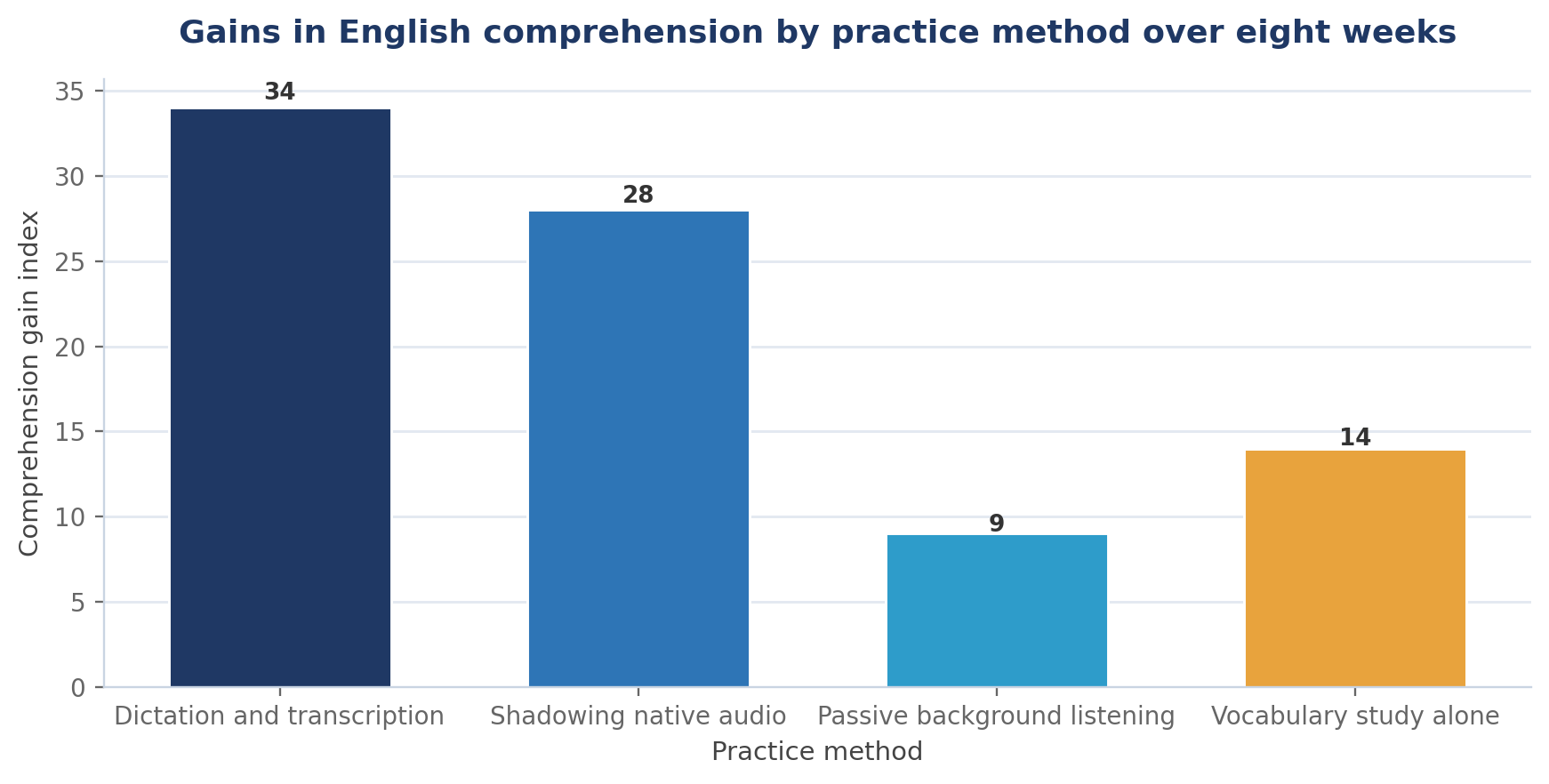
Dictation is the workhorse and the one everyone skips. Five minutes of writing what you hear exposes exactly which sounds you are not processing — and it is always a smaller set than you fear.
What connected speech does to English
English compresses. Once you know the rules, the blur resolves into patterns.
None of this is sloppy speech. It is standard English at natural speed, and every fluent listener's brain is applying these rules continuously.
The 20-minute daily routine
The last two minutes are psychologically important. Hearing a clip that was opaque become clear — in the same session — is the feedback that keeps learners going.
Matching material to your level
The 70–85% band is where improvement happens. Below 50% you learn to tune out; above 95% you learn nothing new.
Ready to turn reading into real English? Start your self-paced course today.
Start the English course →Create a free accountHear English and answer it, not just decode it
Passive listening builds comprehension. A personal AI voice tutor adds the missing half — hearing a question and having to respond, in real time, with AI feedback correcting you. That is where listening becomes usable.
Button: Explore the English Course Pass →
The habit that wastes most listening hours
Background listening while distracted. It feels productive, it is pleasant, and it produces almost nothing — because comprehension requires attention.
It has exactly one legitimate use: familiarising your ear with the sound of English, so it stops being alien. Keep it for that. But do not count it as practice. Practice looks like five focused minutes with a pen and a transcript.
Listening is not about hearing more English. It is about hearing the same English more carefully.
Five weeks of focused work
Five weeks is not arbitrary. It is roughly the point where learners report the "blur breaking" — the moment continuous speech starts arriving as discrete words.
Free sources worth queueing
Bookmark three, not thirty. Depth beats variety — repeating material you half-know is how listening quietly becomes fluency.
Ready to turn reading into real English? Start your self-paced course today.
Start the English course →Create a free accountGet a listening plan matched to your level
A free languageskills.net account includes a level check and guided listening practice, so you stop guessing which material is right and start improving from where you actually are.
Button: Create your free account →
Frequently Asked Questions
Why can I read English better than I can understand it spoken? Reading allows unlimited decoding time; speech does not. Connected speech also merges and reduces sounds, so the same words arrive in a different shape.
How long until my English listening improves? With daily focused practice, most learners report a noticeable improvement within four to six weeks — with the "blur breaking" somewhere around week five.
Should I listen with subtitles? Not on your first pass. Use the transcript afterwards to check what you missed — that comparison is where the learning happens.
Is background listening useful at all? Only for ear familiarity. It is not practice, because comprehension requires attention you are not giving it.
References & Further Reading
- British Council — LearnEnglish listening resources by level
- Cambridge English — Learning English resources
- BBC Learning English — Free lessons, audio and transcripts
- Council of Europe — CEFR levels and listening descriptors
- European Commission — Multilingualism and language-learning policy