Japan's campuses are full of international students who arrived with almost no Japanese — and a few who arrived with N1 and still felt underwater in week one. The difference is not talent. It is route choice. Get that right, and the answer to "how much Japanese do I need for university in Japan?" becomes a number you can actually chase instead of a mystery you panic about.
The Short Answer: Two Doors, Two Different Keys
There are exactly two ways in. English-taught degrees let you start with zero Japanese, but they narrow your part-time work, internships and friendships to the English-speaking bubble. Japanese-taught degrees demand proof you can survive a real lecture hall: usually JLPT N2 minimum, often N1, plus a solid EJU score.
Route One: English-Taught Degrees (The Zero-Japanese Door)
Hundreds of programmes now run entirely in English. The catch is honesty: an English-taught degree is a degree, not an integration. You will still need Japanese to rent an apartment, argue with a phone contract, sign up at a hospital, and — critically — get hired in Japan after graduation. Most recruiters run interviews in Japanese. So even the zero-Japanese door has a Japanese-shaped toll booth at the exit.
Route Two: Japanese-Taught Degrees (The Real Test)
This is where JASSO's EJU becomes your exam. The EJU includes a Japanese as a Foreign Language section scored out of 400 (plus 50 for writing). National universities usually want 220–280+; competitive faculties want more.
The Benchmarks That Matter: EJU and JLPT
The JLPT is a comprehension test: it proves you can read and hear Japanese. The EJU proves you can use Japanese for academic subjects. Both are needed for the Japanese-taught route, and both test vocabulary that ordinary conversation classes never touch.
N2 is the doorway, not the finish line. Passing N2 on a multiple-choice exam and understanding a 90-minute economics lecture are two different skills — which is why the EJU's writing task exists.
Stop guessing your level — train the exact Japanese universities test
Our self-paced Course Pass lessons build academic vocabulary, EJU-style reading and lecture listening with a personal AI voice tutor that gives you feedback as you practise. Instead of self-studying toward a deadline you can't measure, you get a structured progression mapped to N5 through N2.
Find your Japanese course →Create a free accountWhat N2 and N1 Actually Enable in the Lecture Hall
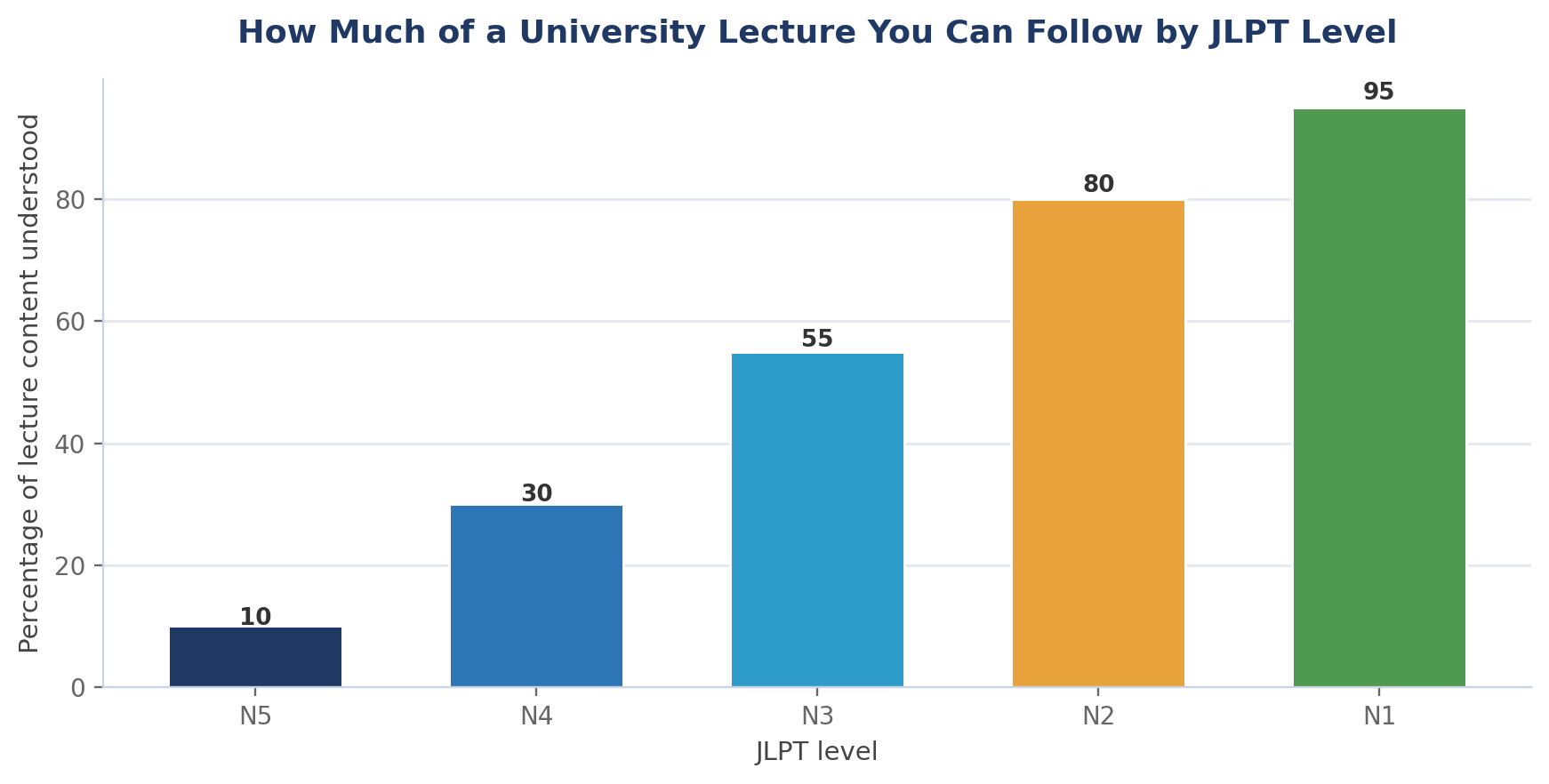
Here's the honest picture. At N3, lectures feel like weather — you catch the shape, not the content. At N2, you follow the structure, miss fast asides, and take notes that hold together. At N1, you catch tone, implication and teacher humour. That progression matters more than the certificate number.
The Reading Load Nobody Warns You About
Speaking gets you through lunch. Reading gets you through your degree. A single undergraduate seminar can assign 60–120 pages of Japanese per week, and academic writing uses long compound sentences that never appear in textbooks.
How Long Does Preparation Actually Take?
From zero, most dedicated learners need roughly 600–900 hours for N2 — and N1 pushes past 1,700. Spread evenly, that is two to three years of daily study. Squeezed into a visa deadline, it becomes nine intense months.
A Realistic Study Plan
Months 1–3: kanji foundations (600 characters), core grammar, daily listening. Months 4–6: N3 grammar, NHK World's Easy Japanese for real-speed audio, start 15-minute reading sprints. Months 7–9: N2 vocabulary in academic context, EJU reading passages, one essay per week. Months 10–12: full practice exercises under time pressure, plus lecture shadowing. Check your trajectory against the CEFR scale — N2 sits around B1–B2, N1 around C1.
Track your Japanese progress like an applicant, not a hobbyist
Create a free account to save your study plan, log daily practice and follow structured lessons that map to the JLPT and EJU benchmarks universities actually check.
Create your free account →Create a free accountFAQ
Can I study at a Japanese university with zero Japanese? Yes — via English-taught programmes, which are increasingly common at national and private universities. You will still need Japanese for daily life and for most post-graduation jobs.
Is N2 enough for a Japanese-taught degree? For most programmes, yes. N2 is the standard requirement for undergraduate and vocational entry, though competitive faculties and graduate research often expect N1.
How much Japanese is needed for the EJU? Around N2-level vocabulary and grammar plus strong academic reading speed. A score of 220–280 is typical for national universities, with higher scores for competitive faculties.
Do I need JLPT or EJU for an English-taught degree? No. English-taught admissions use TOEFL or IELTS scores instead, and the Japanese requirement is waived entirely.
References
- JASSO — Examination for Japanese University Admission (EJU)
- Japan Foundation — Japanese-Language Proficiency Test (JLPT)
- MEXT — Study in Japan
- NHK World — Easy Japanese
- Council of Europe — CEFR reference levels