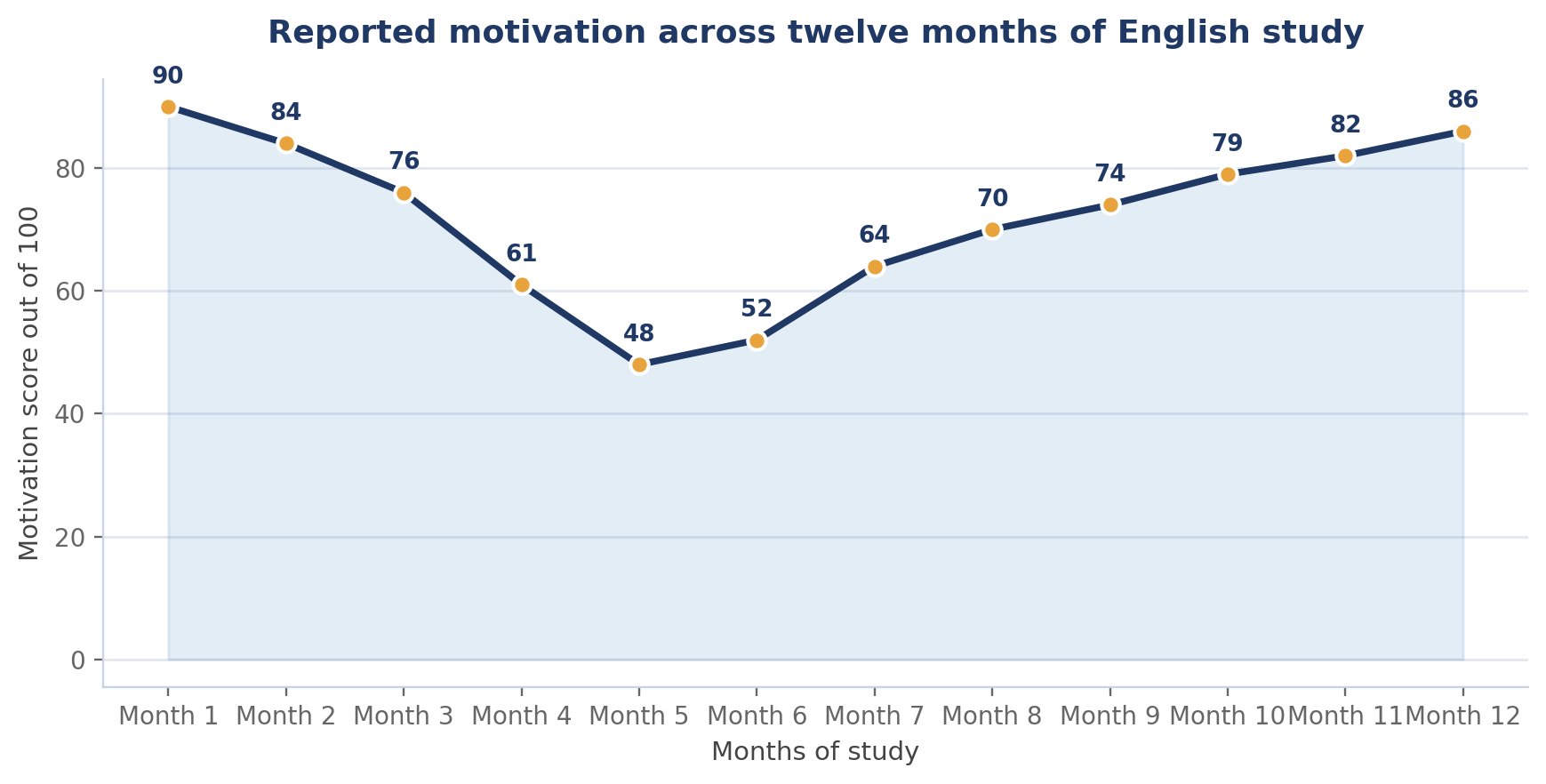
You started with fire. Flashcards on the bus, podcasts in the shower, a notebook you genuinely loved. Then week six arrived, and the fire quietly went out. Nothing dramatic happened — you simply stopped.
Here is the truth nobody tells beginners: motivation is not a personality trait you either have or lack. It is a system you build. And it can be rebuilt at any point, at any level.
What this guide covers
- Why motivation collapses at the intermediate level
- Habit design that works on bad days, not just good ones
- The three metrics that make progress visible
- Why other people are the strongest motivator available
- A 30-day reset you can start tomorrow
Why motivation fades: the intermediate wall
Beginners improve fast because everything is new. Every word is a win. Then you hit B1 — the crowded middle — and progress stops feeling like progress.
The CEFR describes levels as widening bands. The jump from A2 to B1 feels enormous; the jump from B1 to B2 can feel invisible even while it is happening.
The plateau is not evidence that you cannot learn. It is evidence that you have learned enough for the easy wins to run out.
Habit design beats willpower
Willpower is a terrible long-term strategy, because it is finite and mood-dependent. Habits are better because they are automatic. Instead of committing to "study more English", commit to a trigger, a tiny action and a reward.
The last row matters most. Everyone misses days. The learners who succeed are simply the ones who have pre-decided that a missed day is not a verdict.
Shrink the habit until failure is impossible
Ten focused minutes daily beats a heroic three-hour session once a fortnight, because consistency is what your brain encodes. If a habit feels heavy, it is too big — cut it in half until it stops being a decision.
The plateau is a data problem, not a talent problem
When learners say "I am not improving", they usually mean "I cannot feel improvement". Feeling is unreliable. Measurement is not.
Pick three, nothing more, and review them weekly. That alone cures most of the "I am stuck" feeling.
Notice the shape: a dip, a bottom, then recovery. And notice what usually causes the recovery. It is rarely a new app. It is other people.
Ready to turn reading into real English? Start your self-paced course today.
Start the English course →Create a free accountTurn a fragile habit into a daily routine you keep
The Course Pass gives you a personal AI voice tutor that guides structured lessons at your own pace, any time. Show up daily and let the system carry the motivation for you.
Button: Explore the English Course Pass →
Social accountability: the multiplier
You will cancel on yourself. You will not cancel on a tutor who knows your progress, or a study buddy who is waiting for you. This is the most underrated motivation tool in language learning, and it is free to exploit.
Discipline gets you to the first class. Other people get you to the fiftieth.
How structured lessons supply what willpower cannot
Scheduled lessons externalise discipline. The decision is already made, the time is already blocked, and a tutor is already expecting you. Add AI feedback — the feedback loop self-study cannot provide — and you move through the middle levels faster, which is exactly where most learners quit.
A 30-day motivation reset
Repeat monthly. After two cycles, the habit is no longer something you are motivating yourself towards — it is simply something you do.
Ready to turn reading into real English? Start your self-paced course today.
Start the English course →Create a free accountStart tracking progress with a tutor, not just apps
Create a free account to access your AI voice tutor, and give your motivation a structured safety net. It takes a minute — and it makes quitting considerably harder.
Button: Create your free account →
Frequently Asked Questions
Is it normal to lose motivation while learning English? Yes — close to universal. Teaching resources from Cambridge English and the British Council treat motivation dips as a predictable stage rather than a personal failure.
How long does the intermediate plateau last? Most learners notice renewed momentum within four to eight weeks of adding regular speaking practice with feedback. The bottleneck is usually output, not input.
What is the fastest way to stay motivated? Commit to a fixed daily lesson with your AI tutor. External accountability removes the daily decision to study, which is where most motivation is lost.
Should I study every day or a few times a week? Short daily contact plus two or three speaking practice sessions weekly is the sweet spot — consistency builds the habit, and conversation builds the fluency.
References & Further Reading
- British Council — LearnEnglish resources and level guidance
- Cambridge English — Learning English resources
- BBC Learning English — Free lessons, audio and transcripts
- Council of Europe — CEFR levels and descriptors
- European Commission — Multilingualism and language-learning policy