You have got the streak. You have got the badge. So why does a real conversation still feel like walking into a wall?
That is the gap this article is about. The best way to learn English app or course is not a trick question — it is two different jobs. Apps train recognition. Courses train production. Confuse the two and you can spend three years tapping green buttons while your speaking stays frozen at "hello, how are you?"
Let us be specific about which one actually works, and when.
The short version
- Apps are unmatched for vocabulary volume and convenience
- Apps cannot hear your pronunciation, pressure you, or rebuild a curriculum around you
- Cost per usable speaking hour flips the comparison fast
- The winner is a division of labour, not a choice
What English apps genuinely do well
Give credit where it is due. The modern app is a masterpiece of behavioural design: it removes friction, gamifies repetition, and puts native-speed audio in your pocket for the price of a coffee.
None of that is trivial. The British Council and BBC Learning English both publish excellent free material, and used well it can carry you surprisingly far. But "far" has a ceiling, and the ceiling is made of four bricks.
The four things apps structurally cannot do
The first is worth dwelling on. An app will accept a sentence that no native speaker would say, mark it green, and teach you nothing. A teacher hears the word stress that makes your question sound like an accusation — and fixes it in ten seconds.
Apps are brilliant at your first 300 words. Courses are built for your 3,000th.
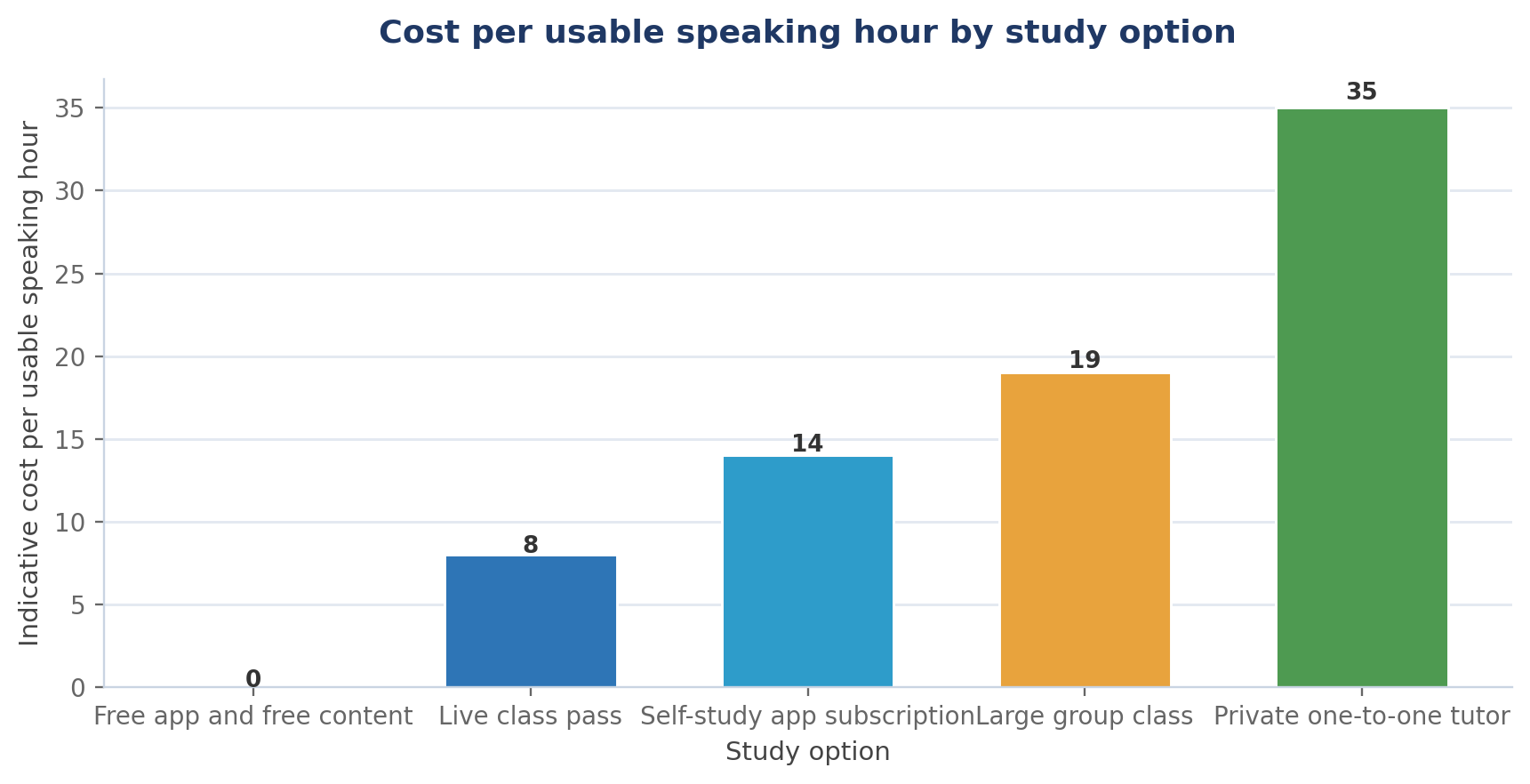
Cost per usable hour: the maths apps do not show you
App marketing sells monthly price. The honest metric is cost per usable hour — time spent actually producing language, not tapping it.
The chart is the whole argument. Free is free only if you convert it into speaking — and apps, by design, rarely do that.
Which option suits whom
There is no universally right answer, only a right first move for your situation.
The hybrid routine that beats both
The winning approach is not a choice — it is a division of labour. Apps own repetition. Courses own performance.
Aim for the CEFR B1 checkpoint first. Note that CEFR describes what you can do, not what you have completed — an app measures completion, a course measures performance. That difference is the entire argument.
Ready to turn reading into real English? Start your self-paced course today.
Start the English course →Create a free accountTurn tapping hours into talking hours
You already know the vocabulary — you just need somewhere to use it out loud, with someone who corrects you. A Course Pass gives you a personal AI voice tutor, structured lessons from A1 to B2, and a plan built around your errors — all self-paced, any time.
Button: See the English Course Pass →
Three signs it is time to switch
That third sign is the real diagnostic. When you start choosing the café where you will not have to talk, the problem has moved from your vocabulary list to your confidence — and confidence is built only by speaking.
Ready to turn reading into real English? Start your self-paced course today.
Start the English course →Create a free accountStart free, then decide
Create an account, take the placement check, and see exactly where you sit on the CEFR scale. No card, no pressure — just a clear starting line and a plan you can build on.
Button: Create your free account →
Frequently Asked Questions
Are English apps a waste of money? Not at all. They are the cheapest, most convenient source of vocabulary and listening exposure ever built. They are a poor only strategy once speaking becomes your bottleneck.
Can I reach fluency with an app alone? Fluency means fluid, unrehearsed conversation. That requires unpredictable human partners and correction. Very few learners get there on app input alone.
How quickly does a self-paced AI tutor course show results? Many learners notice improved confidence after several weeks of regular speaking practice — long before their grammar is perfect.
Do I need both? It is the strongest combination. But if you must pick one and your goal is speaking, choose the course and use free content for repetition.
References & Further Reading
- British Council — English learning and teaching resources
- Cambridge English — Learning English resources and qualifications
- BBC Learning English — Free lessons, audio and transcripts
- Council of Europe — CEFR levels and descriptors
- European Commission — Multilingualism and language-learning policy