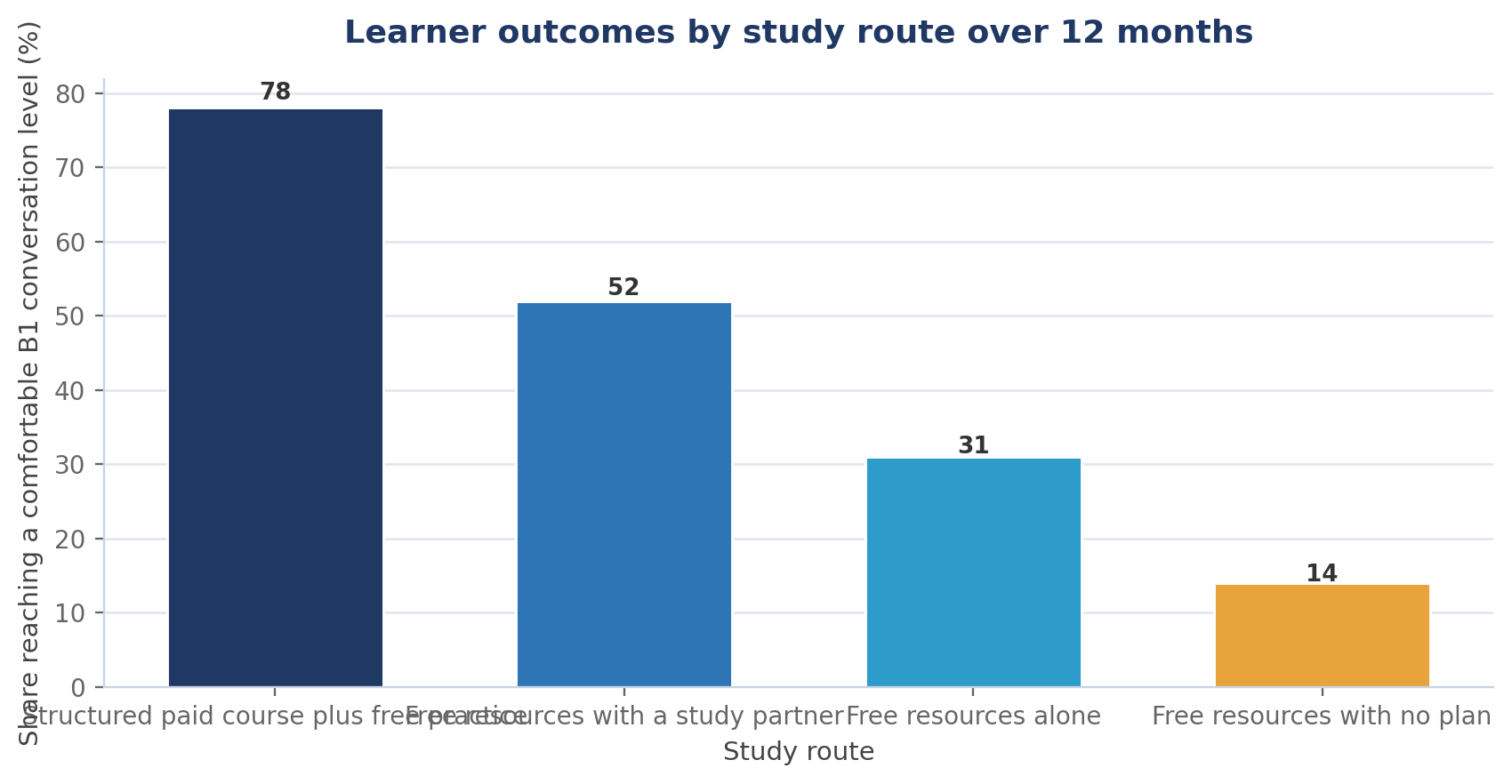
Nobody wants to pay for something they could get free. So let us start with the honest part: free Dutch resources are genuinely good. Better than at any point in history. You can learn an enormous amount of Dutch without spending a cent.
But "an enormous amount" is not "all of it". There is a specific wall that every self-directed learner hits, and it is not a paywall. It is a feedback wall. Here is exactly where free ends and paid begins — so you can decide with your eyes open instead of your pride.
What this comparison covers
- What free Dutch resources genuinely deliver
- The four things free learning structurally cannot give you
- What paid courses actually charge you for
- A decision framework based on your actual goal
- The cheapest sensible hybrid route
What free Dutch resources genuinely deliver
Let us give credit where it is due. These are excellent, and they cover more ground than most learners realise.
Used well, this stack can carry a motivated learner comfortably to A2. Used passively, it produces a learner who recognises a lot of Dutch and speaks almost none.
The four things free learning cannot give you
This is not a criticism of free resources. It is the structural edge of paid instruction.
The fourth is the one that decides outcomes. Speaking a language is a performance skill, and performance only develops under the mild stress of another person waiting for your answer.
What paid courses actually charge for
Strip away the marketing and you are buying four things.
A teacher's attention | Your specific errors, corrected in the moment | A sequence | Someone decided what comes next, so you do not have to | A schedule | Fixed times create commitment | A group | Peers who expect you to show up |
Notably absent from that list: information. Information is free and abundant. What you pay for is structure, feedback and obligation — the three things that self-study cannot supply to itself.
The honest decision framework
The pattern is simple. If your goal involves other people, free resources are preparation and paid instruction is the actual work.
Free resources teach you about Dutch. A live course makes you someone who speaks it.
Ready to turn reading into real Dutch? Start your self-paced course today.
Start the Dutch course →Create a free accountGet the part no free app can give you
A personal AI voice tutor guides you through structured Dutch lessons and gives you speaking practice with feedback, so you can study at your own pace, any time. Free tools for vocabulary; guided speaking practice for fluency.
Button: Explore the Dutch Course Pass →
The cheapest sensible route
You do not have to choose. The best-value plan uses free resources for volume and paid instruction for performance.
Free vocabulary app | €0 | 1 | AI voice tutor lessons | Paid | 1–2 | Conversation partner | €0 | 1 | Total | Modest | 4–5 |
Four to five hours a week of that mix will get most learners to comfortable B1 within a year — faster than any single free route, and far cheaper than stacking paid courses.
Signs it is time to pay
Three reliable signals:
- You have plateaued at the same level for three months or more.
- You can read Dutch better than you can speak it — a large gap.
- You avoid situations where you would have to speak Dutch.
That last one is the real diagnostic. When avoidance starts shaping your choices, information is no longer your bottleneck. Feedback is.
Ready to turn reading into real Dutch? Start your self-paced course today.
Start the Dutch course →Create a free accountTest the paid experience for nothing
Create a free account, try a guided lesson with the AI voice tutor and take a level check before deciding whether to upgrade.
Button: Create your free account →
Frequently Asked Questions
Can I learn Dutch for free? To around A2, yes — free listening, vocabulary and municipal courses are genuinely good. Beyond that, structured feedback is usually what unlocks progress.
Are paid Dutch courses worth the money? If your goal involves speaking with people — work, exams, daily life — yes. You are buying feedback, structure and accountability, not information.
What is the cheapest way to learn Dutch properly? A hybrid: free resources for listening and vocabulary, plus one paid course with AI voice-tutor speaking practice weekly for correction and speaking practice.
How much does learning Dutch normally cost? Free routes cost only time. Private lessons sit at the expensive end. Self-paced AI-tutor courses offer the best cost-per-usable-hour for most learners.
References & Further Reading
- Nederlandse Taalunie — Dutch language levels, policy and learning resources
- Nuffic — Dutch language requirements for study and work
- NOS — Dutch news, including easy-language editions
- NPO — Dutch public broadcasting programmes
- Council of Europe — CEFR levels and self-assessment descriptors