Both routes work. That is the first honest thing to say, because the internet is full of people insisting that one of them is a waste of money or a waste of time. In reality, self-study and guided courses fail and succeed for very specific reasons, and knowing those reasons lets you choose deliberately rather than hopefully.
Here is the comparison, without the sales pitch — followed by the approach that outperforms both.
What you will get from this guide
- What self-study genuinely does better
- What only a guided course can supply
- An honest comparison of cost, speed and outcomes
- The hybrid plan that beats either option alone
What self-study does better
For vocabulary volume, grammar reference and reading practice, self-study is genuinely excellent. Learners who are disciplined and self-aware can reach A2 alone without much trouble.
What only a guided course provides
The critical, irreducible difference is a second person. Language is social before it is academic. You cannot practise a conversation alone, no matter how many apps you install.
The honest comparison
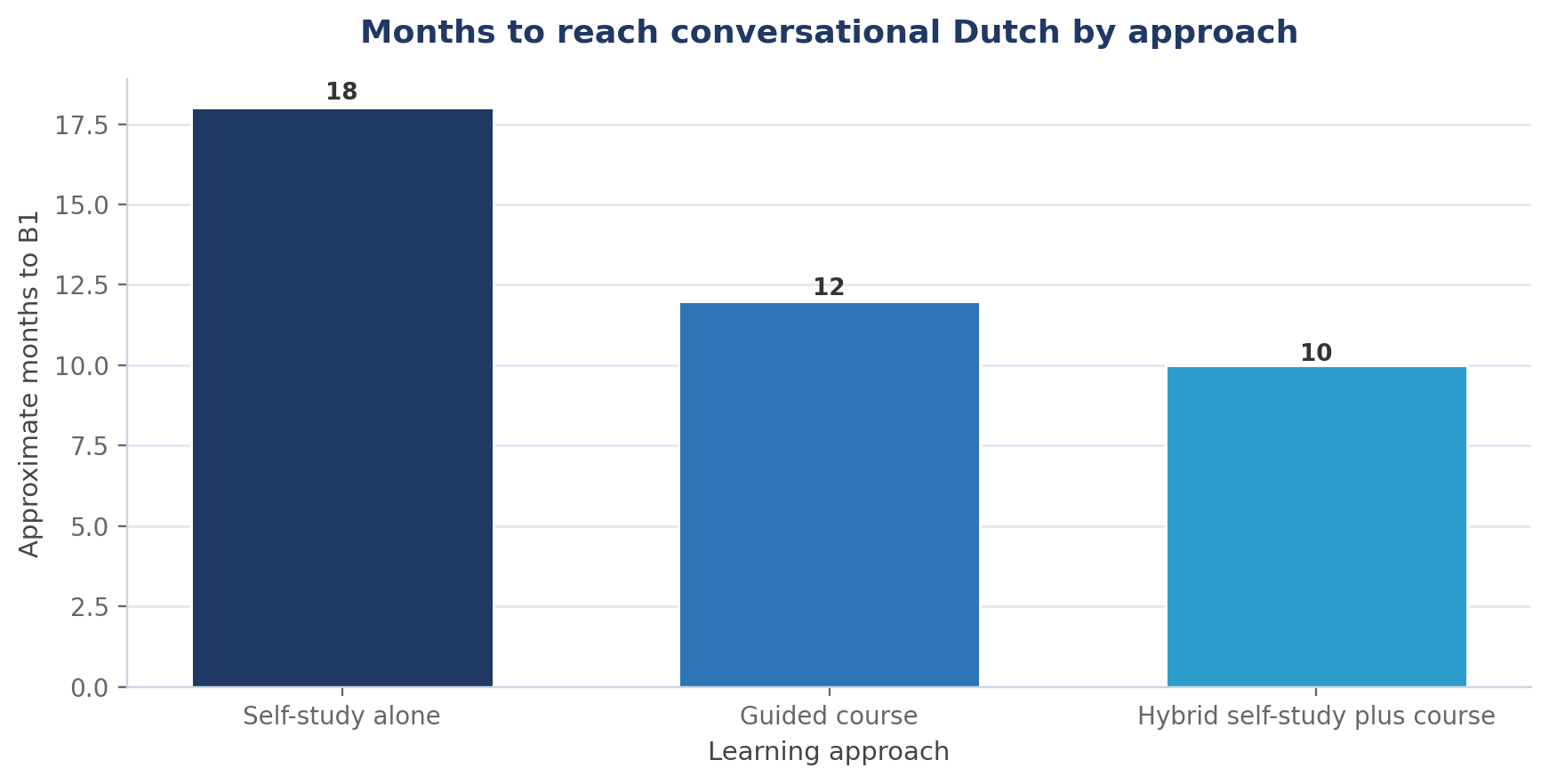
Treat the timelines as relative, not absolute. The pattern is consistent: guidance compresses time, and the compression is largest exactly at the point where self-study usually stalls — around A2 to B1.
Keep the flexibility, add the feedback
A Course Pass (Dutch) slots into whatever self-study routine you already have, supplying the one thing it cannot: a personal AI voice tutor that gives you speaking practice with feedback, so you can study at your own pace, any time.
Add a self-paced Dutch course →Create a free accountWho each route suits
The decisive question is not which method is better in the abstract. It is which method you will actually still be doing in three months. Self-study is cheaper; abandoning it is the most expensive option of all.
The hybrid plan that beats both
That plan costs a fraction of intensive tuition and outperforms full-time self-study, because it uses each method for what it is good at. Volume is cheap; correction is not; do not ask one tool to do both jobs.
How to tell which one you need
Diagnose the bottleneck before you spend. Most learners buy more content when what they actually lack is interaction — and that is the one thing content cannot provide.
Choose the route that fits your actual bottleneck
Self-paced Dutch courses with a personal AI voice tutor are built for the learners whose gap is speaking and correction, not materials. Start with a level check and get a plan that matches your situation.
Start your Dutch course pass →Create a free accountFrequently Asked Questions
Can I learn Dutch entirely by myself? Yes, to a solid A2 and beyond if you are disciplined. Most self-study learners add some form of live conversation to break through the intermediate plateau.
Is a paid Dutch course worth it? If your bottleneck is speaking, feedback or accountability, usually yes. If you simply need more vocabulary, self-study is cheaper and effective.
Which is faster, self-study or a course? Guided learning is typically faster because correction prevents fossilised errors and structure prevents wasted effort. Flexibility is self-study's advantage, not speed.
What is the best free way to start Dutch? Combine free audio and vocabulary practice daily, then add at least one weekly live conversation — free exchanges exist, though paid tutoring tends to be more consistent.
References & Further Reading
- Nederlandse Taalunie — Dutch Language Union: learning and policy resources
- Nuffic — Dutch language and education information
- Council of Europe — CEFR levels and self-assessment
- NPO — Dutch public broadcaster for listening practice
- Dutch for Children — Dutch learning materials and activities