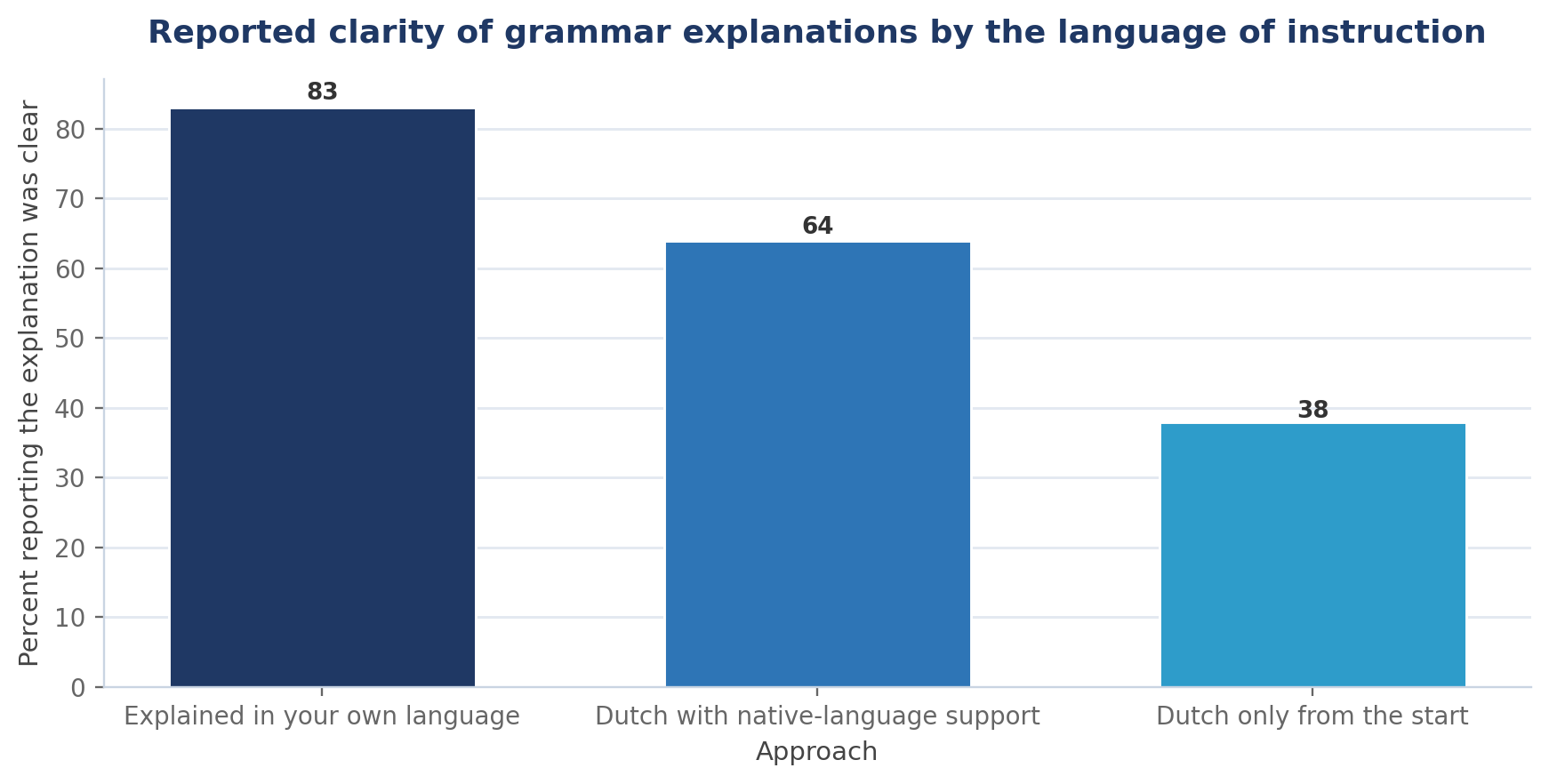
There is a piece of advice that circulates in every language-learning community: stop translating, stop using your own language, and immerse from day one. It sounds rigorous. It is also, for most adult beginners, simply inefficient.
Read the research and the picture is more interesting than the slogan. Explanations in your own language reduce the time to understand a new structure. Immersion reduces the time to use it. Those are two different jobs, and confusing them is why so many learners spend six months in a Dutch course and still cannot explain the word order rule they follow.
This article lays out what actually helps at each stage — and where the immersion advice is completely right.
The Two Approaches, Compared Honestly
Neither column is a philosophy. They are tools for different phases, and the evidence is clearest on the first row.
Why the Mother Tongue Speeds Up Comprehension
Two mechanisms explain the advantage, and both are about efficiency rather than comfort.
The third row is worth dwelling on. When a teacher can say "you are using English word order in a subordinate clause", the correction is immediate and permanent. The same teacher, working only in Dutch, may spend three lessons circling the problem before the learner realises what rule they are breaking.
For Dutch specifically, the anchoring advantage is unusually strong, because English and Dutch share so much structure and vocabulary. Half of learning Dutch is noticing where it diverges from English, and that comparison requires you to know what English does.
Where Immersion Is Genuinely Better
The immersion advice is not wrong. It is aimed at a different target.
The pattern is consistent: language in is best understood in your own language, language use is best built in the target language. A good course holds both.
The Translation Habit — and How to Avoid It
The real objection to using your own language is not learning through it; it is translating through it, permanently, in real time. That habit is worth avoiding, and it is avoidable without abandoning explanations.
The clean rule: use your own language to understand a structure once, then leave it behind and practise the structure in Dutch until it is a shape rather than a translation. That is the efficient version of both approaches.
What This Looks Like in a Lesson
That table is the whole argument. A lesson that starts with a clear explanation and ends in ten minutes of unassisted Dutch conversation produces both understanding and fluency — which is more than either approach delivers alone.
Explained clearly, practised properly
Our Dutch Course Pass pairs clear explanations with a personal AI voice tutor, so you understand the rule today and practise it at your own pace, any time. Explore the Dutch Course Pass →
Start the Dutch course →Create a free accountTwo Learners, Two Outcomes
The difference is easiest to see in concrete terms. Consider two learners starting from zero with the same hours available.
Learner A is genuinely better at listening by month three. Learner B is better at production and accuracy, and by month twelve both have reached a similar conversational level — but B has fewer errors that have hardened into habits. Fossilised errors are the expensive outcome in language learning, because they take years rather than weeks to remove.
The Practical Recommendation
The mistake at the top of the scale is assuming the choice is permanent. Learners who keep using their own language as a crutch at B1 stay reliant on it; learners who refuse support at A1 take longer to understand basic patterns. The skill is knowing when to switch.
There is one more point worth making. If you live in the Netherlands, immersion will happen to you whether you plan it or not — in the supermarket, at the doctor, on the phone with a utility company. The hours you spend learning are best used on the things immersion cannot teach: clear rules, accurate correction and structured practice.
Get the structure immersion cannot give you
Immersion builds fluency but rarely fixes mistakes. Our Dutch Course Pass adds a personal AI voice tutor, clear explanations and speaking practice with AI feedback — so your Dutch gets accurate as well as fast. Start your Dutch Course Pass →
Start the Dutch course →Create a free accountFrequently Asked Questions
Is it better to learn Dutch only in Dutch? For listening and fluency, yes. For understanding grammar quickly and accurately, explanations in your own language are usually faster and more precise, especially at beginner level.
Does using my own language stop me thinking in Dutch? Not if you use it for explanations only and practise in Dutch. What prevents thinking in Dutch is translating sentences in real time, not understanding a rule clearly once.
What is the fastest way to learn Dutch as an English speaker? Learn the rules with clear explanations, then spend most of your practice hours speaking and listening in Dutch. English and Dutch share enough structure that the comparison does real work.
When should I switch to full immersion? By B1 you should be doing most of your listening and speaking in Dutch, with support only when a structure is genuinely unclear.