"Fluent" is the most used and least defined word in language learning. It means everything from "I can order a coffee" to "I can run a meeting", and the ambiguity is expensive, because learners chase a feeling instead of a target.
There is a version of fluency with a definition, and it is the one that matters in real life: B2. At B2 you can hold a spontaneous conversation on unfamiliar topics, follow native speech at natural speed, and write a structured text without reaching for a dictionary. That is Dutch freedom — the point at which the language stops being a project and starts being a tool.
Here is the route from A1 to B2, with the honest input volumes and the specific things that stall learners.
What Fluency Actually Means
The jump that matters is A2 to B1, not B1 to B2. At A2 you need the other person to help. At B1 you no longer do, and that shift in the social dynamic is what people mean when they say they can finally speak Dutch.
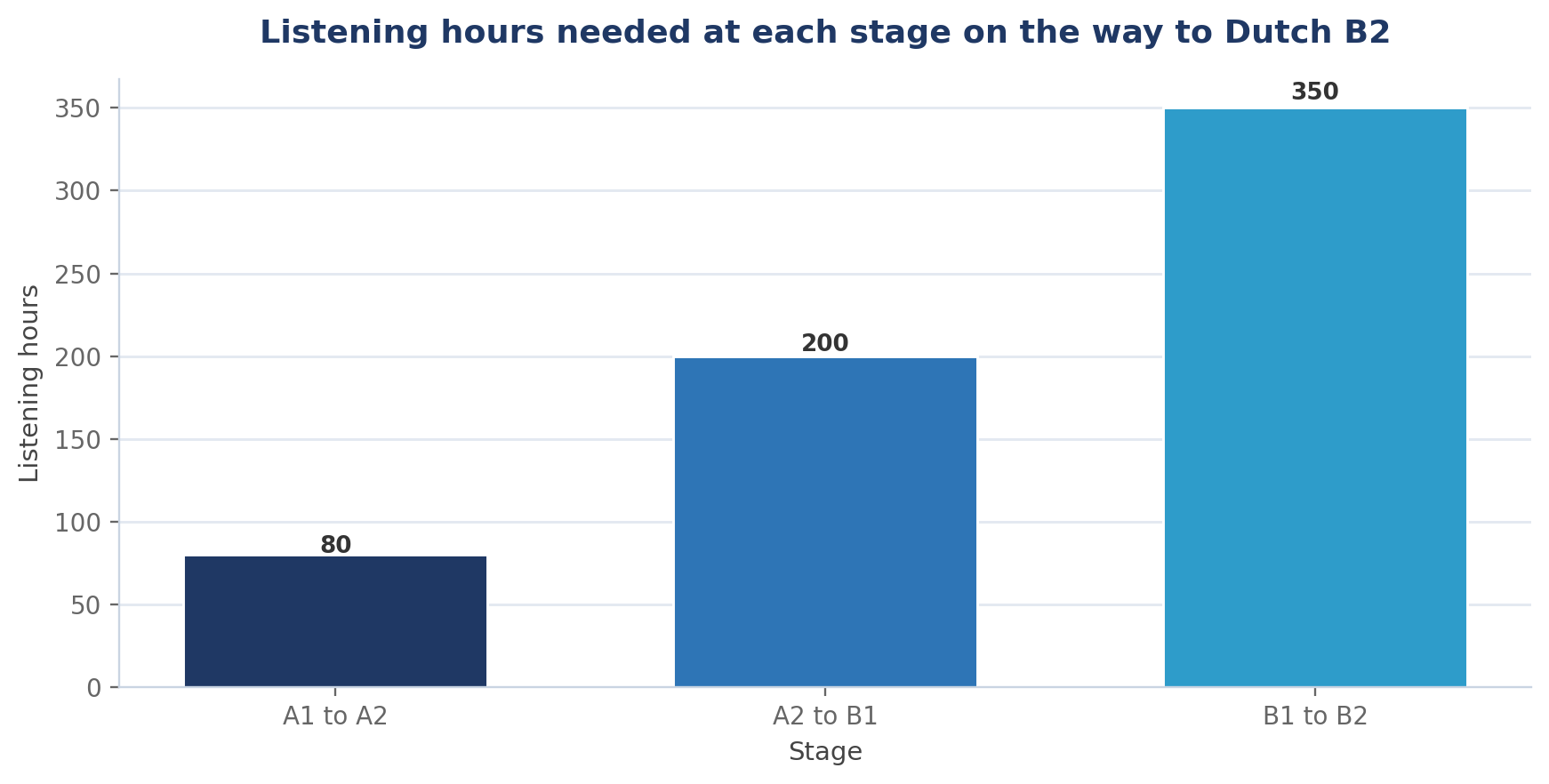
The Input Volume No One Mentions
You can learn grammar rules in an afternoon. You cannot shortcut input volume, and it is the single largest cost on the road to B2.
Those numbers are the reason Dutch in three months is a myth and Dutch in twelve months is realistic. It also explains the most common frustration: a learner who studies grammar for a year without listening reaches B1 on paper and A2 in a room.
The Four Killers That Stall Learners
The fourth killer is the quietest and the most common. B1 feels good — you can hold a conversation, follow a podcast, order confidently. B2 requires content you only partly understand, which feels like regression. Learners who interpret that discomfort as failure stop, and stay at B1 for years.
The Role of Word Order and Sound
Dutch fluency is gated by two things that English speakers must attack deliberately.
These five are worth treating as a checklist. A learner with fluent vocabulary but unaddressed word order will still lose the thread in any complex sentence, which is exactly what B2 conversations contain.
Target the five things that actually gate Dutch fluency
Vocabulary alone will not get you to B2. Our Dutch Course Pass drills word order, separable verbs and the tricky sounds with a personal AI voice tutor that gives you feedback as you practise. Explore the Dutch Course Pass →
Start the Dutch course →Create a free accountA Twelve-Month Route From A1 to B2
At four to six hours a week, this is achievable for a learner starting at A1. The plan's most important feature is that months eight and nine are almost entirely input — no new grammar, just volume, speed and repetition. Learners who try to keep learning new structures during that period usually slow down rather than speed up.
How to Know You Have Arrived
Fluency is measurable. Test against these tasks rather than against a feeling.
The phone test is the most honest one, because there is no visual support. A learner who can run a five-minute phone conversation in Dutch is meaningfully at B2 — and no quiz will tell you that as clearly.
What Accelerates the Second Half
Notice that the two highest-leverage activities are exactly the two that self-study learners avoid: speaking with people and listening to material that is too fast for comfort. Fluency lives on the uncomfortable side of both.
The uncomfortable half is easier with structured practice
Speaking and listening at real speed are what carry you from B1 to B2. Our Dutch Course Pass gives you both, at your own pace, with a personal AI voice tutor and a level-based plan. Start your Dutch Course Pass →
Start the Dutch course →Create a free accountFrequently Asked Questions
How long does it take to become fluent in Dutch? From A1, roughly twelve months at four to six hours a week to reach B2. From A2, six to nine months is realistic with regular speaking practice.
Is Dutch hard to become fluent in for English speakers? Vocabulary is easier than most languages, because so much is similar to English. Word order, separable verbs and the g and ui sounds are the main obstacles.
Can I reach B2 without living in the Netherlands? Yes, but it requires deliberate listening volume and regular conversation practice with speakers. Living there helps mainly by supplying input hours automatically.
What is the biggest mistake learners make at B1? Staying comfortable. B1 feels like success, and B2 requires material you only partly understand. Learners who mistake that discomfort for failure stay at B1 for years.