Fifteen minutes a day sounds like a compromise. It is not. For language learning it is one of the most efficient formats that exists, for a reason that has nothing to do with motivation and everything to do with memory.
Frequency beats volume. Twenty minutes on six days a week produces more durable Dutch than three hours on a Sunday, because language is a skill that consolidates between sessions, not during them. A learner who shows up briefly every day is training retrieval; a learner who studies once a week is mostly re-learning what they have already forgotten.
The catch is that fifteen minutes has to be structured. Here is how to spend it so it works.
Why Short Sessions Win
Look at the top row against the second. The daily learner invests less than half the time and typically progresses further, because the spacing effect does the heavy lifting.
The Four-Block Session
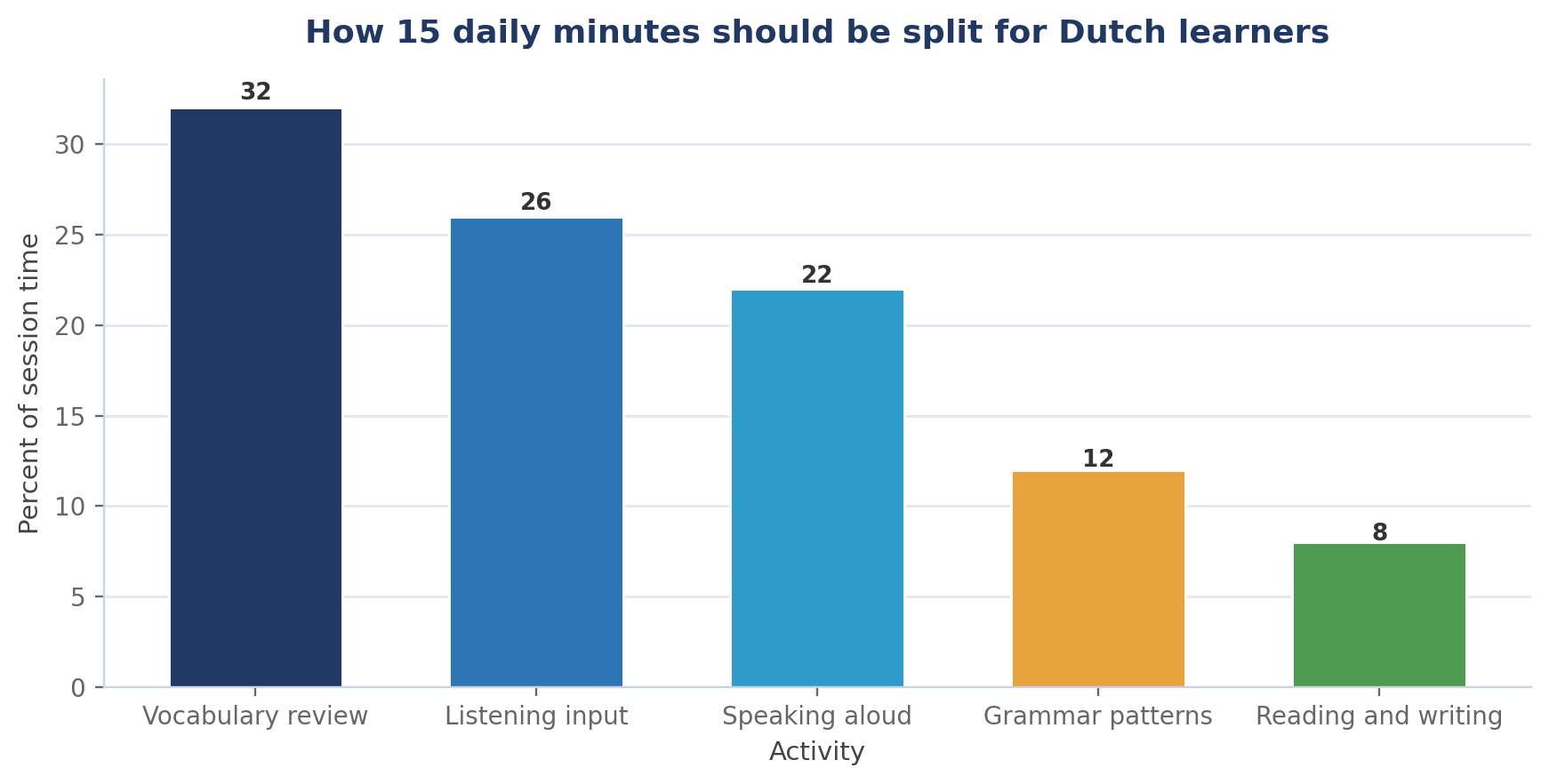
Fifteen minutes, four blocks. The proportions matter more than the content.
The production block is the largest for a reason. Most self-study time goes to input — reading, listening, watching — and input alone produces a learner who understands a great deal and says very little.
What 15 Minutes a Day Actually Covers
What You Can Reach — and When
Fifteen minutes a day reaches A2 in about a year and B1 in eighteen months to two years. Add regular speaking practice and the timeline shortens noticeably, because the limiting factor at every stage after A2 is speaking practice, and that is the one thing a solo session cannot supply.
The Habit Rules That Make It Stick
The last two rules are the practical ones. Deciding what to study is the biggest source of friction in a fifteen-minute session; if yesterday's you already chose it, today's you just starts. And counting sessions rather than minutes gives you a number you can see growing, which is what keeps a habit alive in week nine.
Where 15 Minutes Is Not Enough
Short sessions have one real limitation, and it is worth naming honestly.
Speaking and pronunciation both need something a solo session cannot provide: correction. A learner can practise output alone every day and still carry an error for two years, because no one ever pointed it out. That is why the efficient busy person's plan is fifteen minutes daily plus AI speaking feedback at a lower frequency.
Fifteen minutes a day, with an AI voice tutor when you need one
Our Dutch Course Pass gives you a personal AI voice tutor and short, structured lessons that fit a busy week — so the daily habit actually turns into Dutch you can use. Explore the Dutch Course Pass →
Start the Dutch course →Create a free accountA Ready-Made Week
Total: roughly 105 minutes. Notice that only one day is grammar-focused and only one is reading-focused — the week is deliberately weighted toward the two things that compound fastest, review and speaking aloud.
The Three Mistakes That Break the Habit
The third one is specific to short sessions. Fifteen minutes is not enough to complete a lesson, and learners who try end up skimming. Use the session for one small thing done properly, and let the course advance at whatever pace it advances.
Small sessions, real progress, AI voice tutor
Busy learners do best with structure and accountability. Our Dutch Course Pass combines short lessons with a personal AI voice tutor, so fifteen minutes a day keeps adding up. Start your Dutch Course Pass →
Start the Dutch course →Create a free accountFrequently Asked Questions
Can I really learn Dutch in 15 minutes a day? Yes, steadily. Expect around A2 in a year and B1 in about eighteen months, with faster progress if you add regular speaking practice.
Is 15 minutes a day better than two hours once a week? For retention, yes. Daily short sessions beat weekly long sessions in most studies, because spacing and retrieval matter more than total hours.
What should I do in a 15-minute Dutch session? Four minutes of review, four of new input, five of speaking aloud, and two to log what was hard. Review first, always, and make sure you actually speak.
Do I still need a tutor if I only have 15 minutes a day? You do not need daily lessons, but you do need regular correction. Regular AI speaking feedback is enough to catch errors that solo practice will never reveal.