Most people who want to learn French spend three weeks deciding how to learn French. They compare apps, read Reddit threads, buy a grammar book, and start nothing.
The smartest way to start is embarrassingly simple: say one French sentence out loud today, and build the system around it tomorrow. Everything else — the resources, the schedule, the exam — follows from that first spoken sentence.
Here is the sequence that works, hour by hour and week by week.
What this guide gives you
- Your first hour, first week and first month, planned
- The order to learn things, and why the textbook order is wrong
- The four mistakes that stall beginners for years
- A realistic timeline to A2 and beyond
- How to tell whether your plan is actually working
The first hour: do not open a grammar book
Here is what to do in your first sixty minutes.
Those ten phrases should be greetings, thanks, an apology, a request, and three questions. Not the alphabet. Not conjugation tables. Phrases you can use in a week.
The order to learn things
The textbook order is grammar first, use later. The effective order is the reverse.
The reason is simple: reading and listening build recognition, while speaking and writing build production, and they are separate skills with separate learning curves. Most beginners pour all their hours into recognition and then wonder why they cannot talk.
Learn the grammar you need for the sentence you are already trying to say. Every other order wastes months.
Your first week
Seven days, roughly thirty minutes a day. By the end you can survive a simple exchange in French — which is more than most people manage after three months of app streaks.
Your first month
The milestone that matters at the end of month one: a two-minute spoken monologue about yourself. Not perfect. Just complete.
The four mistakes that stall beginners for years
The fourth is the most common and the most costly. Ten apps and zero sequencing equals zero level. One imperfect plan followed for two months beats a perfect plan abandoned in a week.
Ready to turn reading into real French? Start your self-paced course today.
Start the French course →Create a free accountStart with an AI voice tutor instead of a search bar
The fastest way past the beginner stage is having your pronunciation corrected before it sets. The French Course Pass gives you a structured A1–B2 path with a personal AI voice tutor that gives you speaking feedback whenever you study.
Button: See the French Course Pass →
Where to find free practice that actually helps
Notice what is absent: nothing here is a substitute for speaking. Free resources build input; only conversation builds output.
How to know your plan is working
Two rows there are non-negotiable. Daily out-loud production and correcting your own errors. Everything else can be adjusted.
Ready to turn reading into real French? Start your self-paced course today.
Start the French course →Create a free accountBegin properly, for free
Create a free languageskills.net account to take a level check, try a guided AI voice tutor lesson, and get a beginner plan that starts from today rather than from "someday".
Button: Create your free account →
Frequently Asked Questions
What is the best way to start learning French? Learn the sounds first, then ten phrases you will actually use, and speak out loud from day three. Grammar follows the sentences you are trying to say, not the other way round.
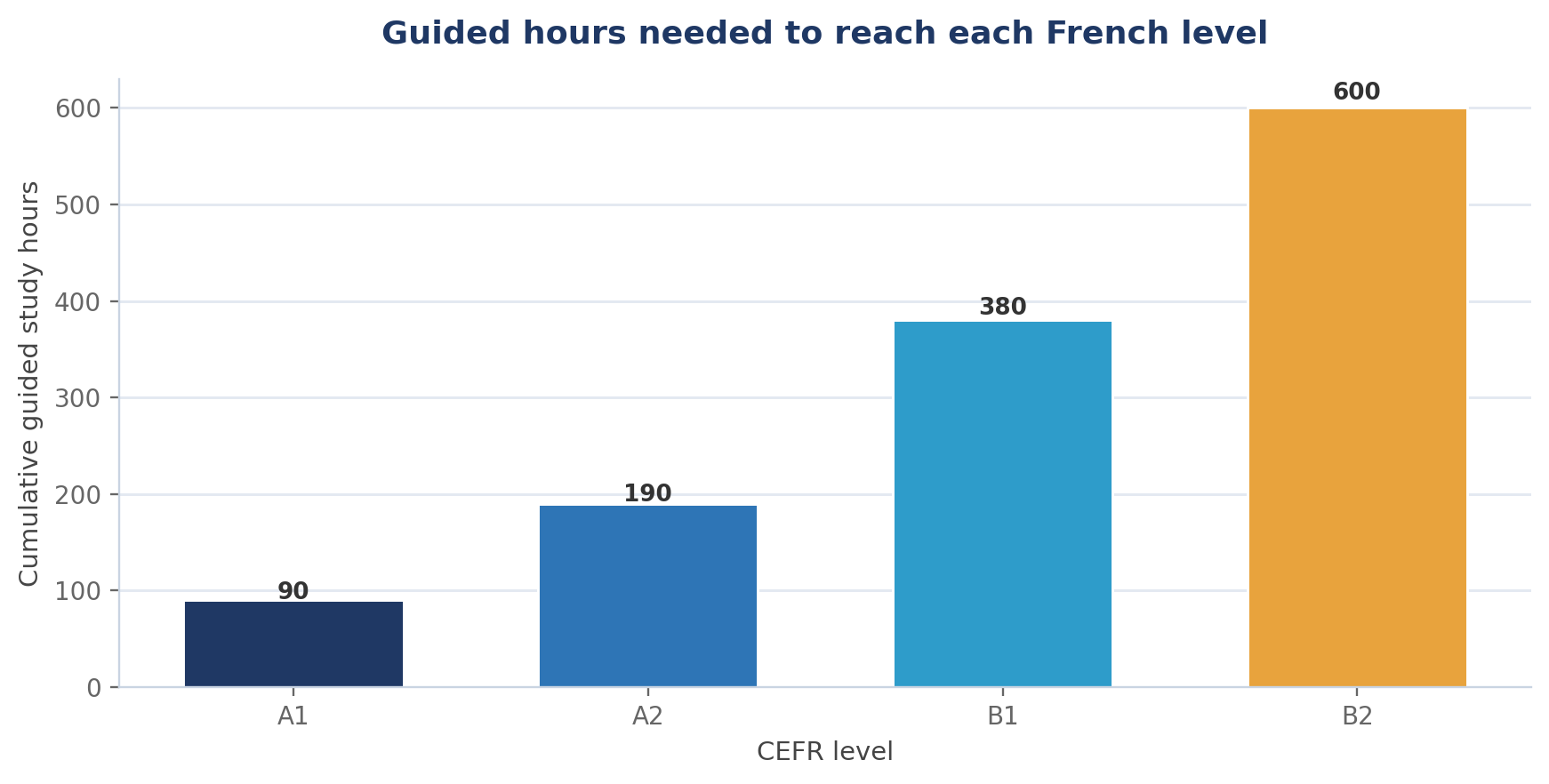
How long does it take to reach A2 in French? Around 190 guided hours. At thirty minutes a day that is roughly a year; at an hour a day, six months.
Do I need a teacher from the beginning? Not strictly, but pronunciation is the hardest skill to self-correct. Even occasional spoken feedback in the first two months saves years of fossilised errors.
How much time should I study daily? Fifteen to thirty focused minutes daily beats two hours once a week. Consistency is the variable that decides your result.
References & Further Reading
- France Éducation international — DELF and DALF levels and descriptors
- TV5Monde — Apprendre le français: exercises by CEFR level
- RFI — Journal en français facile, daily slow-news audio
- Académie française — French language guidance and usage
- Council of Europe — CEFR levels and descriptors