There is a fashionable belief in language learning that you should never, ever use your own language. No translation, no explanations in English, just immersion from day one. It sounds pure. It also sends thousands of beginners into a fog where nothing quite makes sense.
The truth is more pragmatic. Using your own language as a scaffold — a temporary structure that supports learning and then gets removed — is one of the most effective techniques available to adult learners.
What you will get from this guide
- Why comprehensible explanations beat pure immersion for beginners
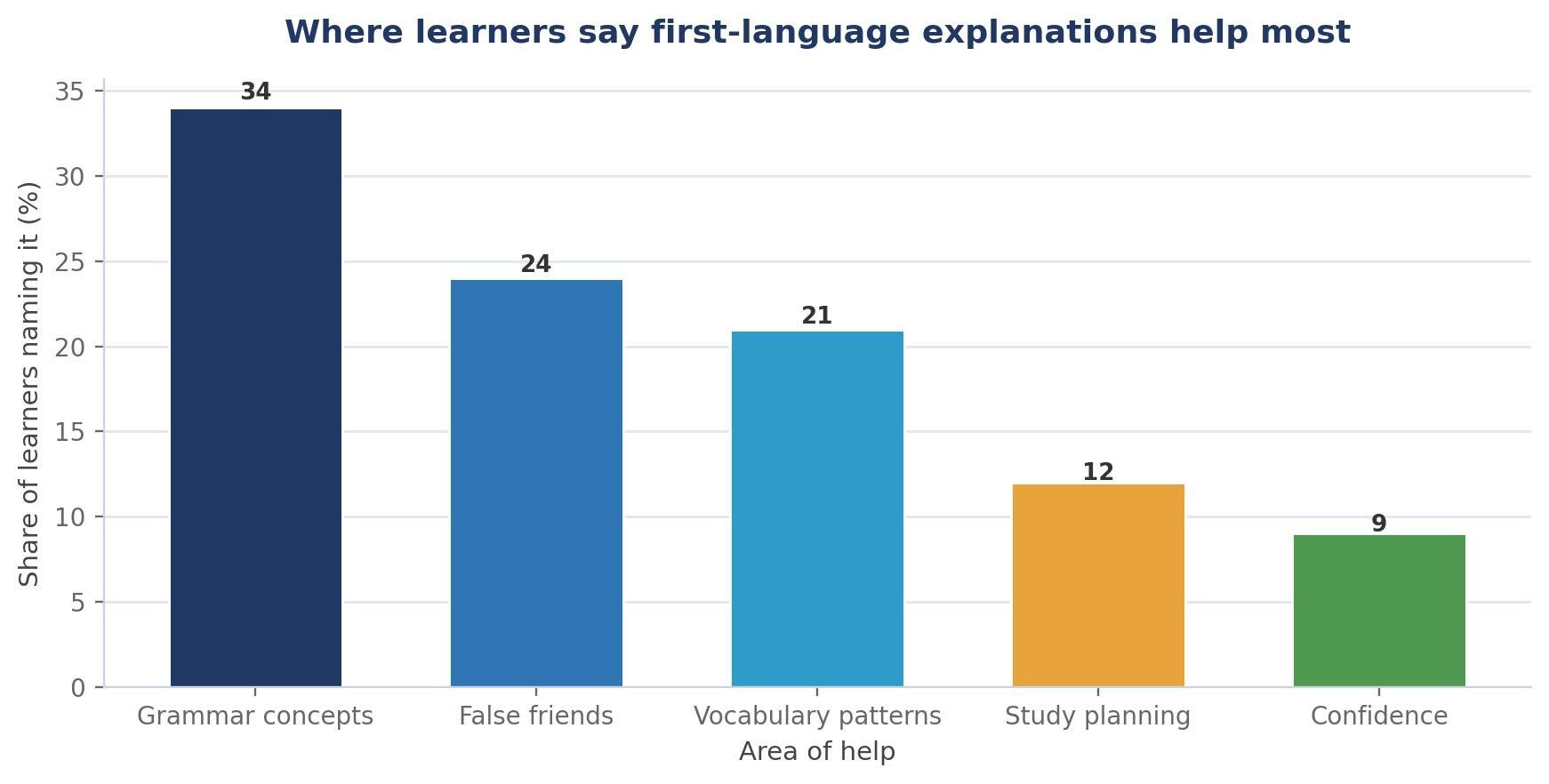
- The specific places your first language helps most
- When translation genuinely harms progress
- How to use your own language as a scaffold and then let it go
The immersion myth, examined
Pure immersion works brilliantly when you have thousands of hours and no deadline. It is how children learn, and how adults become fluent after years abroad. But most adult learners have neither the hours nor the patience for a method that makes the first six months feel like drowning.
The research concept that matters here is comprehensible input: language you can mostly understand, with a little stretch. If the difficulty is too high, nothing is absorbed. A clear explanation in your own language is often what makes French comprehensible in the first place.
Where your own language helps most
Take actuellement. It looks like "actually", but it means "currently". One sentence of explanation saves you from years of misusing it. No amount of immersion prevents that error if nobody ever tells you.
The false friends your first language can hand you
English speakers have a hidden advantage here: roughly a third of English vocabulary came from French. Once you learn to spot the patterns — -tion, -ment, -able, -ité — your vocabulary multiplies without memorisation.
Learn French with explanations you actually understand
A Course Pass (French) pairs structured lessons with a personal AI voice tutor that explains the why clearly, then pushes you into real French as soon as you are ready.
Start your French course pass →Create a free accountWhen translation starts to hurt
Your first language is scaffolding — and scaffolding that never comes down becomes a cage. Three signs you are over-relying on translation.
The fix is gradual. Keep explanations in your own language, but make practice monolingual: French audio, French reading, French conversation, French subtitles.
The scaffold-and-release method
The proportion flips over time, and that is exactly the point. You are not choosing between your language and French. You are choosing the order in which they appear.
Why your first language builds confidence
Here is the part that learning theory often forgets: adults quit because they feel foolish. Every unexplained rule, every mysterious error and every silent classroom moment is a small argument for giving up. Explanations in your own language make the language knowable. Knowable is motivating. Motivating is what gets you to month seven.
The ideal course does not choose purity over clarity. It explains clearly in your language, then spends the practice time entirely in French.
Clear explanations now, fluent French later
Our self-paced French courses combine lessons you can fully understand with speaking practice that pushes you past translation. That balance is why learners stick with it.
Explore self-paced French courses →Create a free accountFrequently Asked Questions
Is it bad to use my own language when learning French? No. Using your own language for explanations is a scaffold, not a shortcut. Problems only appear if you never reduce it.
Does translation slow down fluency? Constant mental translation does, because it adds a step to every sentence. Use explanations in your language, but practise entirely in French.
Are English speakers advantaged in French? Yes. Roughly a third of English vocabulary has French roots, and thousands of words are recognisable — with a small set of deceptive exceptions.
Should I take a course taught in my language or in French? Best is a blend: explanations you can absorb fully, plus practice time that is entirely in French. Purely French instruction from zero is slow for most adults.
References & Further Reading
- Council of Europe — CEFR level descriptions and the role of mediation
- Académie française — Questions on French usage and vocabulary
- France Éducation international — DELF and DALF examinations
- TV5Monde — Apprendre le français: free exercises by level
- Institut français — French courses and learning resources