French looks unfair for about three weeks. Eau is water. Oiseaux is birds. Nothing is spelled the way it sounds, or so it seems.
Then the pattern clicks — and French becomes one of the fastest languages an English speaker can learn, because roughly a third of English vocabulary already came from it. Here is how to learn french from absolute zero, in the right order, without wasting your first month.
Start with sound, not with words
Beginners want vocabulary. French punishes that instinct in week two, when you own five hundred words and cannot say any of them clearly.
Spend your first ten days on sound only. French has nasal vowels, a soft r made at the back of the throat, and silent final consonants — none of them optional.
Learn these five honestly and every word you meet afterwards will be pronounceable. Skip them and you will be re-learning your whole vocabulary in month four.
The first 30 days, day by day
Thirty days will not make you fluent. It will make you functional — greetings, numbers, ordering, introducing yourself, and a habit that survives.
The rules matter more than the topics. Twenty-five minutes daily beats a three-hour Sunday, and speaking out loud every single day beats silent reading.
What you will get from this guide
- The correct order for a true beginner
- Realistic hours for A1, A2 and B1
- Free and paid resources that are actually worth your time
The grammar you need first, and the grammar to postpone
French grammar has a reputation. Most of it can wait.
That short list on the left carries you through thousands of real sentences. The column on the right is where intermediates polish, not where beginners drown.
How long does it really take?
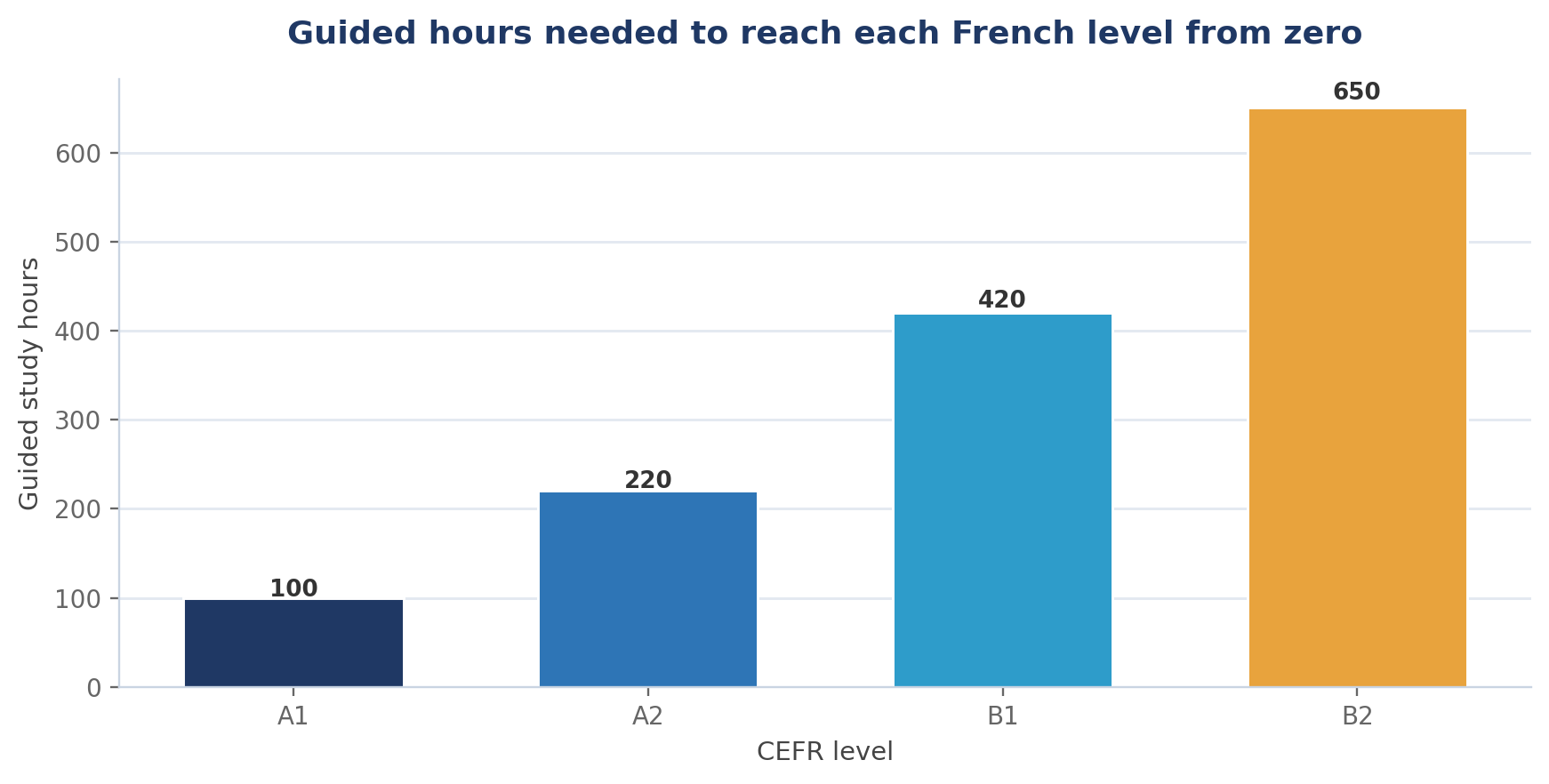
Hours beat feelings. French is Category I for English speakers, which means it is among the quicker languages to reach a working level.
Those are guided hours with practice between them, not hours of passive listening. Five focused hours a week, every week, is enough — and it is more than most people manage.
Skip the guesswork of week one.
A personal AI voice tutor hears your pronunciation in the first lesson and fixes it before it hardens. Start with a free account, meet your AI tutor, and learn the sounds properly.
Create your free account →Create a free accountResources that are worth your time
There is no shortage of French material. There is a shortage of good sequencing.
Use three at most. One input source, one speaking outlet, one habit tracker. Beginners who collect nine apps finish none of them.
The Institut français and its partner Alliance Française centres worldwide teach and administer the DELF and DALF exams, and their public resources are a good sanity check on your level. If you want a certificate at the end of year one, DELF A1 or A2 is a realistic and motivating target.
Five habits that separate finishers from starters
Children learn languages by contact and repetition, not willpower, and adults are no different.
The middle one costs nothing. Sticky notes on the fridge, the kettle, the door: le frigo, la bouilloire, la porte. You will learn twenty nouns in a week without opening an app.
Frequently Asked Questions
Is French hard for English speakers? No — it is one of the easier languages, mainly because so much vocabulary is shared. The genuine difficulties are pronunciation and listening speed, not grammar. Fix the sounds early and the rest is patient repetition.
How long until I can speak French? Two to three months of daily practice gets you basic greetings and simple exchanges. Around four to five months you can hold a slow conversation about everyday topics. Solid comfort usually arrives near 400 guided hours.
Should I learn vocabulary or grammar first? Learn sounds first, then high-frequency vocabulary and the present tense together. Grammar without words is a skeleton; words without grammar are a pile of bones.
Do I need a teacher, or can I learn alone? You can reach a respectable A1 alone. Beyond that, pronunciation and listening need feedback that only a person gives you. One self-paced lessons a week, plus daily self-study, is the fastest realistic route.
References & Further Reading
- Institut français — French courses, DELF and DALF information: https://www.institut-francais.fr/
- Council of Europe — CEFR level descriptions: https://www.coe.int/en/web/common-european-framework-reference-languages
- France Éducation international — official DELF and DALF examinations: https://www.france-education-international.fr
- Académie française — language questions and usage: https://www.academie-francaise.fr
- TV5MONDE — free French learning exercises: https://apprendre.tv5monde.com
Your first French sentence is closer than you think.
Start with a personal AI voice tutor and get corrected from lesson one. Create a free account, take your placement check, and start speaking this week.
Start learning French free →Create a free account