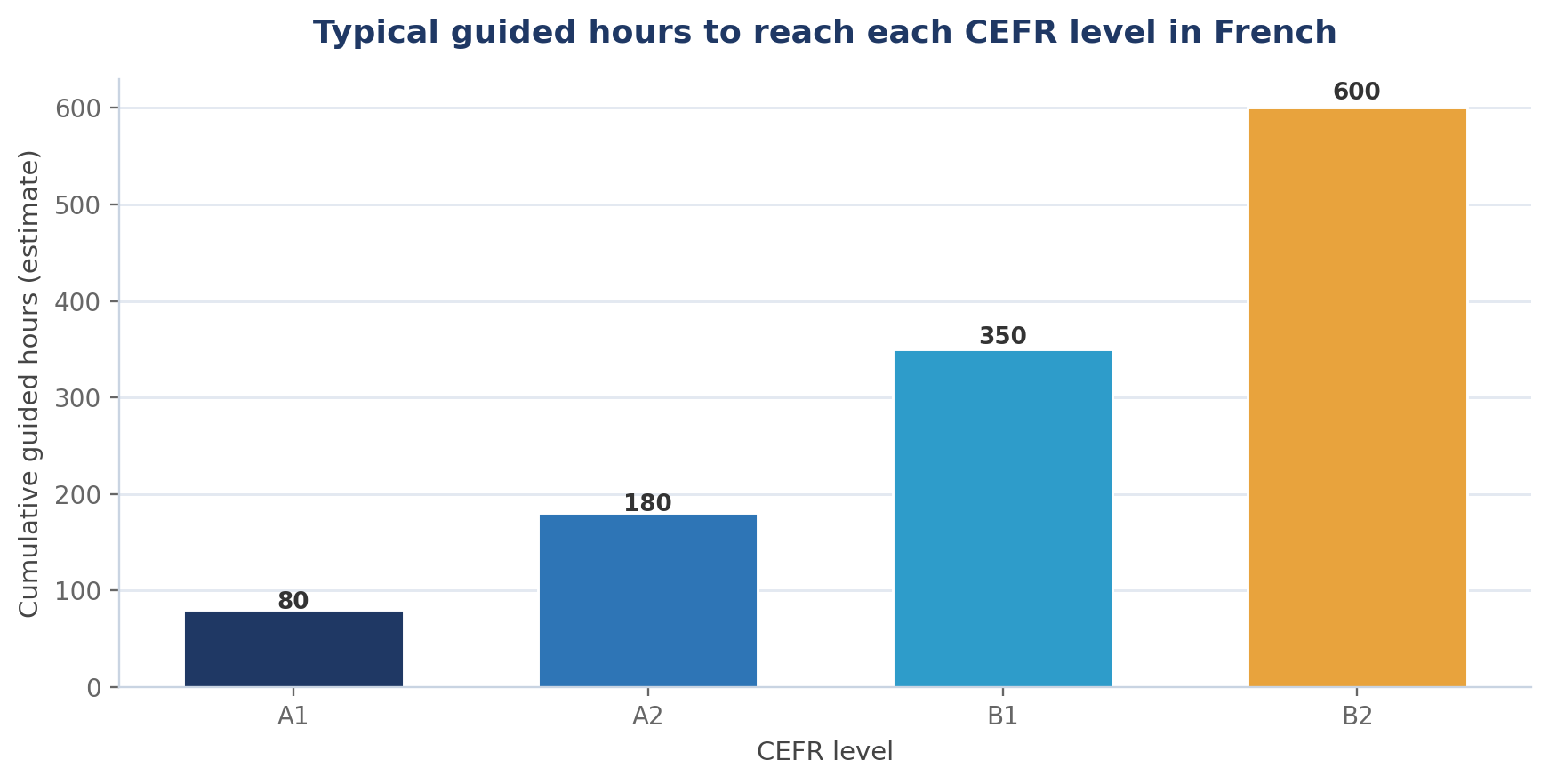
Becoming fluent in French is not a mystery, a talent, or a lucky accident. It is a staircase. Every learner climbs the same four big steps — A1, A2, B1, B2 — and the people who arrive at the top are simply the ones who kept putting one foot on the next stair. If you have ever felt stuck between "I can order a croissant" and "I can argue about politics," this roadmap is for you. Let's climb.
What "Fluent" Actually Means on the CEFR Scale
The Common European Framework of Reference (CEFR) describes six levels, but for most learners "fluent" lands at B2. That is the level where you can hold a spontaneous conversation, understand native media, and express opinions without rehearsing every sentence in your head first.
The honest framing: A1 to B2 is roughly 500–650 guided hours according to widely cited FSI-style and CEFR guidance ranges, though individual timelines vary enormously with your starting language and daily consistency. French is easier than Mandarin for English speakers — but it is not a weekend project.
The A1 Stage: Build the Skeleton (Weeks 1–10)
A1 is about installing the skeleton: pronunciation rules, present tense, the 1,000 most frequent words, and the confidence to open your mouth. Do not chase perfection. Chase volume.
Three pillars carry you through A1:
- Sound first. Learn French phonetics early so you never build bad pronunciation habits.
- Frequency lists. The top 1,000 words cover a huge share of everyday speech — drill them relentlessly.
- Output from day three. Even "Bonjour, je m'appelle…" spoken aloud rewires your brain.
Stop guessing and start climbing
Our French course pass gives you structured A1 lessons with audio, drills, and real feedback so week one actually sticks.
Start your French course pass →Create a free accountThe A2 Stage: Make It Automatic (Months 3–6)
At A2, grammar stops being a puzzle and starts becoming a reflex. Past tenses arrive, your vocabulary doubles, and you begin describing your life rather than reciting flashcards.
The single biggest A2 mistake is studying about French instead of in French. Swap grammar commentary for comprehension you can nearly understand — that sweet spot where you catch 70% and your brain does the hard work of filling gaps.
The B1 Stage: The Painful, Glorious Plateau (Months 6–12)
Welcome to the famous intermediate plateau. B1 is where huge numbers of learners quit — not because the level is impossible, but because progress becomes invisible. You can already communicate, so the dramatic wins disappear.
Three tactics break the plateau:
- Massive input. Switch to native content: series with French subtitles, news podcasts, YouTube commentary.
- Weekly speaking sessions. Nothing replaces real speaking practice with feedback on your output.
- Topical vocabulary sprints. Learn words by theme — the environment, work, travel — not alphabetically.
The B2 Stage: Fluency in the Wild (Months 12–24)
B2 is the summit most learners mean by "fluent." You understand films without subtitles (mostly), you joke, you disagree, you pivot mid-sentence. Getting here demands volume and variety: hundreds of hours of input, dozens of real conversations, and a tolerance for sounding imperfect.
The Habits That Separate Fluent Learners From Stuck Ones
Fluency is a behaviour, not a certificate. Learners who reach B2 share an almost boring consistency: they touch French every single day, they tolerate embarrassment, and they measure progress in months, not minutes.
A guided path beats a scattered one
Instead of assembling a curriculum from scratch, follow a sequenced A1–B2 track that tells you exactly what to do next.
Get the French course pass →Create a free accountReady to lock in the habit? Create your free account and set your first 30-day streak target.
Frequently Asked Questions
How long does it take to become fluent in French? With 20–30 minutes daily and regular speaking practice, many learners reach conversational B1 in about a year and B2 in one to two years, though timelines vary greatly with intensity and prior language experience.
Can I reach B2 without living in France? Absolutely. Millions of learners reach B2 through structured courses, online tutors, and immersion-style media at home. Living abroad helps, but consistency matters more than geography.
Is B2 the same as "fluent"? For most practical purposes, yes. B2 is the level where spontaneous, comfortable conversation and native media comprehension become realistic, which is what people usually mean by fluency.
Should I study grammar or just speak? Both, in balance. Grammar gives you the map; speaking builds the muscle. Lean on conversation, then fix the patterns that keep breaking.